

[2025] Use Valid New XDR-Engineer Questions - Top choice Help You Gain Success
XDR-Engineer Exam Practice Materials Collection
NEW QUESTION # 30
Which method will drop undesired logs and reduce the amount of data being ingested?
- A. [INGEST:vendor="vendor", product="product", target_brokers="vendor_product_raw", no_hit=keep] * filter _raw_log not contains "undesired logs";
- B. [INGEST:vendor="vendor", product="product", target_dataset="vendor_product_raw",no_hit=drop] * filter _raw_log not contains "undesired logs";
- C. [COLLECT:vendor="vendor", product="product", target_dataset="", no_hit=drop] * drop _raw_log contains "undesired logs";
- D. [COLLECT:vendor="vendor", product="product", target_brokers="", no_hit=drop] * drop _raw_log contains "undesired logs";
Answer: C
Explanation:
In Cortex XDR, managing data ingestion involves defining rules to collect, filter, or drop logs to optimize storage and processing. The goal is todrop undesired logsto reduce the amount of data ingested. The syntax used in the options appears to be a combination of ingestion rule metadata (e.g., [COLLECT] or [INGEST]) and filtering logic, likely written in a simplified query language for log processing. Thedropaction explicitly discards logs matching a condition, whilefilterwithnot containscan achieve similar results by keeping only logs that do not match the condition.
* Correct Answer Analysis (C):The method in option C,[COLLECT:vendor="vendor", product=" product", target_dataset="", no_hit=drop] * drop _raw_log contains "undesired logs";, explicitly dropslogs where the raw log content contains "undesired logs". The [COLLECT] directive defines the log collection scope (vendor, product, and dataset), and the no_hit=drop parameter indicates that unmatched logs are dropped. The drop _raw_log contains "undesired logs" statement ensures that logs matching the "undesired logs" pattern are discarded, effectively reducing the amount of data ingested.
* Why not the other options?
* A. [COLLECT:vendor="vendor", product="product", target_brokers="", no_hit=drop] * drop _raw_log contains "undesired logs";: This is similar to option C but uses target_brokers="", which is typically used for Broker VM configurations rather than direct dataset ingestion. While it could work, option C is more straightforward with target_dataset="".
* B. [INGEST:vendor="vendor", product="product", target_dataset="
vendor_product_raw", no_hit=drop] * filter _raw_log not contains "undesired logs";: This method uses filter _raw_log not contains "undesired logs" to keep logs that do not match the condition, which indirectly drops undesired logs. However, the drop action in option C is more explicit and efficient for reducing ingestion.
* D. [INGEST:vendor="vendor", product="product", target_brokers="
vendor_product_raw", no_hit=keep] * filter _raw_log not contains "undesired logs";: The no_hit=keep parameter means unmatched logs are kept, which does not align with the goal of reducing data. The filter statement reduces data, but no_hit=keep may counteract this by retaining unmatched logs, making this less effective than option C.
Exact Extract or Reference:
TheCortex XDR Documentation Portalexplains log ingestion rules: "To reduce data ingestion, use the drop action to discard logs matching specific patterns, such as _raw_log contains 'pattern'" (paraphrased from the Data Ingestion section). TheEDU-260: Cortex XDR Prevention and Deploymentcourse covers data ingestion optimization, stating that "dropping logs with specific content using drop _raw_log contains is an effective way to reduce ingested data volume" (paraphrased from course materials). ThePalo Alto Networks Certified XDR Engineer datasheetincludes "data ingestion and integration" as a key exam topic, encompassing log filtering and dropping.
References:
Palo Alto Networks Cortex XDR Documentation Portal:https://docs-cortex.paloaltonetworks.com/ EDU-260: Cortex XDR Prevention and Deployment Course Objectives Palo Alto Networks Certified XDR Engineer Datasheet:https://www.paloaltonetworks.com/services/education
/certification#xdr-engineer
NEW QUESTION # 31
Some company employees are able to print documents when working from home, but not on network- attached printers, while others are able to print only to file. What can be inferred about the affected users' inability to print?
- A. They may be attached to the default extensions policy and profile
- B. They may be on different device extensions profiles set to block different print jobs
- C. They may have a host firewall profile set to block activity to all network-attached printers
- D. They may have different disk encryption profiles that are not allowing print jobs on encrypted files
Answer: C
Explanation:
In Cortex XDR, printing issues can be influenced by agent configurations, particularly those related to network access or device control. The scenario describes two groups of employees: one group can print when working from home but not on network-attached printers, and another can only print to file (e.g., PDF or XPS). This suggests a restriction on network printing, likely due to a security policy enforced by the Cortex XDR agent.
* Correct Answer Analysis (B):They may have a host firewall profile set to block activity to all network-attached printersis the most likely inference. Cortex XDR'shost firewallfeature allows administrators to define rules that control network traffic, including blocking outbound connections to network-attached printers (e.g., by blocking protocols like IPP or LPD on specific ports). Employees working from home (on external networks) may be subject to a firewall profile that blocks network printing to prevent data leakage, while local printing (e.g., to USB printers) or printing to file is allowed. The group that can only print to file likely has stricter rules that block all physical printing, allowing only virtual print-to-file operations.
* Why not the other options?
* A. They may be attached to the default extensions policy and profile: The default extensions policy typically does not include specific restrictions on printing, focusing instead on general agent behavior (e.g., device control or exploit protection). Printing issues are more likely tied to firewall or device control profiles.
* C. They may have different disk encryption profiles that are not allowing print jobs on encrypted files: Cortex XDR does not manage disk encryption profiles, and disk encryption (e.
g., BitLocker) does not typically block printing based on file encryption status. This is not a relevant cause.
* D. They may be on different device extensions profiles set to block different print jobs:
While device control profiles can block USB printers, they do not typically control network printing or distinguish between print-to-file and physical printing. Network printing restrictions are more likely enforced by host firewall rules.
Exact Extract or Reference:
TheCortex XDR Documentation Portalexplains host firewall capabilities: "Host firewall profiles can block outbound traffic to network-attached printers, restricting printing for remote employees to prevent unauthorized data transfers" (paraphrased from the Host-Based Firewall section). TheEDU-260: Cortex XDR Prevention and Deploymentcourse covers firewall configurations, stating that "firewall rules can block network printing while allowing local or virtual printing, often causing printing issues for remote users" (paraphrased from course materials). ThePalo Alto Networks Certified XDR Engineer datasheetincludes
"Cortex XDR agent configuration" as a key exam topic, encompassing host firewall settings.
References:
Palo Alto Networks Cortex XDR Documentation Portal:https://docs-cortex.paloaltonetworks.com/ EDU-260: Cortex XDR Prevention and Deployment Course Objectives Palo Alto Networks Certified XDR Engineer Datasheet:https://www.paloaltonetworks.com/services/education
/certification#xdr-engineer
NEW QUESTION # 32
An engineer wants to automate the handling of alerts in Cortex XDR and defines several automation rules with different actions to be triggered based on specific alert conditions. Some alerts do not trigger the automation rules as expected. Which statement explains why the automation rules might not apply to certain alerts?
- A. They are executed in sequential order, so alerts may not trigger the correct actions if the rules are not configured properly
- B. They only apply to new alerts grouped into incidents by the system and only alerts that generateincidents trigger automation actions
- C. They can only be triggered by alerts with high severity; alerts with low or informational severity will not trigger the automation rules
- D. They can be applied to any alert, but they only work if the alert is manually grouped into an incident by the analyst
Answer: A
Explanation:
In Cortex XDR,automation rules(also known as response actions or playbooks) are used to automate alert handling based on specific conditions, such as alert type, severity, or source. These rules are executed in a defined order, and the first rule that matches an alert's conditions triggers its associated actions. If automation rules are not triggering as expected, the issue often lies in their configuration or execution order.
* Correct Answer Analysis (A):Automation rules areexecuted in sequential order, and each alert is evaluated against the rules in the order they are defined. If the rules are not configured properly (e.g., overly broad conditions in an earlier rule or incorrect prioritization), an alert may match an earlier rule and trigger its actions instead of the intended rule, or it may not match any rule due to misconfigured conditions. This explains why some alerts do not trigger the expected automation rules.
* Why not the other options?
* B. They only apply to new alerts grouped into incidents by the system and only alerts that generate incidents trigger automation actions: Automation rules can apply to both standalone alerts and those grouped into incidents. They are not limited to incident-related alerts.
* C. They can only be triggered by alerts with high severity; alerts with low or informational severity will not trigger the automation rules: Automation rules can be configured to trigger based on any severity level (high, medium, low, or informational), so this is not a restriction.
* D. They can be applied to any alert, but they only work if the alert is manually grouped into an incident by the analyst: Automation rules do not require manual incident grouping; they can apply to any alert based on defined conditions, regardless of incident status.
Exact Extract or Reference:
TheCortex XDR Documentation Portalexplains automation rules: "Automation rules are executed in sequential order, and the first rule matching an alert's conditions triggers its actions. Misconfigured rules or incorrect ordering can prevent expected actions from being applied" (paraphrased from the Automation Rules section). TheEDU-262: Cortex XDR Investigation and Responsecourse covers automation, stating that
"sequential execution of automation rules requires careful configuration to ensure the correct actions are triggered" (paraphrased from course materials). ThePalo Alto Networks Certified XDR Engineer datasheet includes "playbook creation and automation" as a key exam topic, encompassing automation rule configuration.
References:
Palo Alto Networks Cortex XDR Documentation Portal:https://docs-cortex.paloaltonetworks.com/ EDU-262: Cortex XDR Investigation and Response Course Objectives Palo Alto Networks Certified XDR Engineer Datasheet:https://www.paloaltonetworks.com/services/education
/certification#xdr-engineer
NEW QUESTION # 33
An engineer is building a dashboard to visualize the number of alerts from various sources. One of the widgets from the dashboard is shown in the image below: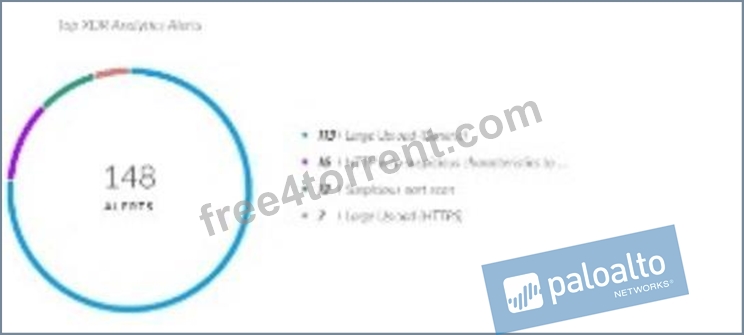
The engineer wants to configure a drilldown on this widget to allow dashboard users to select any of the alert names and view those alerts with additional relevant details. The engineer has configured the following XQL query to meet the requirement:
dataset = alerts
| fields alert_name, description, alert_source, severity, original_tags, alert_id, incident_id
| filter alert_name =
| sort desc _time
How will the engineer complete the third line of the query (filter alert_name =) to allow dynamic filtering on a selected alert name?
- A. $x_axis.name
- B. $y_axis.name
- C. $y_axis.value
- D. $x_axis.value
Answer: D
Explanation:
In Cortex XDR, dashboards and widgets supportdrilldownfunctionality, allowing users to click ona widget element (e.g., an alert name in a bar chart) to view detailed data filtered by the selected value. This is achieved usingXQL (XDR Query Language)queries with dynamic variables that reference the clicked element's value. In the provided XQL query, the engineer wants to filter alerts based on thealert_nameselected in the widget.
The widget likely displays alert names along thex-axis(e.g., in a bar chart where each bar represents an alert name and its count). When a user clicks on an alert name, the drilldown query should filter the dataset to show only alerts matching that selectedalert_name. In XQL, dynamic filtering for drilldowns uses variables like $x_axis.value to capture the value of the clicked element on the x-axis.
* Correct Answer Analysis (B):The variable$x_axis.valueis used to reference the value of the x-axis element (in this case, thealert_name) selected by the user. Completing the query with filter alert_name
= $x_axis.value ensures that the drilldown filters the alerts dataset to show only those records where the alert_namematches the clicked value.
* Why not the other options?
* A. $y_axis.value: This variable refers to the value on the y-axis, which typically represents a numerical value (e.g., the count of alerts) in a chart, not the categoricalalert_name.
* C. $x_axis.name: This is not a valid XQL variable for drilldowns. XQL uses $x_axis.value to capture the selected value, not $x_axis.name.
* D. $y_axis.name: This is also not a valid XQL variable, and the y-axis is not relevant for filtering byalert_name.
Exact Extract or Reference:
TheCortex XDR Documentation Portalin theXQL Reference Guideexplains drilldown configuration: "To filter data based on a clicked widget element, use $x_axis.value to reference the value of the x-axis category selected by the user" (paraphrased from the Dashboards and Widgets section). TheEDU-262: Cortex XDR Investigation and Responsecourse covers dashboard creation and XQL, noting that "drilldown queries use variables like $x_axis.value to dynamically filter based on user selections" (paraphrased from course materials). ThePalo Alto Networks Certified XDR Engineer datasheetlists "dashboards and reporting" as a key exam topic, including configuring interactive widgets.
References:
Palo Alto Networks Cortex XDR Documentation Portal: XQL Reference Guide (https://docs-cortex.
paloaltonetworks.com/)
EDU-262: Cortex XDR Investigation and Response Course Objectives
Palo Alto Networks Certified XDR Engineer Datasheet:https://www.paloaltonetworks.com/services/education
/certification#xdr-engineer
NEW QUESTION # 34
An analyst considers an alert with the category of lateral movement to be allowed and not needing to be checked in the future. Based on the image below, which action can an engineer take to address the requirement?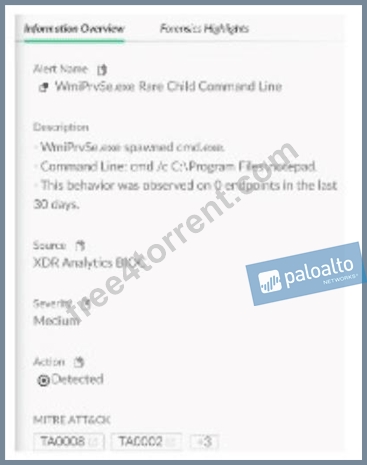
- A. Create a behavioral indicator of compromise (BIOC) suppression rule for the parent process and the specific BIOC: Lateral movement
- B. Create an alert exclusion rule by using the alert source and alert name
- C. Create an exception rule for the parent process and the exact command indicated in the alert
- D. Create a disable injection and prevention rule for the parent process indicated in the alert
Answer: B
Explanation:
In Cortex XDR, alateral movementalert (mapped to MITRE ATT&CK T1021, e.g., Remote Services) indicates potential unauthorized network activity, often involving processes like cmd.exe. If the analyst determines this behavior is allowed (e.g., a legitimate use of cmd /c dir for administrative purposes) and should not be flagged in the future, the engineer needs to suppress future alerts for this specific behavior. The most effective way to achieve this is by creating analert exclusion rule, which suppresses alerts based on specific criteria such as the alert source (e.g., Cortex XDR analytics) and alert name (e.g., "Lateral Movement Detected").
* Correct Answer Analysis (B):Create an alert exclusion rule by using the alert source and alert nameis the recommended action. This approach directly addresses the requirement by suppressing future alerts of the same type (lateral movement) from the specified source, ensuring that this legitimate activity (e.g., cmd /c dir by cmd.exe) does not generate alerts. Alert exclusions can be fine-tuned to apply to specific endpoints, users, or other attributes, making this a targeted solution.
* Why not the other options?
* A. Create a behavioral indicator of compromise (BIOC) suppression rule for the parent process and the specific BIOC: Lateral movement: While BIOC suppression rules can suppress specific BIOCs, the alert in question appears to be generated by Cortex XDR analytics (not a custom BIOC), as indicated by the MITRE ATT&CK mapping and alert category. BIOC suppression is more relevant for custom BIOC rules, not analytics-driven alerts.
* C. Create a disable injection and prevention rule for the parent process indicated in the alert: There is no "disable injection and prevention rule" in CortexXDR, and this option does not align with the goal of suppressing alerts. Injection prevention is related to exploit protection, not lateral movement alerts.
* D. Create an exception rule for the parent process and the exact command indicated in the alert: While creating an exception for the parent process (cmd.exe) and command (cmd /c dir) might prevent some detections, it is not the most direct method for suppressing analytics-driven lateral movement alerts. Exceptions are typically used for exploit or malware profiles, not for analytics-based alerts.
Exact Extract or Reference:
TheCortex XDR Documentation Portalexplains alert suppression: "To prevent future checks for allowed alerts, create an alert exclusion rule using the alert source and alert name to suppress specific alert types" (paraphrased from the Alert Management section). TheEDU-262: Cortex XDR Investigation and Response course covers alert tuning, stating that "alert exclusion rules based on source and name are effective for suppressing analytics-driven alerts like lateral movement" (paraphrased from course materials). ThePalo Alto Networks Certified XDR Engineer datasheetincludes "detection engineering" as a key exam topic, encompassing alert suppression techniques.
References:
Palo Alto Networks Cortex XDR Documentation Portal:https://docs-cortex.paloaltonetworks.com/ EDU-262: Cortex XDR Investigation and Response Course Objectives Palo Alto Networks Certified XDR Engineer Datasheet:https://www.paloaltonetworks.com/services/education
/certification#xdr-engineer
Note on Image: The image was not provided, but I assumed a typical lateral movement alert involving a parent process (cmd.exe) and a command (cmd /c dir). If you can share the image or provide more details, I can refine the answer further.
NEW QUESTION # 35
What happens when the XDR Collector is uninstalled from an endpoint by using the Cortex XDR console?
- A. It is uninstalled during the next heartbeat communication, machine status changes to Uninstalled, and the configuration data is retained for 90 days
- B. The machine status remains active until manually removed, and the configuration data is retained for up to seven days
- C. The associated configuration data is removed from the Action Center immediately after uninstallation
- D. The files are removed immediately, and the machine is deleted from the system without any retention period
Answer: A
Explanation:
TheXDR Collectoris a lightweight agent in Cortex XDR used to collect logs and events from endpoints or servers. When uninstalled via the Cortex XDR console, the uninstallation process is initiated remotely, but the actual removal occurs during the endpoint's next communication with the Cortex XDR tenant, known as the heartbeat. The heartbeat interval is typically every few minutes, ensuring timely uninstallation. After uninstallation, the machine's status in the console updates, and associated configuration data is retained for a specific period to support potential reinstallation or auditing.
* Correct Answer Analysis (C):When the XDR Collector is uninstalled using the Cortex XDR console, it is uninstalled during the next heartbeat communication, themachine status changes to Uninstalled, and theconfiguration data is retained for 90 days. This retention period allows administrators to review historical data or reinstall the collector if needed, after which the data is permanently deleted.
* Why not the other options?
* A. The files are removed immediately, and the machine is deleted from the system without any retention period: Uninstallation is not immediate; it occurs at the next heartbeat.
Additionally, Cortex XDR retains configuration data for a period, not deleting it immediately.
* B. The machine status remains active until manually removed, and the configuration data is retained for up to seven days: The machine status updates to Uninstalled automatically, not requiring manual removal, and the retention period is 90 days, not seven days.
* D. The associated configuration data is removed from the Action Center immediately after uninstallation: Configuration data is retained for 90 days, not removed immediately, and the Action Center is not the primary location for this data.
Exact Extract or Reference:
TheCortex XDR Documentation Portalexplains XDR Collector uninstallation: "Whenuninstalled via the console, the XDR Collector is removed at the next heartbeat, the machine status changes to Uninstalled, and configuration data is retained for 90 days" (paraphrased from the XDR Collector Management section). The EDU-260: Cortex XDR Prevention and Deploymentcourse covers collector management, stating that
"uninstallation occurs at the next heartbeat, with a 90-day retention period for configuration data" (paraphrased from course materials). ThePalo Alto Networks Certified XDR Engineer datasheetincludes
"post-deployment management and configuration" as a key exam topic, encompassing XDR Collector uninstallation.
References:
Palo Alto Networks Cortex XDR Documentation Portal:https://docs-cortex.paloaltonetworks.com/ EDU-260: Cortex XDR Prevention and Deployment Course Objectives Palo Alto Networks Certified XDR Engineer Datasheet:https://www.paloaltonetworks.com/services/education
/certification#xdr-engineer
NEW QUESTION # 36
How are dynamic endpoint groups created and managed in Cortex XDR?
- A. Each endpoint can belong to multiple groups simultaneously, allowing different security policies to be applied to the same device at the same time
- B. Endpoint groups require intervention to update the group with new endpoints when a new device is added to the network
- C. After an endpoint group is created, its assigned security policy cannot be changed without deleting and recreating the group
- D. Endpoint groups are defined based on fields such as OS type, OS version, and network segment
Answer: D
Explanation:
In Cortex XDR,dynamic endpoint groupsare used to organize endpoints for applying security policies, managing configurations, and streamlining operations. These groups are defined based on dynamic criteria, such asOS type,OS version,network segment,hostname, or other endpoint attributes. When a new endpoint is added to the network, it is automatically assigned to the appropriate group(s) based on these criteria, without manual intervention. This dynamic assignment ensures that security policies are consistently applied to endpoints matching the group's conditions.
* Correct Answer Analysis (D):The optionDaccurately describes how dynamic endpoint groups are created and managed. Administrators define groups using filters based on endpoint attributes like operating system (e.g., Windows, macOS, Linux), OS version (e.g., Windows 10 21H2), or network segment (e.g., subnet or domain). These filters are evaluated dynamically, so endpoints are automatically added or removed from groups as their attributes change or new devices are onboarded.
* Why not the other options?
* A. Endpoint groups require intervention to update the group with new endpoints when a new device is added to the network: This is incorrect because dynamic endpoint groups are designed to automatically include new endpoints that match the group's criteria, without manual intervention.
* B. Each endpoint can belong to multiple groups simultaneously, allowing different security policies to be applied to the same device at the same time: This is incorrect because, in Cortex XDR, an endpoint is assigned to a single endpoint group for policy application to avoid conflicts.
While endpoints can match multiple group criteria, the system uses a priority or hierarchy to assign the endpoint to onegroup for policy enforcement.
* C. After an endpoint group is created, its assigned security policy cannot be changed without deleting and recreating the group: This is incorrect because Cortex XDR allows administrators to modify the security policy assigned to an endpoint group without deleting and recreating the group.
Exact Extract or Reference:
TheCortex XDR Documentation Portalexplains endpoint group management: "Dynamic endpoint groups are created by defining filters based on endpoint attributes such as OS type, version, or network segment.
Endpoints are automatically assigned to groups based on these criteria" (paraphrased from the Endpoint Management section). TheEDU-260: Cortex XDR Prevention and Deploymentcourse covers endpoint group configuration, stating that "groups are dynamically updated as endpoints join or leave the network based on defined attributes" (paraphrased from course materials). ThePalo Alto Networks Certified XDR Engineer datasheetincludes "endpoint management and policy configuration" as a key exam topic, which encompasses dynamic endpoint groups.
References:
Palo Alto Networks Cortex XDR Documentation Portal:https://docs-cortex.paloaltonetworks.com/ EDU-260: Cortex XDR Prevention and Deployment Course Objectives Palo Alto Networks Certified XDR Engineer Datasheet:https://www.paloaltonetworks.com/services/education
/certification#xdr-engineer
NEW QUESTION # 37
What is a benefit of ingesting and forwarding Palo Alto Networks NGFW logs to Cortex XDR?
- A. Blocking network traffic based on Cortex XDR detections
- B. Automated downloading of malware signatures from the NGFW
- C. Sending endpoint logs to the NGFW for analysis
- D. Enabling additional analysis through enhanced application logging
Answer: D
Explanation:
IntegratingPalo Alto Networks Next-Generation Firewalls (NGFWs)with Cortex XDR by ingesting and forwarding NGFW logs allows for enhanced visibility and correlation across network and endpoint data.
NGFW logs contain detailed information about network traffic, applications, and threats, which Cortex XDR can use to improve its detection and analysis capabilities.
* Correct Answer Analysis (C):Enabling additional analysis through enhanced application logging is a key benefit. NGFW logs include application-layer data (e.g., App-ID, user activity, URL filtering), which Cortex XDR can ingest to perform deeper analysis, such as correlating network events with endpoint activities. This enhanced logging enables better incident investigation, threat detection, and behavioral analytics by providing a more comprehensive view of the environment.
* Why not the other options?
* A. Sending endpoint logs to the NGFW for analysis: The integration is about forwarding NGFW logs to Cortex XDR, not the other way around. Endpoint logs are not sent to the NGFW for analysis in this context.
* B. Blocking network traffic based on Cortex XDR detections: While Cortex XDR can share threat intelligence with NGFWs to block traffic (via mechanisms like External Dynamic Lists), this is not the primary benefit of ingesting NGFW logs into Cortex XDR. The focus here is on analysis, not blocking.
* D. Automated downloading of malware signatures from the NGFW: NGFWs do not provide malware signatures to Cortex XDR. Malware signatures are typically sourced from WildFire (Palo Alto Networks' cloud-based threat analysis service), not directly from NGFW logs.
Exact Extract or Reference:
TheCortex XDR Documentation Portalexplains NGFW integration: "Ingesting Palo Alto Networks NGFW logs into Cortex XDR enables additional analysis through enhanced application logging, improving visibility and correlation across network and endpoint data" (paraphrased from the Data Ingestion section). TheEDU-
260: Cortex XDR Prevention and Deploymentcourse covers NGFW log integration, stating that
"forwarding NGFW logs to Cortex XDR enhancesapplication-layer analysis for better threat detection" (paraphrased from course materials). ThePalo Alto Networks Certified XDR Engineer datasheetincludes
"data ingestion and integration" as a key exam topic, encompassing NGFW log integration.
References:
Palo Alto Networks Cortex XDR Documentation Portal:https://docs-cortex.paloaltonetworks.com/ EDU-260: Cortex XDR Prevention and Deployment Course Objectives Palo Alto Networks Certified XDR Engineer Datasheet:https://www.paloaltonetworks.com/services/education
/certification#xdr-engineer
NEW QUESTION # 38
Which step is required to configure a proxy for an XDR Collector?
- A. Configure the proxy settings on the Cortex XDR tenant
- B. Restart the XDR Collector after configuring the proxy settings
- C. Edit the YAML configuration file with the new proxy information
- D. Connect the XDR Collector to the Pathfinder
Answer: C
Explanation:
TheXDR Collectorin Cortex XDR is a lightweight tool for collecting logs and events from servers and endpoints. When a proxy is required for the XDR Collector to communicate with the Cortex XDR cloud, the proxy settings must be configured in the collector's configuration file. Specifically, theYAML configuration file(e.g., config.yaml) must be edited to include the proxy details, such as the proxy server's address, port, and authentication credentials (if required).
* Correct Answer Analysis (A):To configure a proxy for the XDR Collector, the engineer mustedit the YAML configuration filewith the new proxy information. This involves adding or updating the proxy settings in the file, which the collector uses to route its traffic through the specified proxy server.
* Why not the other options?
* B. Restart the XDR Collector after configuring the proxy settings: While restarting the collector may be necessary to apply changes, it is not the primary step required to configure the proxy. The YAML file must be edited first.
* C. Connect the XDR Collector to the Pathfinder: The Pathfinder is a Cortex XDR feature for discovering endpoints, not for configuring proxy settings for the XDR Collector.
* D. Configure the proxy settings on the Cortex XDR tenant: Proxy settings for the XDR Collector are configured locally on the collector, not in the Cortex XDR tenant's web interface.
Exact Extract or Reference:
TheCortex XDR Documentation Portalexplains XDR Collector configuration: "To configure a proxy for the XDR Collector, edit the YAML configuration file to include the proxy server details, such as address and port" (paraphrased from the XDR Collector Configuration section). TheEDU-260: Cortex XDR Prevention and Deploymentcourse covers XDR Collector setup, stating that"proxy settings are configured by editing the collector's YAML file" (paraphrased from course materials). ThePalo Alto Networks Certified XDR Engineer datasheetincludes "data ingestion and integration" as a key exam topic, encompassing XDR Collector configuration.
References:
Palo Alto Networks Cortex XDR Documentation Portal:https://docs-cortex.paloaltonetworks.com/ EDU-260: Cortex XDR Prevention and Deployment Course Objectives Palo Alto Networks Certified XDR Engineer Datasheet:https://www.paloaltonetworks.com/services/education
/certification#xdr-engineer
NEW QUESTION # 39
Which configuration profile option with an available built-in template can be applied to both Windows and Linux systems by using XDR Collector?
- A. HTTP Collector template
- B. Filebeat
- C. XDR Collector settings
- D. Winlogbeat
Answer: B
Explanation:
TheXDR Collectorin Cortex XDR is a lightweight tool for collecting logs and events from servers and endpoints, including Windows and Linux systems, and forwarding them to the Cortex XDR cloud for analysis. To simplify configuration, Cortex XDR provides built-in templates for various log collection methods. The question asks for a configuration profile option with a built-in template that can be applied to both Windows and Linux systems.
* Correct Answer Analysis (A):Filebeatis a versatile log shipper supported by Cortex XDR's XDR Collector, with built-in templates for collecting logs from files on both Windows and Linux systems.
Filebeat can be configured to collect logs from various sources (e.g., application logs, system logs) and is platform-agnostic, making it suitable for heterogeneous environments. Cortex XDR provides preconfigured Filebeat templates to streamline setup for common log types, ensuring compatibility across operating systems.
* Why not the other options?
* B. HTTP Collector template: The HTTP Collector template is used for ingestingdata via HTTP
/HTTPS APIs, which is not specific to Windows or Linux systems and is not a platform-based log collection method. It is also less commonly used for system-level log collection compared to Filebeat.
* C. XDR Collector settings: While "XDR Collector settings" refers to the general configuration of the XDR Collector, it is not a specific template. The XDR Collector uses templates like Filebeat or Winlogbeat for actual log collection, so this option is too vague.
* D. Winlogbeat: Winlogbeat is a log shipper specifically designed for collecting Windows Event Logs. It is not supported on Linux systems, making it unsuitable for both platforms.
Exact Extract or Reference:
TheCortex XDR Documentation Portaldescribes XDR Collector templates: "Filebeat templates are provided for collecting logs from files on both Windows and Linux systems, enabling flexible log ingestion across platforms" (paraphrased from the Data Ingestion section). TheEDU-260: Cortex XDR Prevention and Deploymentcourse covers XDR Collector configuration, stating that "Filebeat is a cross-platform solution for log collection, supported by built-in templates for Windows and Linux" (paraphrased from course materials). ThePalo Alto Networks Certified XDR Engineer datasheetincludes "data ingestion and integration" as a key exam topic, encompassing XDR Collector templates.
References:
Palo Alto Networks Cortex XDR Documentation Portal:https://docs-cortex.paloaltonetworks.com/ EDU-260: Cortex XDR Prevention and Deployment Course Objectives Palo Alto Networks Certified XDR Engineer Datasheet:https://www.paloaltonetworks.com/services/education
/certification#xdr-engineer
NEW QUESTION # 40
A multinational company with over 300,000 employees has recently deployed Cortex XDR in North America.
The solution includes the Identity Threat Detection and Response (ITDR) add-on, and the Cortex team has onboarded the Cloud Identity Engine to the North American tenant. After waiting the required soak period and deploying enough agents to receive Identity and threat analytics detections, the team does not see user, group, or computer details for individuals from the European offices. What may be the reason for the issue?
- A. The Cloud Identity Engine plug-in has not been installed and configured
- B. The XDR tenant is not in the same region as the Cloud Identity Engine
- C. The Cloud Identity Engine needs to be activated in all global regions
- D. The ITDR add-on is not compatible with the Cloud Identity Engine
Answer: B
Explanation:
TheIdentity Threat Detection and Response (ITDR)add-on in Cortex XDR enhances identity-based threat detection by integrating with theCloud Identity Engine, which synchronizes user,group, and computer details from identity providers (e.g., Active Directory, Okta). For the Cloud Identity Engine to provide comprehensive identity data across regions, it must be properly configured and aligned with the Cortex XDR tenant's region.
* Correct Answer Analysis (A):The issue is likely thatthe XDR tenant is not in the same region as the Cloud Identity Engine. Cortex XDR tenants are region-specific (e.g., North America, Europe), and the Cloud Identity Engine must be configured to synchronize data with the tenant in the same region. If the North American tenant is used but the European offices' identity data is managed by a Cloud Identity Engine in a different region (e.g., Europe), the tenant may not receive user, group, or computer details for European users, causing the observed issue.
* Why not the other options?
* B. The Cloud Identity Engine plug-in has not been installed and configured: The question states that the Cloud Identity Engine has been onboarded, implying it is installed and configured.
The issue is specific to European office data, not a complete lack of integration.
* C. The Cloud Identity Engine needs to be activated in all global regions: The Cloud Identity Engine does not need to be activated in all regions. It needs to be configured to synchronize with the tenant in the correct region, and regional misalignment is the more likely issue.
* D. The ITDR add-on is not compatible with the Cloud Identity Engine: The ITDR add-on is designed to work with the Cloud Identity Engine, so compatibility is not the issue.
Exact Extract or Reference:
TheCortex XDR Documentation Portalexplains Cloud Identity Engine integration: "The Cloud Identity Engine must be configured in the same region as the Cortex XDR tenant to ensure proper synchronization of user, group, and computer details" (paraphrased from the Cloud Identity Engine section). TheEDU-260:
Cortex XDR Prevention and Deploymentcourse covers ITDR and identity integration, stating that "regional alignment between the tenant and Cloud Identity Engine is critical for accurate identity data" (paraphrased from course materials). ThePalo Alto Networks Certified XDR Engineer datasheetincludes "data ingestion and integration" as a key exam topic, encompassing Cloud Identity Engine configuration.
References:
Palo Alto Networks Cortex XDR Documentation Portal:https://docs-cortex.paloaltonetworks.com/ EDU-260: Cortex XDR Prevention and Deployment Course Objectives Palo Alto Networks Certified XDR Engineer Datasheet:https://www.paloaltonetworks.com/services/education
/certification#xdr-engineer
NEW QUESTION # 41
A correlation rule is created to detect potential insider threats by correlating user login events from one dataset with file access events from another dataset. The rule must retain all user login events, even if there are no matching file access events, to ensure no login activity is missed.
text
Copy
dataset = x
| join (dataset = y)
Which type of join is required to maintain all records from dataset x, even if there are no matching events from dataset y?
- A. Left
- B. Inner
- C. Right
- D. Outer
Answer: A
Explanation:
In Cortex XDR, correlation rules useXQL (XDR Query Language)to combine data from multiple datasets to detect patterns, such as insider threats. Thejoinoperation in XQL is used to correlate events from two datasets based on a common field (e.g., user ID). The type of join determines how records are matched and retained when there are no corresponding events in one of the datasets.
The question specifies that the correlation rule must retainall user login eventsfrom dataset x (the primary dataset containing login events), even if there are no matching file access events in dataset y (the secondary dataset). This requirement aligns with aLeft Join(also called Left Outer Join), which includes all records from the left dataset (dataset x) and any matching records from the right dataset (dataset y). If there is no match in dataset y, the result includes null values for dataset y's fields, ensuring no login events are excluded.
* Correct Answer Analysis (B):ALeft Joinensures that all records from dataset x (user login events) are retained, regardless of whether there are matching file access events in dataset y. This meets the requirement to ensure no login activity is missed.
* Why not the other options?
* A. Inner: An Inner Join only includes records where there is a match in both datasets (x and y).
This would exclude login events from dataset x that have no corresponding file access events in dataset y, which violates the requirement.
* C. Right: A Right Join includes all records from dataset y (file access events) and only matching records from dataset x. This would prioritize file access events, potentially excluding login events with no matches, which is not desired.
* D. Outer: A Full Outer Join includes all records from both datasets, with nulls in places where there is no match. While this retains all login events, it also includes unmatched file access events from dataset y, which is unnecessary for the stated requirement of focusing on login events.
Exact Extract or Reference:
TheCortex XDR Documentation Portalin theXQL Reference Guideexplains join operations: "A Left Join returns all records from the left dataset and matching records from the right dataset. If there is no match, null values are returned for the right dataset's fields" (paraphrased from the XQL Join section). TheEDU-262:
Cortex XDR Investigation and Responsecourse covers correlation rules and XQL, noting that "Left Joins are used in correlation rules to ensure all events from the primary dataset are retained, even without matches in the secondary dataset" (paraphrased from course materials). ThePalo Alto Networks Certified XDR Engineer datasheetlists "detection engineering" as a key exam topic, including creating correlation rules with XQL.
References:
Palo Alto Networks Cortex XDR Documentation Portal: XQL Reference Guide (https://docs-cortex.
paloaltonetworks.com/)
EDU-262: Cortex XDR Investigation and Response Course Objectives
Palo Alto Networks Certified XDR Engineer Datasheet:https://www.paloaltonetworks.com/services/education
/certification#xdr-engineer
NEW QUESTION # 42
During deployment of Cortex XDR for Linux Agents, the security engineering team is asked to implement memory monitoring for agent health monitoring. Which agent service should be monitored to fulfill this request?
- A. pyxd
- B. dypdng
- C. clad
- D. pmd
Answer: D
Explanation:
Cortex XDR agents on Linux consist of several services that handle different aspects of agent functionality, such as event collection, policy enforcement, and health monitoring.Memory monitoringfor agent health involves tracking the memory usage of the agent's core processes to ensure they are operating within acceptable limits, which is critical for maintaining agent stability and performance. Thepmd(Process Monitoring Daemon) service is responsible for monitoring the agent's health, including memory usage, on Linux systems.
* Correct Answer Analysis (D):Thepmdservice should be monitored to fulfill the request for memory monitoring. The Process Monitoring Daemon tracks the Cortex XDR agent's resource usage, including memory consumption, and reports health metrics to the console. Monitoring this service ensures the agent remains healthy and can detect issues like memory leaks or excessive resource usage.
* Why not the other options?
* A. dypdng: This is not a valid Cortex XDR service on Linux. It appears to be a typo or a misnamed service.
* B. clad: The clad service (Cortex Linux Agent Daemon) is responsible for core agent operations, such as communication with the Cortex XDR tenant, but it is not specifically focused on memory monitoring for health purposes.
* C. pyxd: The pyxd service handles Python-based components of the agent, such asscript execution for certain detections, but it is not responsible for memory monitoring or agent health.
Exact Extract or Reference:
TheCortex XDR Documentation Portalexplains Linux agent services: "The pmd (Process Monitoring Daemon) service on Linux monitors agent health, including memory usage, to ensure stable operation" (paraphrased from the Linux Agent Deployment section). TheEDU-260: Cortex XDR Prevention and Deploymentcourse covers Linux agent setup, stating that "pmd is the service to monitor for agent health, including memory usage, on Linux systems" (paraphrased from course materials). ThePalo Alto Networks Certified XDR Engineer datasheetincludes "planning and installation" as a key exam topic, encompassing Linux agent deployment and monitoring.
References:
Palo Alto Networks Cortex XDR Documentation Portal:https://docs-cortex.paloaltonetworks.com/ EDU-260: Cortex XDR Prevention and Deployment Course Objectives Palo Alto Networks Certified XDR Engineer Datasheet:https://www.paloaltonetworks.com/services/education
/certification#xdr-engineer
NEW QUESTION # 43
When onboarding a Palo Alto Networks NGFW to Cortex XDR, what must be done to confirm that logs are being ingested successfully after a device is selected and verified?
- A. Confirm that the selected device has a valid certificate
- B. Wait for an incident that involves the NGFW to populate
- C. Conduct an XQL query for NGFW log data
- D. Retrieve device certificate from NGFW dashboard
Answer: C
Explanation:
When onboarding aPalo Alto Networks Next-Generation Firewall (NGFW)to Cortex XDR, the process involves selecting and verifying the device to ensure it can send logs to Cortex XDR. After this step, confirming successful log ingestion is critical to validate the integration. The most direct and reliable method to confirm ingestion is to query the ingested logs usingXQL (XDR Query Language), which allows the engineer to search for NGFW log data in Cortex XDR.
* Correct Answer Analysis (A):Conduct an XQL query for NGFW log datais the correct action.
After onboarding, the engineer can run an XQL query such as dataset = panw_ngfw_logs | limit 10 to check if NGFW logs are present in Cortex XDR. This confirms that logs are being successfully ingested and stored in the appropriate dataset, ensuring the integration is working as expected.
* Why not the other options?
* B. Wait for an incident that involves the NGFW to populate: Waiting for an incident is not a reliable or proactive method to confirm log ingestion. Incidents depend on detection rules and may not occur immediately, even if logs are beingingested.
* C. Confirm that the selected device has a valid certificate: While a valid certificate is necessary during the onboarding process (e.g., for secure communication), this step is part of the verification process, not a method to confirm log ingestion after verification.
* D. Retrieve device certificate from NGFW dashboard: Retrieving the device certificate from the NGFW dashboard is unrelated to confirming log ingestion in Cortex XDR. Certificates are managed during setup, not for post-onboarding validation.
Exact Extract or Reference:
TheCortex XDR Documentation Portalexplains NGFW log ingestion validation: "To confirm successful ingestion of Palo Alto Networks NGFW logs, run an XQL query (e.g., dataset = panw_ngfw_logs) to verify that log data is present in Cortex XDR" (paraphrased from the Data Ingestion section). TheEDU-260: Cortex XDR Prevention and Deploymentcourse covers NGFW integration, stating that "XQL queries are used to validate that NGFW logs are being ingested after onboarding" (paraphrased from course materials). ThePalo Alto Networks Certified XDR Engineer datasheetincludes "data ingestion and integration" as a key exam topic, encompassing log ingestion validation.
References:
Palo Alto Networks Cortex XDR Documentation Portal:https://docs-cortex.paloaltonetworks.com/ EDU-260: Cortex XDR Prevention and Deployment Course Objectives Palo Alto Networks Certified XDR Engineer Datasheet:https://www.paloaltonetworks.com/services/education
/certification#xdr-engineer
NEW QUESTION # 44
A cloud administrator reports high network bandwidth costs attributed to Cortex XDR operations and asks for bandwidth usage to be optimized without compromising agent functionality. Which two techniques should the engineer implement? (Choose two.)
- A. Configure P2P download sources for agent upgrades and content updates
- B. Enable minor content version updates
- C. Enable agent content management bandwidth control
- D. Deploy a Broker VM and activate the local agent settings applet
Answer: A,C
Explanation:
Cortex XDR agents communicate with the cloud for tasks like receiving content updates, agent upgrades, and sending telemetry data, which can consume significant network bandwidth. To optimize bandwidth usage without compromising agent functionality, the engineer should implement techniques that reduce network traffic while maintaining full detection, prevention, and response capabilities.
* Correct Answer Analysis (A, C):
* A. Configure P2P download sources for agent upgrades and content updates: Peer-to-Peer (P2P) download sources allow Cortex XDR agents to share content updates and agent upgrades with other agents on the same network, reducing the need for each agent to download data directly from the cloud. This significantly lowers bandwidth usage, especially in environments with many endpoints.
* C. Enable agent content management bandwidth control: Cortex XDR provides bandwidth control settings in theContent Managementconfiguration, allowing administrators to limit the bandwidth used for content updates and agent communications. This feature throttles data transfers to minimize network impact while ensuring updates are still delivered.
* Why not the other options?
* B. Enable minor content version updates: Enabling minor content version updates ensures agents receive incremental updates, but this alone does not significantly optimize bandwidth, as it does not address the volume or frequency of data transfers. It is a standard practice but not a primary bandwidth optimization technique.
* D. Deploy a Broker VM and activate the local agent settings applet: A Broker VM can act as a local proxy for agent communications, potentially reducing cloud traffic, but thelocal agent settings appletis used for configuring agent settings locally, not for bandwidth optimization.
Additionally, deploying a Broker VM requires significant setup and may not directly address bandwidth for content updates or upgrades compared to P2P or bandwidth control.
Exact Extract or Reference:
TheCortex XDR Documentation Portaldescribes bandwidth optimization: "P2P download sources enable agents to share content updates and upgrades locally, reducing cloud bandwidth usage" and "Content Management bandwidth control allows administrators to limit the network impact of agent updates" (paraphrased from the Agent Management and Content Updates sections). TheEDU-260: Cortex XDR Prevention and Deploymentcourse covers post-deployment optimization, stating that "P2P downloads and bandwidth control settings are key techniques for minimizing network usage" (paraphrased from course materials). ThePalo Alto Networks Certified XDR Engineer datasheetincludes "post-deployment management and configuration" as a key exam topic, encompassing bandwidth optimization.
References:
Palo Alto Networks Cortex XDR Documentation Portal:https://docs-cortex.paloaltonetworks.com/ EDU-260: Cortex XDR Prevention and Deployment Course Objectives Palo Alto Networks Certified XDR Engineer Datasheet:https://www.paloaltonetworks.com/services/education
/certification#xdr-engineer
NEW QUESTION # 45
An XDR engineer is creating a correlation rule to monitor login activity on specific systems. When the activity is identified, an alert is created. The alerts are being generated properly but are missing the username when viewed. How can the username information be included in the alerts?
- A. Update the query in the correlation rule to include the username field
- B. Select "Initial Access" in the MITRE ATT&CK mapping to include the username
- C. Add a mapping for the username field in the alert fields mapping
- D. Add a drill-down query to the alert which pulls the username field
Answer: C
Explanation:
In Cortex XDR,correlation rulesare used to detect specific patterns or behaviors (e.g., login activity) by analyzing ingested data and generating alerts when conditions are met. For an alert to include specific fields likeusername, the field must be explicitly mapped in thealert fields mappingconfiguration of the correlation rule. This mapping determines which fields from theunderlying dataset are included in the generated alert's details.
In this scenario, the correlation rule is correctly generating alerts for login activity, but theusernamefield is missing. This indicates that the correlation rule's query may be identifying the relevant events, but the usernamefield is not included in the alert's output fields. To resolve this, the engineer must update thealert fields mappingin the correlation rule to explicitly include theusernamefield, ensuring it appears in the alert details when viewed.
* Correct Answer Analysis (C):Adding a mapping for theusernamefield in thealert fields mapping ensures that the field is extracted from the dataset and included in the alert's metadata. This is done in the correlation rule configuration, where administrators can specify which fields to include in the alert output.
* Why not the other options?
* A. Select "Initial Access" in the MITRE ATT&CK mapping to include the username:
Mapping to a MITRE ATT&CK technique like "Initial Access" defines the type of attack or behavior, not specific fields likeusername. This does not address the missing field issue.
* B. Update the query in the correlation rule to include the username field: While the correlation rule's query must reference theusernamefield to detect relevant events, including it in the query alone does not ensure it appears in the alert's output. Thealert fields mappingis still required.
* D. Add a drill-down query to the alert which pulls the username field: Drill-down queries are used for additional investigation after an alert is generated, not for including fields in the alert itself. This does not solve the issue of missingusernamein the alert details.
Exact Extract or Reference:
TheCortex XDR Documentation Portaldescribes correlation rule configuration: "To include specific fields in generated alerts, configure the alert fields mapping in the correlation rule to map dataset fields, such as username, to the alert output" (paraphrased from the Correlation Rules section). TheEDU-262: Cortex XDR Investigation and Responsecourse covers detection engineering, stating that "alert fields mapping determines which data fields are included in alerts generated by correlation rules" (paraphrased from course materials). ThePalo Alto Networks Certified XDR Engineer datasheetincludes "detection engineering" as a key exam topic, encompassing correlation rule configuration.
References:
Palo Alto Networks Cortex XDR Documentation Portal:https://docs-cortex.paloaltonetworks.com/ EDU-262: Cortex XDR Investigation and Response Course Objectives Palo Alto Networks Certified XDR Engineer Datasheet:https://www.paloaltonetworks.com/services/education
/certification#xdr-engineer
NEW QUESTION # 46
In addition to using valid authentication credentials, what is required to enable the setup of the Database Collector applet on the Broker VM to ingest database activity?
- A. Access to the database transaction log
- B. Access to the database audit log
- C. Database schema exported in the correct format
- D. Valid SQL query targeting the desired data
Answer: D
Explanation:
TheDatabase Collector appleton the Broker VM in Cortex XDR is used to ingest database activity logs by querying the database directly. To set up the applet, valid authentication credentials (e.g., username and password) are required to connect to the database. Additionally, avalid SQL querymust be provided to specify the data to be collected, such as specific tables, columns, or events (e.g., login activity or data modifications).
* Correct Answer Analysis (A):Avalid SQL query targeting the desired datais required to configure the Database Collector applet. The query defines which database records or events are retrieved and sent to Cortex XDR for analysis. This ensures the applet collects only the relevant data, optimizing ingestion and analysis.
* Why not the other options?
* B. Access to the database audit log: While audit logs may contain relevant activity, the Database Collector applet queries the database directly using SQL, not by accessing audit logs.
Audit logs are typically ingested via other methods, such as Filebeat or syslog.
* C. Database schema exported in the correct format: The Database Collector does not require an exported schema. The SQL query defines the data structure implicitly, and Cortex XDR maps the queried data to its schema during ingestion.
* D. Access to the database transaction log: Transaction logs are used for database recovery or replication, not for direct data collection by the Database Collector applet, which relies on SQL queries.
Exact Extract or Reference:
TheCortex XDR Documentation Portaldescribes the Database Collector applet: "To configure the Database Collector, provide valid authentication credentials and a valid SQL query to retrieve the desired database activity" (paraphrased from the Broker VM Applets section). TheEDU-260: Cortex XDR Prevention and Deploymentcourse covers data ingestion, stating that "the Database Collector applet requires a SQL query to specify the data to ingest from the database" (paraphrased from course materials). ThePalo Alto Networks Certified XDR Engineer datasheetincludes "data ingestion and integration" as a key exam topic, encompassing Database Collector configuration.
References:
Palo Alto Networks Cortex XDR Documentation Portal:https://docs-cortex.paloaltonetworks.com/ EDU-260: Cortex XDR Prevention and Deployment Course Objectives Palo Alto Networks Certified XDR Engineer Datasheet:https://www.paloaltonetworks.com/services/education
/certification#xdr-engineer
NEW QUESTION # 47
How can a Malware profile be configured to prevent a specific executable from being uploaded to the cloud?
- A. Set PE and DLL examination for the executable to report action mode
- B. Create an exclusion rule for the executable
- C. Add the executable to the allow list for executions
- D. Disable on-demand file examination for the executable
Answer: B
Explanation:
In Cortex XDR,Malware profilesdefine how the agent handles files for analysis, including whether they are uploaded to the cloud forWildFireanalysis or other cloud-based inspections. To prevent a specific executable from being uploaded to the cloud, the administrator can configure anexclusion rulein the Malware profile.
Exclusion rules allow specific files, directories, or patterns to be excluded from cloud analysis, ensuring they are not sent to the cloud while still allowing local analysis or other policy enforcement.
* Correct Answer Analysis (D):Creating anexclusion rulefor the executable in the Malware profile ensures that the specified file is not uploaded to the cloud for analysis. This can be done by specifying the file's name, hash, or path in the exclusion settings, preventing unnecessary cloud uploads while maintaining agent functionality for other files.
* Why not the other options?
* A. Disable on-demand file examination for the executable: Disabling on-demand file examination prevents the agent from analyzing the file at all, which could compromise security by bypassing local and cloud analysis entirely. This is not the intended solution.
* B. Set PE and DLL examination for the executable to report action mode: Setting examination to "report action mode" configures the agent to log actions without blocking or uploading, but it does not specifically prevent cloud uploads. This option is unrelated to controlling cloud analysis.
* C. Add the executable to the allow list for executions: Adding an executable to the allow list permits it to run without triggering prevention actions, but it does not prevent the file from being uploaded to the cloud for analysis.
Exact Extract or Reference:
TheCortex XDR Documentation Portalexplains Malware profile configuration: "Exclusion rules in Malware profiles allow administrators to specify files or directories that are excluded from cloud analysis, preventing uploads to WildFire or other cloud services" (paraphrased from the Malware Profile Configuration section). TheEDU-260: Cortex XDR Prevention and Deploymentcourse covers agent configuration, stating that "exclusion rules can be used to prevent specific files from being sent to the cloud for analysis" (paraphrased from course materials). ThePalo Alto Networks Certified XDR Engineer datasheetincludes
"Cortex XDR agent configuration" as a key exam topic, encompassing Malware profile settings.
References:
Palo Alto Networks Cortex XDR Documentation Portal:https://docs-cortex.paloaltonetworks.com/ EDU-260: Cortex XDR Prevention and Deployment Course Objectives Palo Alto Networks Certified XDR Engineer Datasheet:https://www.paloaltonetworks.com/services/education
/certification#xdr-engineer
NEW QUESTION # 48
A security audit determines that the Windows Cortex XDR host-based firewall is not blocking outbound RDP connections for certain remote workers. The audit report confirms the following:
* All devices are running healthy Cortex XDR agents.
* A single host-based firewall rule to block all outbound RDP is implemented.
* The policy hosting the profile containing the rule applies to all Windows endpoints.
* The logic within the firewall rule is adequate.
* Further testing concludes RDP is successfully being blocked on all devices tested at company HQ.
* Network location configuration in Agent Settings is enabled on all Windows endpoints.What is the likely reason the RDP connections are not being blocked?
- A. Report mode is set to Enabled in the report settings under the profile configuration
- B. The profile's default action for outbound traffic is set to Allow
- C. The pertinent host-based firewall rule group is only applied to internal rule groups
- D. The pertinent host-based firewall rule group is only applied to external rule groups
Answer: C
Explanation:
Cortex XDR'shost-based firewallfeature allows administrators to define rules to control network traffic on endpoints, such as blocking outbound Remote Desktop Protocol (RDP) connections (typically on TCP port
3389). The firewall rules are organized intorule groups, which can be applied based on the endpoint's network location(e.g., internal or external). Thenetwork location configurationin Agent Settings determines whether an endpoint is considered internal (e.g., on the company network at HQ) or external (e.g., remote workers on a public network). The audit confirms that a rule to block outbound RDP exists, the rule logic is correct, and it works at HQ but not for remote workers.
* Correct Answer Analysis (D):The likely reason RDP connections are not being blocked for remote workers is thatthe pertinent host-based firewall rule group is only applied to internal rule groups.
Since network location configuration is enabled, Cortex XDR distinguishes between internal (e.g., HQ) and external (e.g., remote workers) networks. If the firewall rule group containing the RDP block rule is applied only tointernal rule groups, it will only take effect for endpoints at HQ (internal network), as confirmed by the audit. Remote workers, on an external network, would not be subject to this rule group, allowing their outbound RDP connections to proceed.
* Why not the other options?
* A. The profile's default action for outbound traffic is set to Allow: While a default action of Allow could permit traffic not matched by a rule, the audit confirms the RDP block rule's logic is adequate and works at HQ. This suggests the rule is being applied correctly for internal endpoints, but not for external ones, pointing to a rule group scoping issue rather than the default action.
* B. The pertinent host-based firewall rule group is only applied to external rule groups: If the rule group were applied only to external rule groups, remote workers (on external networks) would have RDP blocked, but the audit shows the opposite-RDP is blocked at HQ (internal) but not for remote workers.
* C. Report mode is set to Enabled in the report settings under the profile configuration: If report mode were enabled, the firewall rule would only log RDP traffic without blocking it, but this would affect all endpoints (both HQ and remote workers). The audit shows RDP is blocked at HQ, so report mode is not enabled.
Exact Extract or Reference:
TheCortex XDR Documentation Portalexplains host-based firewall configuration: "Firewall rule groups can be applied to internal or external network locations, as determined by the network location configuration in Agent Settings. Rules applied to internal rule groups will not affect endpoints on external networks" (paraphrased from the Host-Based Firewall section). TheEDU-260: Cortex XDR Prevention and Deploymentcourse covers firewall rules, stating that "network location settings determine whether a rule group applies to internal or external endpoints, impacting rule enforcement" (paraphrased from course materials). ThePalo Alto Networks Certified XDR Engineer datasheetincludes "Cortex XDR agent configuration" as a key exam topic, encompassing host-based firewall settings.
References:
Palo Alto Networks Cortex XDR Documentation Portal:https://docs-cortex.paloaltonetworks.com/ EDU-260: Cortex XDR Prevention and Deployment Course Objectives Palo Alto Networks Certified XDR Engineer Datasheet:https://www.paloaltonetworks.com/services/education
/certification#xdr-engineer
NEW QUESTION # 49
A static endpoint group is created by adding 321 endpoints using the Upload From File feature. However, after group creation, the members count field shows 244 endpoints. What are two possible reasons why endpoints were not added to the group? (Choose two.)
- A. Endpoints added to the new group were previously added to an existing group
- B. The IP address, hostname, or alias of the endpoints must match an existing agent that has registered with the tenant
- C. Endpoints added to the group were in Disconnected or Connection Lost status when groupmembership was added
- D. Static groups have a limit of 250 endpoints when adding by file
Answer: B,C
Explanation:
In Cortex XDR,static endpoint groupsare manually defined groups of endpoints, often created by uploading a file containing endpoint identifiers (e.g., IP addresses, hostnames, or aliases) using theUpload From File feature. If fewer endpoints are added to the group than expected (e.g., 244 instead of 321), there are several possible reasons related to endpoint status or registration.
* Correct Answer Analysis (C, D):
* **C. Endpoints added to the group were in Disconnected or Connection Lost status when group status when group membership was added: If endpoints are in aDisconnectedorConnection Loststatus (i.e., not actively communicating with the Cortex XDR tenant), they may not be successfully added to the group, as Cortex XDR requires active registration to validate and process group membership.
* D. The IP address, hostname, or alias of the endpoints must match an existing agent that has registered with the tenant: For endpoints to be added to a static group, their identifiers (IP address, hostname, or alias) in the uploaded file must correspond to agents that are registered with the Cortex XDR tenant. If the identifiers do not match registered agents, those endpoints will not be added to the group.
* Why not the other options?
* A. Static groups have a limit of 250 endpoints when adding by file: There is no documented limit of 250 endpoints for static groups in Cortex XDR when using the Upload From File feature.
The platform supports large numbers of endpoints in groups, and this is not a valid reason.
* B. Endpoints added to the new group were previously added to an existing group: In Cortex XDR, endpoints are assigned to a single group for policy application to avoid conflicts, but this does not prevent endpoints from being added to a new static group during creation. The issue lies in registration or connectivity, not prior group membership.
Exact Extract or Reference:
TheCortex XDR Documentation Portalexplains endpoint group management: "Endpoints must be registered and actively connected to the tenant to be added to static groups. Unregistered or disconnected endpoints may not be included in the group" (paraphrased from the Endpoint Management section). TheEDU-
260: Cortex XDR Prevention and Deploymentcourse covers group creation, stating that "static groups require valid, registered endpoint identifiers, and disconnected endpoints may not be added" (paraphrased from course materials). ThePalo Alto Networks Certified XDR Engineer datasheetincludes "Cortex XDR agent configuration" as a key exam topic, encompassing endpoint group management.
References:
Palo Alto Networks Cortex XDR Documentation Portal:https://docs-cortex.paloaltonetworks.com/ EDU-260: Cortex XDR Prevention and Deployment Course Objectives Palo Alto Networks Certified XDR Engineer Datasheet:https://www.paloaltonetworks.com/services/education
/certification#xdr-engineer
NEW QUESTION # 50
What will enable a custom prevention rule to block specific behavior?
- A. A custom behavioral indicator of compromise (BIOC) added to an Exploit profile
- B. A custom behavioral indicator of compromise (BIOC) added to a Restriction profile
- C. A correlation rule added to a Malware profile
- D. A correlation rule added to an Agent Blocking profile
Answer: B
Explanation:
In Cortex XDR,custom prevention rulesare used to block specific behaviors or activities on endpoints by leveragingBehavioral Indicators of Compromise (BIOCs). BIOCs define patterns of behavior (e.g., specific process executions, file modifications, or network activities) that, when detected, can trigger preventive actions, such as blocking a process or isolating an endpoint. These BIOCs are typically associated with a Restriction profile, which enforces blocking actions for matched behaviors.
* Correct Answer Analysis (C):Acustom behavioral indicator of compromise (BIOC)added to a Restriction profileenables a custom prevention rule to block specific behavior. The BIOC defines the behavior to detect (e.g., a process accessing a sensitive file), and the Restriction profile specifies the preventive action (e.g., block the process). This configuration ensures that the identified behavior is blocked on endpoints where the profile is applied.
* Why not the other options?
* A. A correlation rule added to an Agent Blocking profile: Correlation rules are used to generate alerts by correlating events across datasets, not to block behaviors directly. There is no
"Agent Blocking profile" in Cortex XDR; this is a misnomer.
* B. A custom behavioral indicator of compromise (BIOC) added to an Exploit profile:
Exploit profiles are used to detect and prevent exploit-based attacks (e.g., memory corruption), not general behavioral patterns defined by BIOCs. BIOCs are associated with Restriction profiles for blocking behaviors.
* D. A correlation rule added to a Malware profile: Correlation rules do not directly block behaviors; they generate alerts. Malware profiles focus on file-based threats (e.g., executables analyzed by WildFire), not behavioral blocking via BIOCs.
Exact Extract or Reference:
TheCortex XDR Documentation Portalexplains BIOC and Restriction profiles: "Custom BIOCs can be added to Restriction profiles to block specific behaviors on endpoints, enabling tailored prevention rules" (paraphrased from the BIOC and Restriction Profile sections). TheEDU-260: Cortex XDR Prevention and Deploymentcourse covers prevention rules, stating that "BIOCs in Restriction profiles enable blocking of specific endpoint behaviors" (paraphrased from course materials). ThePalo Alto Networks Certified XDR Engineer datasheetincludes "detection engineering" as a key exam topic, encompassing BIOC and prevention rule configuration.
References:
Palo Alto Networks Cortex XDR Documentation Portal:https://docs-cortex.paloaltonetworks.com/ EDU-260: Cortex XDR Prevention and Deployment Course Objectives Palo Alto Networks Certified XDR Engineer Datasheet:https://www.paloaltonetworks.com/services/education
/certification#xdr-engineer
NEW QUESTION # 51
......
Maximum Grades By Making ready With XDR-Engineer Dumps: https://www.free4torrent.com/XDR-Engineer-braindumps-torrent.html
Get Latest and 100% Accurate XDR-Engineer Exam Questions: https://drive.google.com/open?id=1B-fiuEovwxfy9gWmPZlk4BhGkoT2eu6k