

2026 New AACE-PSP Exam Questions Real AACE International Dumps
Course 2026 AACE-PSP Test Prep Training Practice Exam Download
The AACE-PSP certification exam covers a wide range of topics related to project planning and scheduling, including project initiation, scope management, resource planning, cost estimation, risk management, and project control. AACE-PSP exam is comprised of 125 multiple-choice questions, and candidates are given four hours to complete it. To pass the exam and earn their AACE-PSP certification, candidates must achieve a score of at least 70%. In addition to passing the exam, candidates must also fulfill certain educational and professional requirements, such as holding a bachelor's degree and demonstrating a certain number of hours of project planning and scheduling experience.
NEW QUESTION # 45
Of the following update procedures, which is the least important in achieving an accurate forecast for completion of a construction schedule?
- A. Entering the time impacts of delays and change orders.
- B. Making "downstream" logic revisions as required.
- C. Estimating remaining durations of activities.
- D. The correct recording of actual start dates.
Answer: B
Explanation:
* Schedule Update Procedures:
Accurate schedule updates rely on entering actual data (start/finish dates, durations) and evaluating impacts of changes.
"Downstream" logic revisions may be needed but are less critical compared to ensuring accurate historical data and reflecting immediate changes.
* PSP Study Guide Reference:
Schedule updating emphasizes capturing accurate historical data and estimating remaining durations accurately.
* Analysis of Options:
Option A and B: Key to progress tracking and forecasting.
Option D: Essential for reflecting impacts of delays and change orders.
Option C: While important, downstream logic revisions are less immediate compared to other procedures.
* Conclusion: The correct answer is C, as downstream logic revisions are less critical in achieving an accurate schedule forecast compared to other updates
NEW QUESTION # 46
What problems can a soils engineer deal with on a project?
- A. Toxic soils.
- B. Archeological findings.
- C. Survey error.
- D. Hidden subsurface conditions.
Answer: D
Explanation:
* Role of Soils Engineer:
Soils engineers address subsurface conditions, such as soil stability, unexpected geology, and underground obstacles.
* Evaluation of Other Options:
A: Survey errors are typically addressed by surveyors.
C: Archeological findings involve specialists in historical preservation.
D: Toxic soils are typically handled by environmental engineers.
* Verification with PSP Guidelines:
The PSP Study Guide includes subsurface investigations as a key responsibility for geotechnical professionals (Ref: PSP Study Guide, Chapter 1A: Site Conditions).
NEW QUESTION # 47
Estimate to complete (ETC) is __________________.
- A. The expected total cost of an activity, group of activities or the project
- B. The value of the completed work expressed in terms of the budget assigned to that work
- C. The costs actually incurred in accomplishing the work performed
- D. The expected remaining cost needed to complete an activity, group of activities or the project
Answer: D
Explanation:
Estimate to Complete (ETC) is the forecast of additional costs required to complete the remaining project work.
Option B refers to actual costs incurred (AC).
Option C refers to Estimate at Completion (EAC), which includes both actual costs and ETC.
Option D refers to Budgeted Cost of Work Performed (BCWP).
ETC is a critical concept for forecasting and project control as described in the PSP Study Guide.
NEW QUESTION # 48
Assuming that you had only one crane capable of 30 lifts per day, 3 column pours requiring 28 lifts each, plus associated assorted work requiring an additional 150 lifts, what is the minimum planned working duration for this work?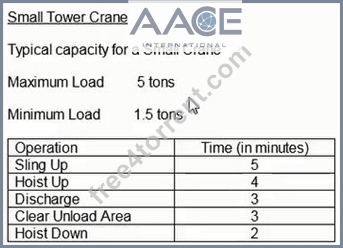
- A. 15 workdays
- B. 7 work days
- C. 18 work days
- D. 8 work days
Answer: C
Explanation:
* Calculation of Total Lifts Required:
3 column pours = 28×3=8428 \times 3 = 8428×3=84.
Additional lifts = 150150150.
Total lifts = 84+150=23484 + 150 = 23484+150=234.
* Lifts Per Day with One Crane:
1 crane performs 30 lifts per day.
* Required Duration:
Minimum planned working duration = ⌈234÷30⌉=18\lceil 234 \div 30 \rceil = 18⌈234÷30⌉=18.
* Verification with PSP Guidelines:
Aligning workload with equipment capacity ensures practical schedule planning (Ref: PSP Study Guide, Chapter 2B: Workload Balancing).
NEW QUESTION # 49
Which of these letters, symbols or words best approximates the graphical shape of a project's cumulative BCWS?
- A. Bell curve
- B. _
- C. S
- D. /
Answer: B
Explanation:
* Shape of Cumulative BCWS:
The Budgeted Cost of Work Scheduled (BCWS) reflects a cumulative expenditure curve over time, typically shaped like an "S".
* Explanation of the S-Curve:
Initially slow expenditure, acceleration during peak work, and tapering off near completion.
* Verification with PSP Guidelines:
The PSP Study Guide discusses BCWS as part of earned value management (Ref: PSP Study Guide, Chapter 1D: Earned Value Analysis).
NEW QUESTION # 50
In the "normal" schedule, excluding Activity 1000, what activity(s) are concurrent with Activity 3001?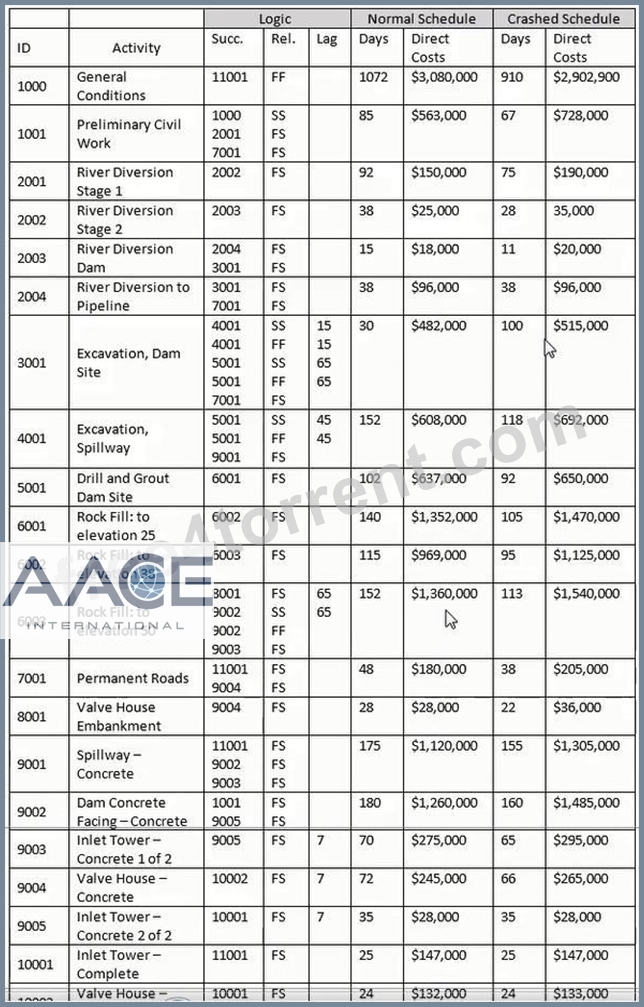
- A. 4001 and 5001.
- B. 2004.
- C. 2003 and 7001.
- D. 4001, 5001 and 6001.
Answer: A
NEW QUESTION # 51
Of the following update procedures, which is the least important in achieving an accurate forecast for completion of a construction schedule?
- A. Entering the time impacts of delays and change orders.
- B. Making "downstream" logic revisions as required.
- C. Estimating remaining durations of activities.
- D. The correct recording of actual start dates.
Answer: B
NEW QUESTION # 52
What changes to logic would eliminate Activity B from the critical path?
- A. Reduce the lag value of the relationship from Activity A to Activity B from 5 to 0
- B. Add a SS 15 relationship from Activity A to Activity B and replace the relationship from Activity A to Activity B with FFO
- C. Replace the relationship from Activity B to Activity C with SSO
- D. Replace the relationship from Activity A to Activity B with FFO and add an FSO relationship from Activity A to Activity C
Answer: D
Explanation:
* To eliminate Activity B from the critical path, its dependencies must change so that its delay no longer impacts the path's completion time.
* Replacing the A → B relationship with a Finish-to-Finish with Offset (FFO) and adding an FSO (Finish-to-Start with Offset) relationship from A → C allows Activity C to proceed independently of Activity B.
* Reference: PSP Study Guide, Section 2.2.4 - Relationships and Calculations, explains how relationship types can influence critical path determination.
NEW QUESTION # 53
Constructability is NOT intended to:
- A. optimize engineering and procurement
- B. balance project and environment goals
- C. correct deficiencies in the project design
- D. integrate construction knowledge into the design
Answer: C
NEW QUESTION # 54
What owner action could have mitigated the late completion of the project?
- A. Hire a more senior project manager.
- B. Prepare better structural steel drawings.
- C. Self-perform more of the work.
- D. Use a procurement agent to monitor and expedite equipment deliveries.
Answer: D
NEW QUESTION # 55
What is a critical path method schedule?
- A. The timeline of the riskiest work
- B. List of work to be accomplished by responsible party and when it is to be accomplished
- C. A graphical means of showing the important work
- D. A network diagram of logically interconnected activities
Answer: D
NEW QUESTION # 56
In the normal schedule, excluding Activity 1000. what activity(s) are concurrent with Activity 3001?
- A. 4001, 5001, and 6001
- B. 4001 and 5001
- C. 2003 and 7001
- D. 2004, 4001. and 5001
Answer: A
Explanation:
Concurrency Analysis:
Activity 3001 (Excavation, Dam Site) has concurrent activities during its execution period.
Based on the schedule, 4001 (Excavation, Spillway), 5001 (Drill and Grout Dam Site), and 6001 (Rock Fill to Elevation 25) overlap with Activity 3001.
Excluded Options:
B, C, and D: Do not fully represent concurrent activities based on schedule analysis.
Verification with PSP Guidelines:
Logical sequencing confirms the concurrency of these activities (Ref: PSP Study Guide, Chapter 2A: Activity Sequencing).
NEW QUESTION # 57
Activity durations are normally estimated in an intuitive and subjective way. All of the following will improve duration accuracy EXCEPT
- A. Use the people responsible for performing the work as a resource to assign activity durations.
- B. Use gross building square footages. The pluses and minuses all average out.
- C. Look at each activity independently and don't follow specific logic paths when assigning activity durations.
- D. Divide activities into smaller activities. This will increase activity detail and duration estimate accuracy.
Answer: A
NEW QUESTION # 58
Determine the correct formula and date for the late start for Activity 9001.
- A. There is insufficient data provided to calculate the answer.
- B. The early finish is required in order to determine the answer.
- C. LS.6001 Dur.6001 -> 11-20-02.
- D. LF.9001 Dur.9001 -> 11-20-02.
Answer: D
NEW QUESTION # 59
When should the Project Plan have incorporated the relevant interfaces and requirements of the project contract documents?
- A. After the NTP
- B. During the Bid Phase
- C. Before the commercial decision to bid on the project
- D. Af1er the award and before the NTP
Answer: C
NEW QUESTION # 60
Budgeted cost of work scheduled is _______________________.
- A. The expected total cost of an activity, group of activities or the project
- B. The value of the completed work expressed in terms of the budget assigned to that work
- C. The total authorized budget for accomplishing the project scope
- D. The sum of all budgets for work scheduled to be accomplished within a given time period
Answer: D
NEW QUESTION # 61
Determine the correct formula and date for the late finish for Activity 2002.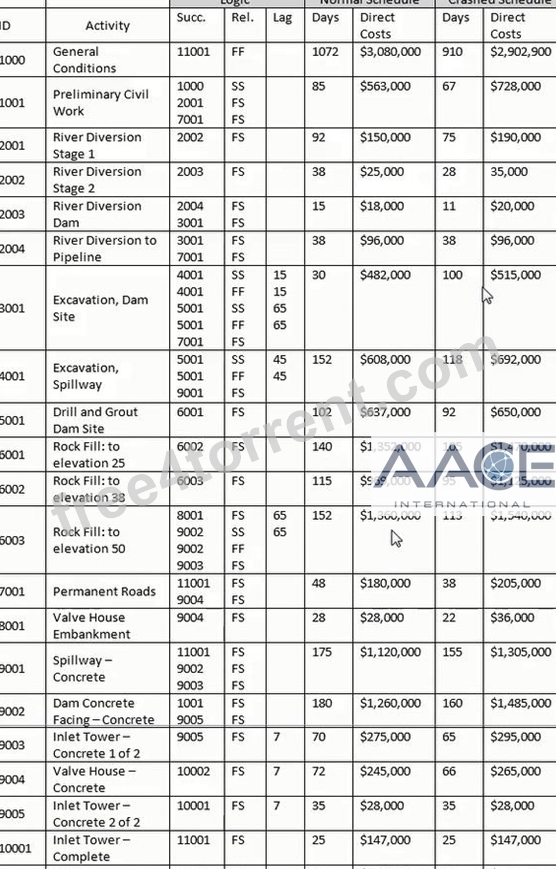
- A. LS.2003 - 1 day -> 10-05-01.
- B. LS.2003 + 1 day -> 10-07-01.
- C. LS.2003 - 1 day -> 11.06.01.
- D. LS.2003 - 1 day -> 10-06-01.
Answer: A
NEW QUESTION # 62
Midway through the project you received an executed change order for this project, adding thirty-three days to the contract for weather delays. In its simplest form, how would your next project update display the changed condition?
- A. After Activity 1000, add a new Activity 1050 with a start-to-start relationship to Activity 1000, and tie the end of this new activity with a finish-to-finish relationship to the final activity of the project.
- B. After Activity 1000, add a new Activity 1010 with a finish-to-start relationship to Activity 1000, and tie the end of this new activity with a finish-to-start relationship to the final activity of the project.
- C. After Activity 1001, add a new Activity 1011 with a finish-to-start relationship to Activity 1000, and tie the end of this new activity with a finish-to-start relationship to the final activity of the project.
Answer: C
NEW QUESTION # 63
......
AACE-PSP Exam Info and Free Practice Test Professional Quiz Study Materials: https://www.free4torrent.com/AACE-PSP-braindumps-torrent.html
Accurate Hot Selling AACE-PSP Exam Dumps 2026 Newly Released: https://drive.google.com/open?id=1mn4z0BHi4gFHY8k8-t8aU2mJla15NjTk