

2026 Updated Fortinet FCSS_SASE_AD-25 Dumps PDF - Want To Pass FCSS_SASE_AD-25 Fast
FCSS_SASE_AD-25 Practice Exam Dumps - 99% Marks In Fortinet Exam
NEW QUESTION # 20
When viewing the daily summary report generated by FortiSASE. the administrator notices that the report contains very little dat a. What is a possible explanation for this almost empty report?
- A. There are no security profile group applied to all policies.
- B. The web filter security profile is not set to Monitor
- C. Log allowed traffic is set to Security Events for all policies.
- D. Digital experience monitoring is not configured.
Answer: C
Explanation:
If the daily summary report generated by FortiSASE contains very little data, one possible explanation is that the "Log allowed traffic" setting is configured to log only "Security Events" for all policies. This configuration limits the amount of data logged, as it only includes security events and excludes normal allowed traffic.
Log Allowed Traffic Setting:
The "Log allowed traffic" setting determines which types of traffic are logged.
When set to "Security Events," only traffic that triggers a security event (such as a threat detection or policy violation) is logged.
Impact on Report Data:
If the log setting excludes regular allowed traffic, the amount of data captured and reported is significantly reduced.
This results in reports with minimal data, as only security-related events are included.
FortiOS 7.2 Administration Guide: Provides details on configuring logging settings for traffic policies.
FortiSASE 23.2 Documentation: Explains the impact of logging configurations on report generation and data visibility.
NEW QUESTION # 21
How can digital experience monitoring (DEM) on an endpoint assist in diagnosing connectivity and network issues?
- A. FortiSASE runs a ping from the endpoint to calculate the TTL to the SaaS application.
- B. FortiSASE runs SNMP traps to the endpoint using the DEM agent to verify the SaaS application health status.
- C. FortiSASE runs a netstat from the endpoint to the SaaS application to see if ports are open.
- D. FortiSASE runs a trace job on the endpoint using the DEM agent to the Software-as-a-Service (SaaS) application.
Answer: D
Explanation:
The Digital Experience Monitoring (DEM) agent on the endpoint performs a trace route to the SaaS application to measure latency, packet loss, and hop-by-hop performance. This helps diagnose where in the path connectivity or performance issues are occurring.
NEW QUESTION # 22
Which service is included in a secure access service edge (SASE) solution, but not in a security service edge (SSE) solution?
- A. CASB
- B. SWG
- C. SD-WAN
- D. ZTNA
Answer: C
Explanation:
SD-WAN is a networking component included in a SASE solution but not in an SSE solution. SSE focuses solely on security services (like ZTNA, SWG, and CASB), while SASE combines both networking (e.g., SD- WAN) and security into a unified cloud-delivered service.
NEW QUESTION # 23
Refer to the exhibit.
While reviewing the traffic logs, the FortiSASE administrator notices that the usernames are showing random characters.
Why are the usernames showing random characters?
- A. Users are using a shared single sign-on SSO username.
- B. FortiSASE uses FortiClient unique identifiers for usernames.
- C. Log anonymization is turned on to hash usernames.
- D. Special characters are used in usernames.
Answer: C
Explanation:
The usernames appear as random character strings because log anonymization is enabled in FortiSASE, which hashes sensitive user information such as usernames to protect privacy while still allowing log analysis.
NEW QUESTION # 24
Refer to the exhibit.
While reviewing the traffic logs, the FortiSASE administrator notices that the usernames are showing random characters.
Why are the usernames showing random characters?
- A. Users are using a shared single sign-on SSO username.
- B. FortiSASE uses FortiClient unique identifiers for usernames.
- C. Log anonymization is turned on to hash usernames.
- D. Special characters are used in usernames.
Answer: C
Explanation:
The usernames appear as random character strings because log anonymization is enabled in FortiSASE, which hashes sensitive user information such as usernames to protect privacy while still allowing log analysis.
NEW QUESTION # 25
Which event log subtype captures FortiSASE SSL VPN user creation?
- A. Endpoint Events
- B. VPN Events
- C. Administrator Events
- D. User Events
Answer: D
Explanation:
The event log subtype that captures FortiSASE SSL VPN user creation is User Events . This subtype is specifically designed to log activities related to user management, such as creating, modifying, or deleting user accounts. When an SSL VPN user is created, it falls under this category because it involves adding a new user to the system.
Here's why the other options are incorrect:
A . Endpoint Events: These logs pertain to activities related to endpoint devices, such as device registration, compliance checks, or security posture assessments. SSL VPN user creation is unrelated to endpoint events.
B . VPN Events: These logs capture activities related to VPN connections, such as session establishment, termination, or errors. While SSL VPN usage generates VPN events, the creation of a user account itself is not logged under this subtype.
D . Administrator Events: These logs track actions performed by administrators, such as configuration changes or policy updates. While an administrator might create the SSL VPN user, the specific event of user creation is categorized under User Events, not Administrator Events.
Fortinet FCSS FortiSASE Documentation - Event Logging and Subtypes
FortiSASE Administration Guide - Monitoring and Logging
NEW QUESTION # 26
What are two advantages of using zero-trust tags? (Choose two.)
- A. Zero-trust tags can be assigned to endpoint profiles based on user groups.
- B. Zero-trust tags can help monitor endpoint system resource usage.
- C. Zero-trust tags can be used to allow or deny access to network resources.
- D. Zero-trust tags can determine the security posture of an endpoint.
Answer: C,D
Explanation:
Zero-trust tags assess endpoint compliance based on defined posture rules and are used in access policies to control whether a device is permitted or denied access to specific network resources.
NEW QUESTION # 27
In which two ways does FortiSASE help organizations ensure secure access for remote workers? (Choose two.)
- A. It uses the FortiCloud organizational units to assign endpoint profiles to remote workers.
- B. It uses the identity and access management (IAM) portal to validate the identities of remote workers.
- C. It offers zero trust network access (ZTNA) capabilities.
- D. It secures traffic from endpoints to cloud applications.
Answer: C,D
Explanation:
FortiSASE ensures secure access for remote workers by protecting traffic between endpoints and cloud applications and enforcing ZTNA policies that validate user identity and device posture before granting access to corporate resources.
NEW QUESTION # 28
Refer to the exhibit.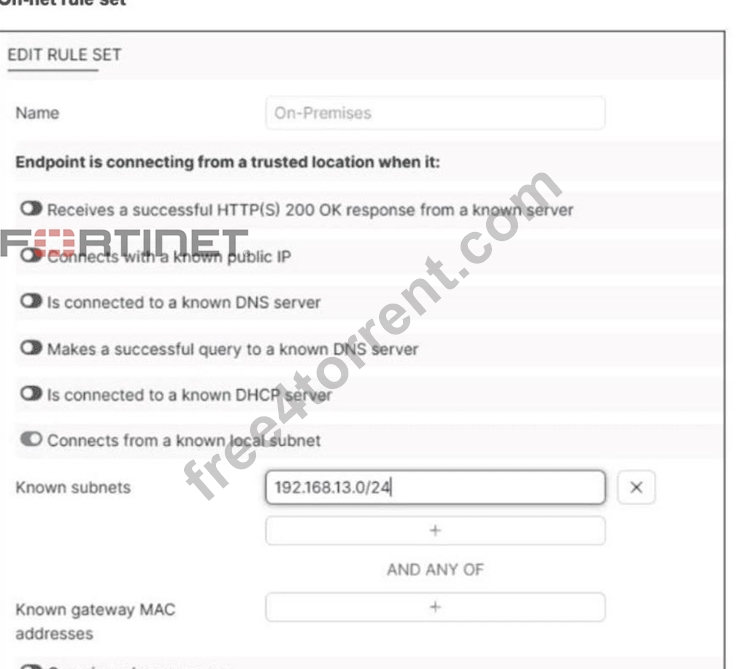
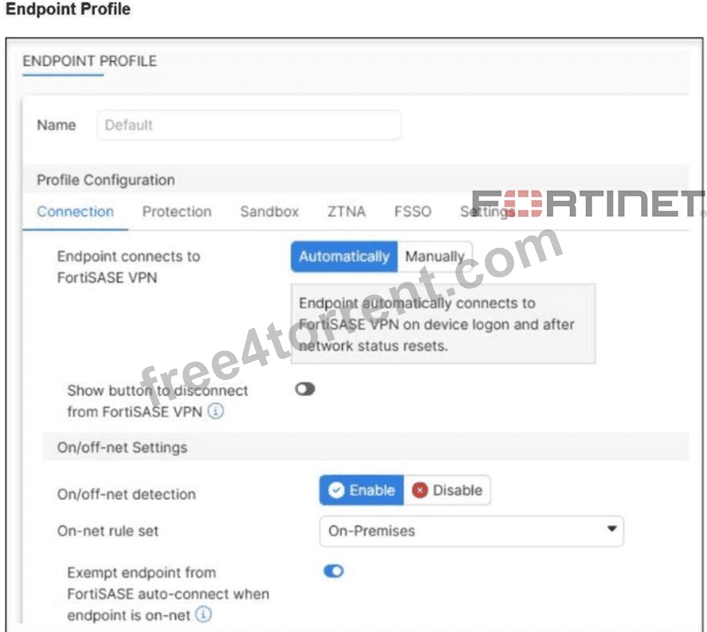
An endpoint is assigned an IP address of 192.168.13.101/24.
Which action will be run on the endpoint?
- A. The endpoint will be exempted from auto-connect to the FortiSASE tunnel.
- B. The endpoint will be detected as off-net.
- C. The endpoint will be able to bypass the on-net rule because it is connecting from a known subnet.
- D. The endpoint will automatically connect to the FortiSASE tunnel.
Answer: A
Explanation:
The FortiClient Administration Guide states that on-net rules determine when an endpoint is in a trusted location. If the endpoint matches the configured subnet, the client is considered on-net, and therefore bypasses auto-connect.
* "Device registration and on-net status information for a device that is running FortiClient appears only on the FortiGate that applies the FortiClient profile to that device." Since 192.168.13.101 falls inside the trusted subnet 192.168.13.0/24, the endpoint is treated as on-net # it will be exempted from auto-connect.
NEW QUESTION # 29
Which statement applies to a single sign-on (SSO) deployment on FortiSASE?
- A. SSO users can be imported into FortiSASE and added to user groups.
- B. SSO identity providers can be integrated using public and private access types.
- C. SSO is recommended only for agent-based deployments.
- D. SSO overrides any other previously configured user authentication.
Answer: D
NEW QUESTION # 30
When viewing the daily summary report generated by FortiSASE, the administrator notices that the report contains very little data.
What is a possible explanation for this almost empty report?
- A. The web filter security profile is not set to Monitor.
- B. There are no security profile groups applied to all policies.
- C. Log allowed traffic is set to Security Events for all policies.
- D. Digital experience monitoring is not configured.
Answer: C
Explanation:
The issue of an almost empty daily summary report in FortiSASE can often be traced back to how logging is configured within the system. Specifically, if "Log Allowed Traffic" is set to "Security Events" for all policies, it means that only security-related events (such as threats or anomalies) are being logged, while normal, allowed traffic is not being recorded. Since most traffic in a typical network environment is allowed, this configuration would result in very little data being captured and subsequently reported in the daily summary.
Here's a breakdown of why the other options are less likely to be the cause:
B . There are no security profile groups applied to all policies: While applying security profiles is important for comprehensive protection, their absence does not directly affect the volume of data in reports unless specific logging settings are also misconfigured.
C . The web filter security profile is not set to Monitor: This option pertains specifically to web filtering activities. Even if web filtering is not set to monitor mode, other types of traffic and logs should still populate the report.
D . Digital experience monitoring is not configured: Digital Experience Monitoring (DEM) focuses on user experience metrics rather than general traffic logging. Its absence would not lead to an almost empty report.
To resolve this issue, administrators should review the logging settings across all policies and ensure that "Log Allowed Traffic" is appropriately configured to capture the necessary data for reporting purposes.
Fortinet FCSS FortiSASE Documentation - Reporting and Logging Best Practices FortiSASE Administration Guide - Configuring Logging Settings
NEW QUESTION # 31
Refer to the exhibit.
While reviewing the traffic logs, the FortiSASE administrator notices that the usernames are showing random characters.
Why are the usernames showing random characters?
- A. Users are using a shared single sign-on SSO username.
- B. FortiSASE uses FortiClient unique identifiers for usernames.
- C. Log anonymization is turned on to hash usernames.
- D. Special characters are used in usernames.
Answer: C
Explanation:
The usernames appear as random character strings because log anonymization is enabled in FortiSASE, which hashes sensitive user information such as usernames to protect privacy while still allowing log analysis.
NEW QUESTION # 32
Which information does FortiSASE use to bring network lockdown into effect on an endpoint?
- A. The number of critical vulnerabilities detected on the endpoint
- B. The connection status of the tunnel to FortiSASE
- C. The security posture of the endpoint based on ZTNA tags
- D. Zero-day malware detection on endpoint
Answer: C
Explanation:
FortiSASE uses ZTNA tags to assess the endpoint's security posture. If the posture is non-compliant based on predefined rules, FortiSASE enforces network lockdown to restrict access accordingly.
NEW QUESTION # 33
Refer to the exhibits.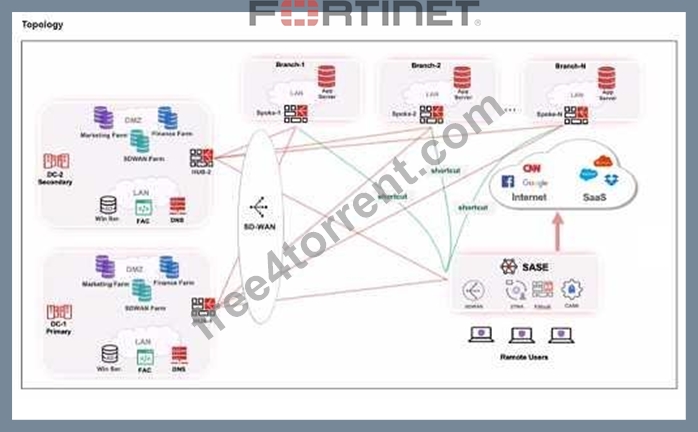
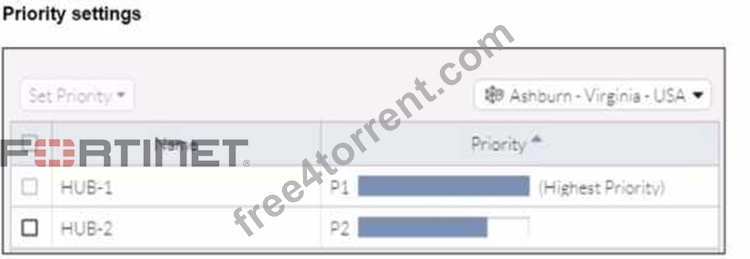
When remote users connected to FortiSASE require access to internal resources on Branch-2. how will traffic be routed?
- A. FortiSASE will use the SD-WAN capability and determine that traffic will be directed to HUB-2. which will then route traffic to Branch-2.
- B. FortiSASE will use the AD VPN protocol and determine that traffic will be directed to Branch-2 directly, using a static route
- C. FortiSASE will use the SD-WAN capability and determine that traffic will be directed to HUB-1, which will then route traffic to Branch-2.
- D. FortiSASE will use the AD VPN protocol and determine that traffic will be directed to Branch-2 directly, using a dynamic route
Answer: D
NEW QUESTION # 34
Refer to the exhibits.
How will the application vulnerabilities be patched, based on the exhibits provided?
- A. An administrator will patch the vulnerability remotely using FortiSASE.
- B. The vulnerability will be patched by installing the patch from the vendor's website.
- C. The vulnerability will be patched automatically based on the endpoint profile configuration.
- D. The end user will patch the vulnerabilities using the FortiClient software.
Answer: B
NEW QUESTION # 35
Refer to the exhibit.
The daily report for application usage for internet traffic shows an unusually high number of unknown applications by category.
What are two possible explanations for this? (Choose two.)
- A. The inline-CASB application control profile does not have application categories set to Monitor.
- B. Deep inspection is not being used to scan traffic.
- C. Certificate inspection is not being used to scan application traffic.
- D. The private access policy must be to set to log Security Events.
Answer: B,C
NEW QUESTION # 36
How does FortiSASE hide user information when viewing and analyzing logs?
- A. By tokenization in log data
- B. By masking log data
- C. By compressing log data
- D. By hashing log data
Answer: D
Explanation:
FortiSASE hides user information in logs by using hashing, which anonymizes sensitive data such as usernames or IP addresses while still allowing for consistent tracking and analysis.
NEW QUESTION # 37
Refer to the exhibits.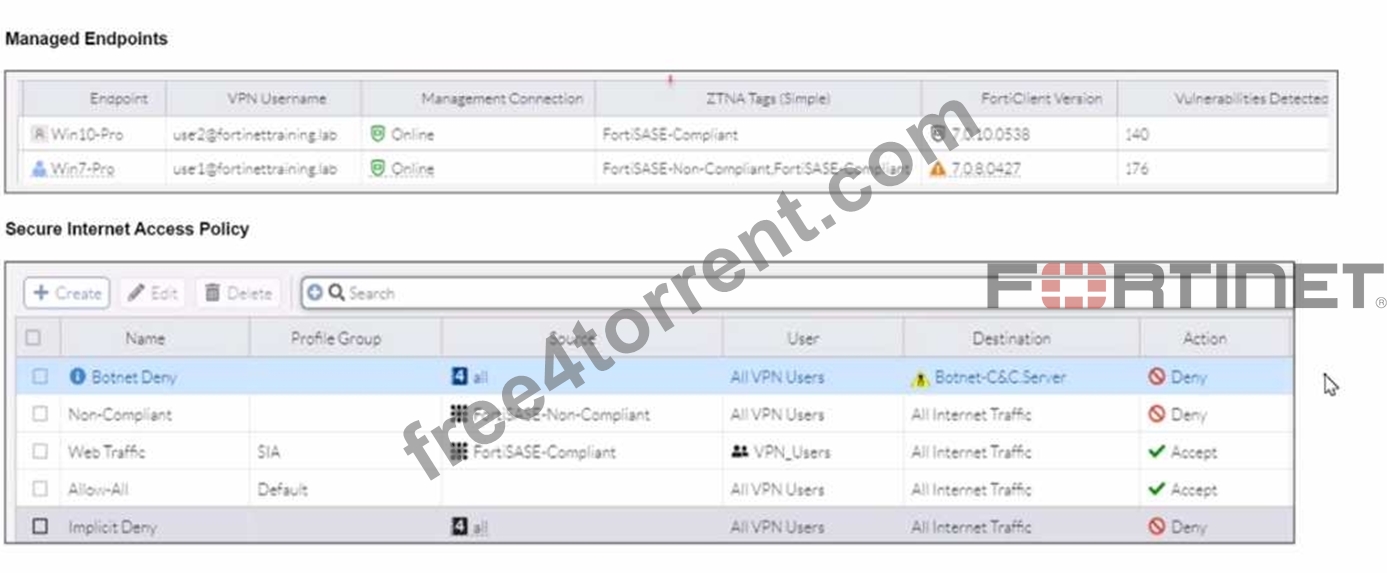
WiMO-Pro and Win7-Pro are endpoints from the same remote location. WiMO-Pro can access the internet though FortiSASE, while Wm7-Pro can no longer access the internet Given the exhibits, which reason explains the outage on Wm7-Pro?
- A. The Win7-Pro FortiClient version does not match the FortiSASE endpoint requirement.
- B. Win-7 Pro has exceeded the total vulnerability detected threshold.
- C. The Win7-Pro device posture has changed.
- D. Win7-Pro cannot reach the FortiSASE SSL VPN gateway
Answer: B
Explanation:
Based on the provided exhibits, the reason why the Win7-Pro endpoint can no longer access the internet through FortiSASE is due to exceeding the total vulnerability detected threshold. This threshold is used to determine if a device is compliant with the security requirements to access the network.
Endpoint Compliance:
FortiSASE monitors endpoint compliance by assessing various security parameters, including the number of vulnerabilities detected on the device.
The compliance status is indicated by the ZTNA tags and the vulnerabilities detected.
Vulnerability Threshold:
The exhibit shows that Win7-Pro has 176 vulnerabilities detected, whereas Win10-Pro has 140 vulnerabilities.
If the endpoint exceeds a predefined vulnerability threshold, it may be restricted from accessing the network to ensure overall network security.
Impact on Network Access:
Since Win7-Pro has exceeded the vulnerability threshold, it is marked as non-compliant and subsequently loses internet access through FortiSASE.
The FortiSASE endpoint profile enforces this compliance check to prevent potentially vulnerable devices from accessing the internet.
FortiOS 7.2 Administration Guide: Provides information on endpoint compliance and vulnerability management.
FortiSASE 23.2 Documentation: Explains how vulnerability thresholds are used to determine endpoint compliance and access control.
NEW QUESTION # 38
Which two advantages does FortiSASE bring to businesses with microbranch offices that have FortiAP deployed for unmanaged devices? (Choose two.)
- A. It eliminates the requirement for an on-premises firewall.
- B. It secures internet access both on and off the network.
- C. It simplifies management and provisioning.
- D. It uses zero trust network access (ZTNA) tags to perform device compliance checks.
Answer: A,B
NEW QUESTION # 39
Refer to the exhibits.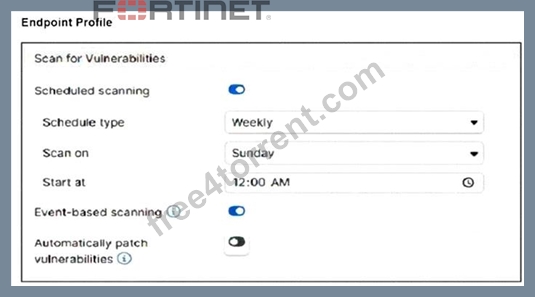
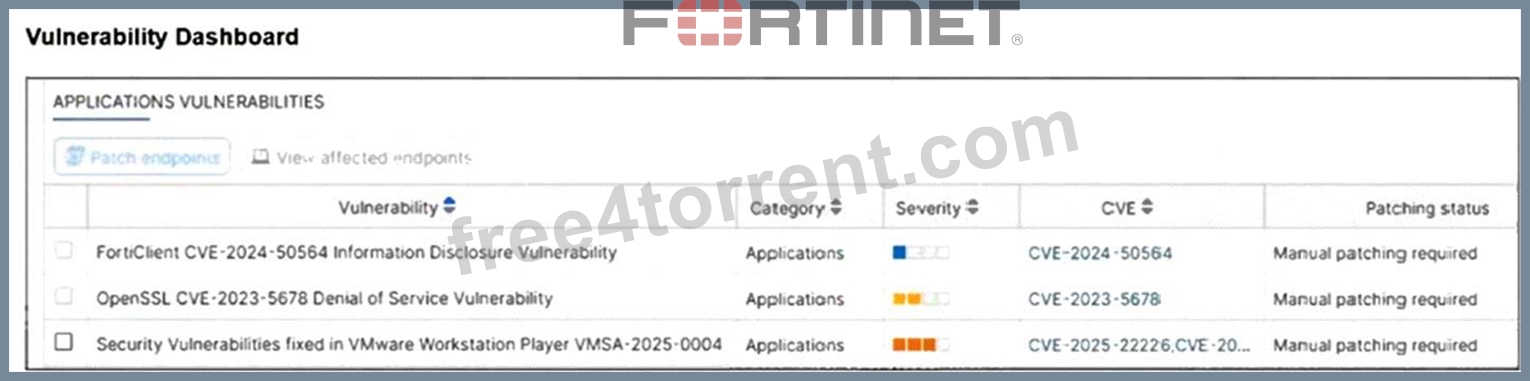
How will the application vulnerabilities be patched, based on the exhibits provided?
- A. An administrator will patch the vulnerability remotely using FortiSASE.
- B. The vulnerability will be patched automatically based on the endpoint profile configuration.
- C. The vulnerability will be patched by installing the patch from the vendor's website.
- D. The end user will patch the vulnerabilities using the FortiClient software.
Answer: A
Explanation:
The "Automatically patch vulnerabilities" option is disabled in the endpoint profile. Additionally, the Vulnerability Dashboard shows the patching status as "Manual patching required." This means an administrator must manually initiate the patching process remotely using FortiSASE.
NEW QUESTION # 40
Which secure internet access (SIA) use case minimizes individual endpoint configuration?
- A. Agentless remote user internet access
- B. SIA using ZTNA
- C. SIA for FortiClient agent remote users
- D. Site-based remote user internet access
Answer: D
Explanation:
Site-based remote user internet access minimizes individual endpoint configuration by routing user traffic through a centralized FortiSASE connection point (such as a FortiAP or FortiGate), rather than requiring each device to be individually configured with the FortiClient agent.
NEW QUESTION # 41
Which two settings are automatically pushed from FortiSASE to FortiClient in a new FortiSASE deployment with default settings? (Choose two.)
- A. tunnel profile
- B. zero trust network access (ZTNA) tags
- C. FortiSASE certificate authority (CA) certificate
- D. real-time protection
Answer: A,C
Explanation:
In a default FortiSASE deployment, the tunnel profile (for secure connectivity) and the FortiSASE CA certificate (for SSL inspection and trusted communication) are automatically pushed to FortiClient endpoints.
NEW QUESTION # 42
Refer to the exhibits.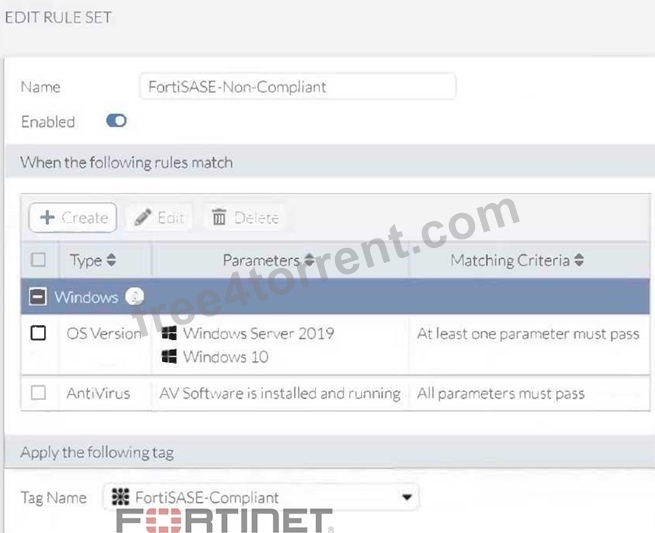
Antivirus is installed on a Windows 10 endpoint, but the windows application firewall is stopping it from running. What will the endpoint security posture check be?
- A. FortiClient will tag the endpoint as FortiSASE-Non-Compliant.
- B. FortiClient will block the endpoint from getting access to the network.
- C. FortiClient telemetry will be disconnected because of failed compliance.
- D. FortiClient will prompt the user to enable antivirus.
Answer: B
NEW QUESTION # 43
When accessing the FortiSASE portal for the first time, an administrator must select data center locations for which three FortiSASE components? (Choose three.)
- A. Logging
- B. Endpoint management
- C. Sandbox
- D. Points of presence
- E. Identity & access management (IAM)
Answer: A,B,C
Explanation:
When first accessing the FortiSASE portal, the administrator must select data center locations for endpoint management, logging, and sandbox services to ensure optimized performance and compliance with data residency requirements.
NEW QUESTION # 44
......
Updated Verified FCSS_SASE_AD-25 Q&As - Pass Guarantee: https://www.free4torrent.com/FCSS_SASE_AD-25-braindumps-torrent.html
FCSS_SASE_AD-25 Certification with Actual Questions: https://drive.google.com/open?id=1cnCwlx9W22hgJWJ448Y6-ZImJfXBNf0R