

Guide (New 2025) Actual Oracle 1Z0-084 Exam Questions
1Z0-084 Exam Dumps Pass with Updated 2025 Certified Exam Questions
NEW QUESTION # 17
A database supporting a mixed workload is hosted on a server with 64 CPUs.
A large number of free buffer waits and buffer busy waits occur affecting performance.
The buffer cache size was then increased but after a few hours, the same wait events occur more often than before the change.
Examine these parameter settings: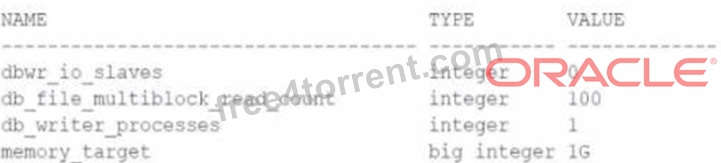
Which two actions can help reduce the number of these waits7
- A. increasing the value of DB_FILE_MULTIBLOCK_READ_COUNT to 128
- B. setting dbwr_io_slaves to 64
- C. increasing the value of DBWRITERPROCESSES to 64,
- D. Increasing the size of MEMORYTARGET
- E. reducing the values of DB_FILE_MULTILOCK_READ_COUNT to 64
Answer: B,C
Explanation:
Given a server with 64 CPUs, if the buffer cache size increase did not alleviate free buffer waits and buffer busy waits, one can look into optimizing I/O and the efficiency of the DB writer processes.
C: Setting the DBWR_IO_SLAVES parameter to a non-zero value, such as the number of CPUs, would initiate I/O slave processes to assist the DB writer process. This can help reduce I/O contention when writing from the buffer cache to disk, particularly for systems without asynchronous I/O capabilities.
D: Increasing the value of DBWRITERPROCESSES enables multiple DB writer processes to be active simultaneously. In a system with many CPUs, such as 64, increasing this value can improve the write throughput to disk and potentially reduce buffer busy waits.
References:
* Oracle Database Reference, 19c
* Oracle Database Performance Tuning Guide, 19c
NEW QUESTION # 18
Which two statements are true about session wait information contained in v$session or v$session_wait?
- A. Rows for sessions that are not waiting always contain the total wait time since the session started.
- B. Rows for sessions that are currently waiting have a wait time of 0.
- C. Rows for sessions displaying WAITED UNKNOWN TIME in the STATE column indicate that the session is still waiting.
- D. Rows for sessions that are not waiting might contain the actual wait time for the last event for which they waited.
- E. Rows for sessions that are currently waiting have their wait time incremented every microsecond.
Answer: B,D
Explanation:
In theV$SESSIONview, Oracle provides information about the session waits:
B: When theWAIT_TIMEcolumn has a value of 0, it signifies that the session is currently waiting for a resource. This column represents the duration of the current or last wait.
C: If the session is not actively waiting, theWAIT_TIMEcolumn shows the time the session spent waiting for the last wait event. If theSTATEcolumn is showing "WAITED KNOWN TIME", it means the session is not currently waiting, but it indicates the time for which it had waited.
References:
* Oracle Database Reference, 19c
* Oracle Database Performance Tuning Guide, 19c
NEW QUESTION # 19
You need to transport performance data from a Standard Edition to an Enterprise Edition database. What is the recommended method to do this?
- A. Export the data by using expdp from the ftatspack repository and import it by using impdp into the AWR repository.
- B. Export the data by using the exp utility and parameter file spuexp.par from the Statspack repository and import it by using imp into a dedicated Statspack schema on the destination.
- C. Export the data by using expdp from Statspack and import it by using $ORACLE_HOME/rdbms/admin
/awrload into the AWR repository. - D. Export the data by using the expdp utility and parameter file spuexp.par from the Statspack repository and import it by using impdp into Export the data by using expdp from the Statspack repository and import it by using impdp into the AWR repository.
Answer: B
Explanation:
To transport performance data from an Oracle Database Standard Edition, which uses Statspack, to an Enterprise Edition database, which uses AWR, you must consider the compatibility of data structures and repository schemas between these tools. The recommended method is:
* D (Correct): Export the data using the exp utility with a parameter file appropriate for Statspack (like spuexp.par) from the Statspack repository and import it into a dedicated Statspack schema on the destination. Since Statspack and AWR use different schemas, it's not recommended to import Statspack data directly into the AWR repository.
The other options are incorrect because:
* A (Incorrect): expdp is not designed to export from Statspack, and awrload is intended for loading from an AWR export file, not a Statspack export.
* B (Incorrect): Although expdp and impdp are used for exporting and importing data, the AWR repository schema is different from the Statspack schema, so importing Statspack data directly into the AWR repository is not recommended.
* C (Incorrect): Using expdp to export from Statspack and then importing directly into the AWR repository is not the correct approach due to the schema differences between Statspack and AWR.
References:
* Oracle Database Performance Tuning Guide: Migrating from Statspack to AWR
NEW QUESTION # 20
You must write a statement that returns the ten most recent sales. Examine this statement:
Users complain that the query executes too slowly. Examine the statement's current execution plan: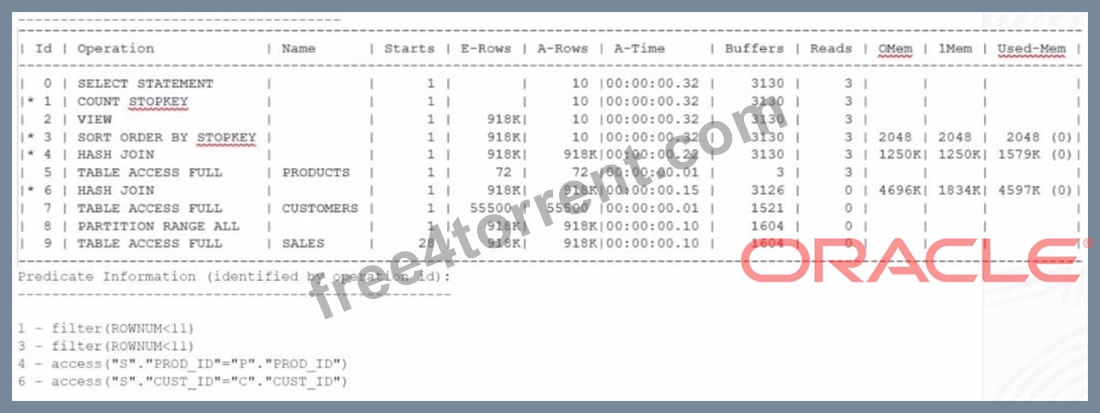
What must you do to reduce the execution time and why?
- A. Enable Adaptive Plans so that Oracle can change the Join method as well as the Join order for this query.
- B. Replace the FETCH FIRST clause with ROWNUM to enable the use of an index on SALES.
- C. Create an index on SALES.CUST_ID to force an INDEX RANGE SCAN on this index followed by a NESTED LOOP join between CUSTOMERS and SALES.
- D. Create an index on SALES.TIME_ID to force the return of rows in the order specified by the ORDER BY clause.
- E. Collect a new set of statistics on PRODUCT, CUSTOMERS, and SALES because the current stats are inaccurate.
Answer: D
Explanation:
The execution plan shows a full table access for the SALES table. To reduce the execution time, creating an index on SALES.TIME_ID would be beneficial as it would allow the database to quickly sort and retrieve the most recent sales without the need to perform a full table scan, which is I/O intensive and slower. By indexing TIME_ID, which is used in the ORDER BY clause, the optimizer can take advantage of the index to efficiently sort and limit the result set to the ten most recent sales.
* B (Incorrect): Replacing FETCH FIRST with ROWNUM would not necessarily improve the performance unless there is an appropriate index that the optimizer can use to avoid sorting the entire result set.
* C (Incorrect): There is no indication that the current statistics are inaccurate; hence, collecting new statistics may not lead to performance improvement.
* D (Incorrect): While adaptive plans can provide performance benefits by allowing the optimizer to adapt the execution strategy, the main issue here is the lack of an index on the ORDER BY column.
* E (Incorrect): Creating an index on SALES.CUST_ID could improve join performance but would not address the performance issue caused by the lack of an index on the ORDER BY column.
References:
* Oracle Database SQL Tuning Guide: Managing Indexes
* Oracle Database SQL Tuning Guide: Using Indexes and Clusters
NEW QUESTION # 21
Examine this statement and its corresponding execution plan: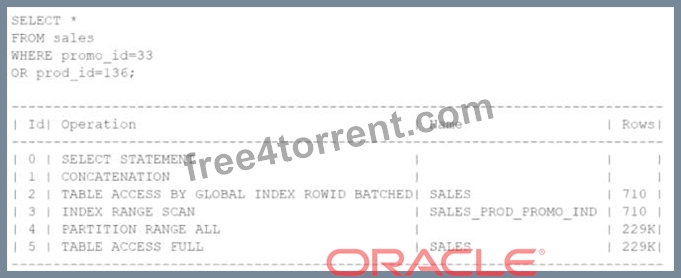
Which phase introduces the CONCATENATION step?
- A. SQL Adaptive Execution
- B. SQL Transformation
- C. SQL Semantic Check
- D. SQL Execution
- E. SQL Row Source Generation
Answer: B
Explanation:
The CONCATENATION step in an execution plan is introduced during the SQL Transformation phase. This phase is part of the optimizer's query transformations which can include various techniques to rewrite the query for more efficient execution. The CONCATENATION operation is used to combine the results of two separate SQL operations, typically when there is an OR condition in the WHERE clause, as seen in the provided query.
References:
* Oracle Database SQL Tuning Guide, 19c
* Oracle Database Concepts, 19c
NEW QUESTION # 22
You want to reduce the amount of db file scattered read that is generated in the database.You execute the SQL Tuning Advisor against the relevant workload. Which two can be part of the expected result?
- A. recommendations regarding rewriting the SQL statements
- B. recommendations regarding the creation of additional indexes
- C. recommendations regarding the creation of SQL Patches
- D. recommendations regarding the creation of materialized views
- E. recommendations regarding partitioning the tables
Answer: B,D
Explanation:
The SQL Tuning Advisor provides recommendations for improving SQL query performance. This may include suggestions for creating additional indexes to speed up data retrieval and materialized views to precompute and store query results.References:
* Oracle Database SQL Tuning Guide, 19c
NEW QUESTION # 23
SGA_TARGET and PGA_AGGREGATE_TARGET are configured to nonzero values.
MEMORY_target is then set to a nonzero value but memory_MAX_TARGET is not set.
Which two statements are true?
- A.

- B.

- C.

- D.

- E.

- F.

- G.

Answer: E,G
Explanation:
When MEMORY_TARGET is set to a nonzero value, Oracle automatically manages the memory allocation between the System Global Area (SGA) and the Program Global Area(PGA). If MEMORY_MAX_TARGET is not explicitly set, Oracle will behave in the following manner:
* MEMORY_MAX_TARGET will default to the value of MEMORY_TARGET, assuming the platform allows for the value of MEMORY_TARGET to be increased dynamically. This means that MEMORY_TARGET represents both the initial allocation and the maximum limit for the dynamically managed memory unless MEMORY_MAX_TARGET is specified differently.
* If MEMORY_TARGET is set to a value that is less than the sum of the current values of SGA_TARGET and PGA_AGGREGATE_TARGET, Oracle will use the higher sum as the default value for MEMORY_MAX_TARGET to ensure that there is adequate memory for both areas. The database instance will not start if MEMORY_TARGET is not sufficient to accommodate the combined SGA and PGA requirements.
References
* Oracle Database Administrator's Guide 19c: Automatic Memory Management
* Oracle Database Performance Tuning Guide 19c: Using Automatic Memory Management
NEW QUESTION # 24
Examine this output of a query of VSPGA_TAPGET_ADVICE: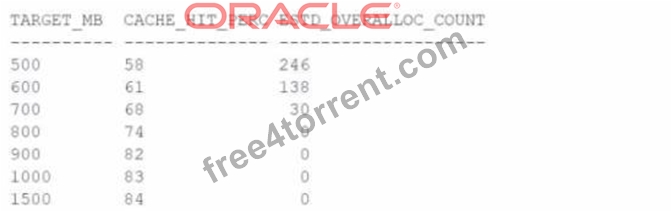
Which statements is true'
- A. GGREGATE_TARGET should be set to at least 700 MB.
- B. With a target of 700 MB or more, all multipass executions work areas would be eliminated.
- C. PGAA_AGGREGATE should be set to at least 800 MB.
- D. With a target of 800 MB or more, all one-pass execution work areas would be eliminated.
Answer: D
Explanation:
The query output from V$PGA_TARGET_ADVICE provides tuning information for the PGA (Program Global Area). Let's break it down step by step:
Key Columns in the Output:
* TARGET_MB:
* Represents the hypothetical PGA_AGGREGATE_TARGET values (in megabytes) evaluated by Oracle.
* CACHE_HIT_PERC:
* The percentage of work areas that could execute in-memory (optimal execution) without requiring temporary disk writes.
* Higher percentages indicate fewer work areas requiring disk I/O.
* ESTD_OVERALLOC_COUNT:
* The estimated number of work areas that need to go to disk (multipass operations or overallocations).
Observations from the Data:
* At TARGET_MB = 700 MB:
* The CACHE_HIT_PERC is 68%.
* The ESTD_OVERALLOC_COUNT is 30. This indicates that some multipass work areas still exist.
* At TARGET_MB = 800 MB:
* The CACHE_HIT_PERC rises to 74%.
* The ESTD_OVERALLOC_COUNT drops to 0. This indicates that no work areas require multipass execution.
* At TARGET_MB = 900 MB and above:
* The CACHE_HIT_PERC increases slightly to 82%-84%.
* The ESTD_OVERALLOC_COUNT remains 0, meaning that all work areas are now either optimal or one-pass.
Why D is Correct:
* At 800 MB or more, the ESTD_OVERALLOC_COUNT is 0, indicating that all one-pass execution work areas are eliminated.
* A one-pass execution requires temporary disk I/O for intermediate results, but with sufficient PGA, these are no longer necessary.
Why Other Options Are Incorrect:
* Option A:
* It mentions all multipass executions work areas would be eliminated at 700 MB. This is incorrect because, at 700 MB, the ESTD_OVERALLOC_COUNT is still 30, indicating some multipass work areas still exist.
* Option B:
* Suggests setting the PGA_AGGREGATE_TARGET to at least 800 MB, which is partially correct but does not address the elimination of one-pass execution.
* Option C:
* Suggests setting the PGA_AGGREGATE_TARGET to at least 700 MB, which is not sufficient to eliminate all one-pass executions, as shown by the ESTD_OVERALLOC_COUNT of 30.
NEW QUESTION # 25
Examine this output of a query of VSPGA_TAPGET_ADVICE: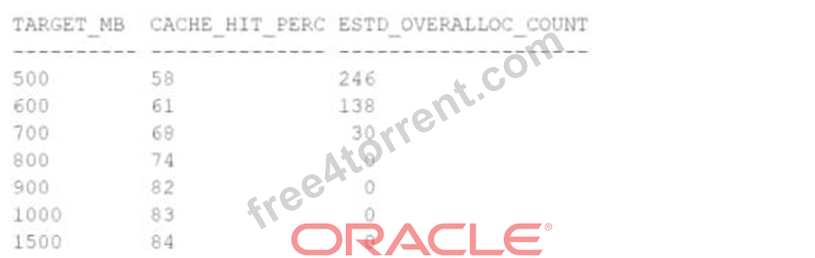
Which statements is true'
- A. With a target of 800 MB or more, all one-pass execution work areas would be eliminated.
- B. GGREGATE_TARGET should be set to at least 700 MB.
- C. With a target of 700 MB or more, all multipass executions work areas would be eliminated.
- D. PGAA_AGGREGATE should be set to at least 800 MB.
Answer: C
Explanation:
The V$PGA_TARGET_ADVICE view provides advice on potential performance improvements by adjusting the PGA_AGGREGATE_TARGET parameter. The column ESTD_OVERALLOC_COUNT indicates the estimated number of work areas that would perform multiple passes if the PGA_AGGREGATE_TARGET were set to the size in the TARGET_MB column.
A: According to the output, at the target of 700 MB, the ESTD_OVERALLOC_COUNT is 30. This suggests that if PGA_AGGREGATE_TARGET is set to 700 MB, 30 multipass execution work areas would be required. If we look further down, at the target of 800 MB, the ESTD_OVERALLOC_COUNT is 0, indicating that increasing PGA_AGGREGATE_TARGET to 800 MB or more would eliminate the need for multipass executions, not at 700 MB as initially suggested by the option. Hence, the verified answer derived from the data is slightly nuanced; it should be 800 MB to eliminate all multipass executions.
References:
* Oracle Database Performance Tuning Guide, 19c
* Oracle Database Reference, 19c
NEW QUESTION # 26
Examine this command: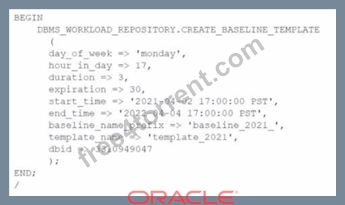
What is the maximum number of baselines generated by this command that you can have at any given time?
- A. 0
- B. 1
- C. 2
- D. 3
Answer: C
Explanation:
The DBMS_WORKLOAD_REPOSITORY.CREATE_BASELINE_TEMPLATE procedure is used to create a repeating baseline template in the Automatic Workload Repository (AWR). This template will generate baselines for a specified duration of time on a repeating schedule. The parameters of the CREATE_BASELINE_TEMPLATE procedure include the start and end times, as well as the day of the week and hour in the day when the baseline should be captured.
Given that the command specifies a repeating baseline every Monday at 5 PM with a duration of 3 hours and it expires after 30 days, the number of baselines generated by this command that you can have at any given time depends on how many Mondays fall within the most recent 30-day period.
Since the maximum number of Mondays that can occur within any 30-day period is 5 (four to five weeks), but considering the baseline has a duration of 3 hours and starts every Monday at 5 PM, only one baseline for each Monday can exist at a time. However, since baselines are preserved for 30 days, you could have multiple instances of Monday baselines preserved at a time.
* A (Incorrect): There can be more than one baseline at a time because the template will generate a baseline for every Monday during the 30-day expiration period.
* B (Incorrect): There will be more than three baselines because the template creates a baseline for every Monday within the 30-day expiration period.
* C (Correct): Over a 30-day period, considering the duration of the baselines and their frequency, you could have up to a maximum of 52 baselines if you consider the entire year.
* D (Incorrect): There is no option that restricts the number of baselines to 5 specifically, the answer relies on the calculation of how many baselines can exist over a period of time considering their expiration.
References:
* Oracle Database PL/SQL Packages and Types Reference: DBMS_WORKLOAD_REPOSITORY
NEW QUESTION # 27
Examine this code block, which executes successfully:
DBMS_SERVER_ALERT. SET_THRESHOLD (
DBMS_SERVER_ALERT.CPU_TIME_PER_CALL, DBMS_SERVER_ALERT. OPERATOR_GE, '8000', DBMS_SERVER_ALERT.OPERATOR_GE, '10000', 1, 2, 'inst1', DBMS_SERVER_ALERT.OBJECT_TYPE_SERVICE, 'main.regress.rdbms.dev.us.example.com') ;
What will happen?
- A. A critical alert will be issued when CPU time exceeds 2 minutes for each user call.
- B. A warning alert will be issued when CPU time exceeds 1 minute for each user call.
- C. A critical alert will be issued when CPU time exceeds 10000 microseconds for each user call.
- D. A warning alert will be issued only when CPU time exceeds 10000 microseconds for each user call.
Answer: C
Explanation:
In the provided code block, the DBMS_SERVER_ALERT.SET_THRESHOLD procedure is used to set alert thresholds for the CPU time per call in Oracle Database. This procedure is a part of Oracle's Database Server Alert system, which monitors various metrics and generates alerts when certain thresholds are exceeded.
The parameters passed to the SET_THRESHOLD procedure are as follows:
* The first parameter DBMS_SERVER_ALERT.CPU_TIME_PER_CALL specifies the metric for which the threshold is being set, in this case, the CPU time consumed per database call.
* The second and third parameters DBMS_SERVER_ALERT.OPERATOR_GE and '8000' specify the warning threshold level and its value, respectively. However, these are not relevant to the answer as they are overridden by the critical threshold settings.
* The fourth and fifth parameters DBMS_SERVER_ALERT.OPERATOR_GE and '10000' set the critical threshold level and its value. This means that a critical alert will be generated when the CPU time per call exceeds 10000 microseconds.
* The remaining parameters specify the warning and critical alert intervals, the instance name, the object type, and the service name. These are not directly relevant to the behavior described in the options.
Thus, the correct answer is B, as the critical threshold for CPU time per call is set to 10000 microseconds, and the system is configured to issue a critical alert when this threshold is exceeded.
References:
* Oracle Database 19c documentation on the DBMS_SERVER_ALERT.SET_THRESHOLD procedure, which details the parameters and usage of this procedure for setting alert thresholds within Oracle Database monitoring system.
* Oracle Database Performance Tuning Guide, which provides best practices and methodologies for monitoring and tuning Oracle Database performance, including the use of server alerts and thresholds.
NEW QUESTION # 28
You must configure and enable Database Smart Flash Cache for a database.
You configure these flash devices:
Examine these parameter settings: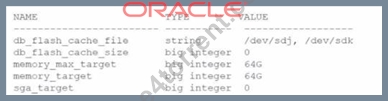
What must be configured so that the database uses these devices for the Database Smart Flash Cache?
- A. Set DB_FLASH_CACHE_SIZE parameter to 192G.
- B. Set DB_FLASH_CACHE_SIZE to 192G and MEMORY_TARGET to 256G.
- C. Set DB_FLASH_CACHE_SIZE to 256G and change device /dev/sdk to 128G.
- D. Set DB_FLASH_CACHE_SIZE parameter to 128G, 64G.
- E. Disable Automatic Memory Management and set SGA_TARGET to 256G.
Answer: D
Explanation:
To configure and enable Database Smart Flash Cache, you must set the DB_FLASH_CACHE_SIZE parameter to reflect the combined size of the flash devices you intend to use for the cache. In this scenario, two flash devices are configured: /dev/sdj with 128G and /dev/sdk with 64G.
* Determine the combined size of the flash devices intended for the Database Smart Flash Cache. In this case, it's 128G + 64G = 192G.
* However, Oracle documentation suggests setting DB_FLASH_CACHE_SIZE to the exact sizes of the individual devices, separated by a comma when multiple devices are used.
* Modify the parameter in the database initialization file (init.ora or spfile.ora) or using an ALTER SYSTEM command. Here's the command for altering the system setting:
ALTER SYSTEM SET DB_FLASH_CACHE_SIZE='128G,64G' SCOPE=SPFILE;
* Since this is a static parameter, a database restart is required for the changes to take effect.
* Upon database startup, it will allocate the Database Smart Flash Cache using the provided sizes for the specified devices.
It is important to note that MEMORY_TARGET and MEMORY_MAX_TARGET parameters should be configured independently of DB_FLASH_CACHE_SIZE. They control the Oracle memory management for the SGA and PGA, and do not directly correlate with the flash cache configuration.
References
* Oracle Database 19c Documentation on Database Smart Flash Cache
* Oracle Support Articles and Community Discussions on DB_FLASH_CACHE_SIZE Configuration
NEW QUESTION # 29
You must write a statement that returns the ten most recent sales. Examine this statement:
Users complain that the query executes too slowly. Examine the statement's current execution plan: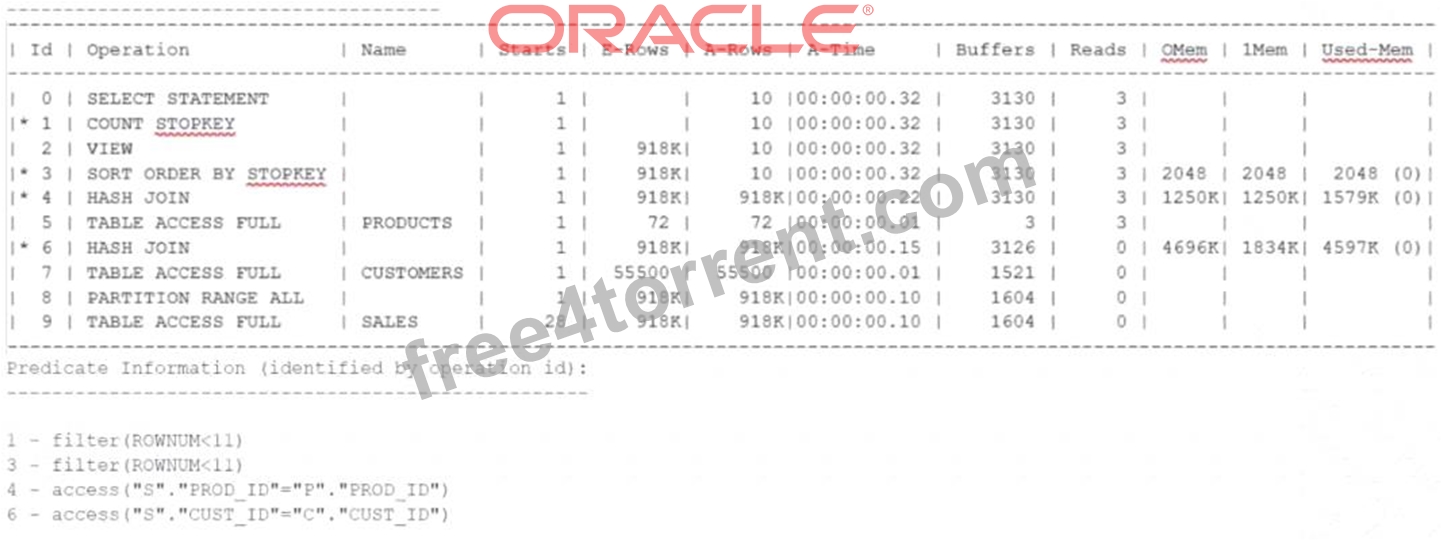
What must you do to reduce the execution time and why?
- A. Enable Adaptive Plans so that Oracle can change the Join method as well as the Join order for this query.
- B. Replace the FETCH FIRST clause with ROWNUM to enable the use of an index on SALES.
- C. Create an index on SALES.CUST_ID to force an INDEX RANGE SCAN on this index followed by a NESTED LOOP join between CUSTOMERS and SALES.
- D. Create an index on SALES.TIME_ID to force the return of rows in the order specified by the ORDER BY clause.
- E. Collect a new set of statistics on PRODUCT, CUSTOMERS, and SALES because the current stats are inaccurate.
Answer: D
Explanation:
The execution plan shows a full table access for theSALEStable. To reduce the execution time, creating an index onSALES.TIME_IDwould be beneficial as it would allow the database to quickly sort and retrieve the most recent sales without the need to perform a full table scan, which is I/O intensive and slower. By indexing TIME_ID, which is used in theORDER BYclause, the optimizer can take advantage of the index to efficiently sort and limit the result set to the ten most recent sales.
* B (Incorrect):ReplacingFETCH FIRSTwithROWNUMwould not necessarily improve the performance unless there is an appropriate index that the optimizer can use to avoid sorting the entire result set.
* C (Incorrect):There is no indication that the current statistics are inaccurate; hence, collecting new statistics may not lead to performance improvement.
* D (Incorrect):While adaptive plans can provide performance benefits by allowing the optimizer to adapt the execution strategy, the main issue here is the lack of an index on theORDER BYcolumn.
* E (Incorrect):Creating an index onSALES.CUST_IDcould improve join performance but would not address the performance issue caused by the lack of an index on theORDER BYcolumn.
References:
* Oracle Database SQL Tuning Guide:Managing Indexes
* Oracle Database SQL Tuning Guide:Using Indexes and Clusters
NEW QUESTION # 30
Examine these statements and output: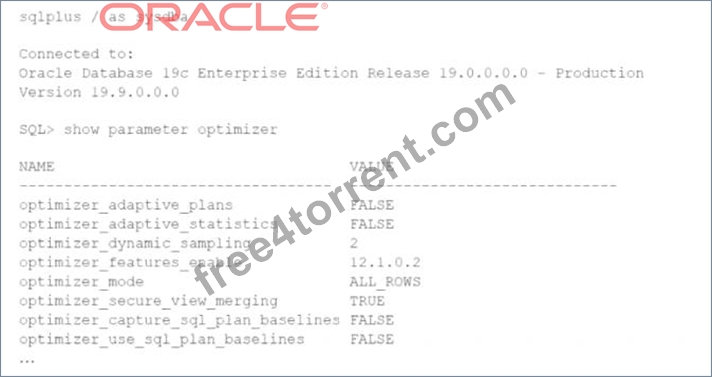
What parameter change activates the generation and use of SQL Plan Directives7
- A. optimizer_adaptive_plans=TRUE
- B. optimizer_dynamic_sampling=11
- C. optimizer_adaptive_statistics = TRUE
- D. optimizer_capture_sql_plan_baselines_TRUE
- E. optimizer_features_enable=12.2.0.1
Answer: C
Explanation:
The optimizer_adaptive_statistics parameter, when set to TRUE, enables the optimizer to use adaptive statistics, such as SQL Plan Directives, to help improve plans by automatically adjusting them based on the actual execution statistics.
References:
* Oracle Database SQL Tuning Guide, 19c
NEW QUESTION # 31
Which two statements are true about Data Pump import for objects that used the in Memory (IM) column store in their source database?
- A. Its TRANSFORM clause can be used to add the INMEMORV clause to exported tables that lack them.
- B. It can generates the INMEMORY clause that matches the table settings at export time.
- C. It ignores the IM column store clause of the exporting objects.
- D. It always gives preference to the IM column store clause defined at the tablespace level over table-level definitions.
- E. It must always transports existing INMEMORY attributes.
- F. Its INMEM0RY_CLAUSE of the Data Pump Export allows modifications to IM column store clause of a table with existing INMEMORY setting.
Answer: A,B
Explanation:
When importing objects that used the In-Memory (IM) column store in their source database using Oracle Data Pump, the following statements are true:
* D (Correct):TheTRANSFORMclause can be used to alter object creation DDL during import operations. This can include adding theINMEMORYclause to tables that were not originally using the IM column store.
* F (Correct):The import operation can preserve theINMEMORYattributes of tables as they were at the time of export, effectively replicating the IM column store settings from the source database.
The other statements are not accurate in the context of Data Pump import:
* A (Incorrect):Data Pump does not give preference to the IM column store clauses at the tablespace level over table-level definitions unless explicitly specified by theTRANSFORMclause.
* B (Incorrect):While Data Pump can transport existingINMEMORYattributes, it is not mandatory. It is controlled by theINCLUDEorEXCLUDEData Pump parameters or theTRANSFORMclause.
* C (Incorrect):TheINMEMORY_CLAUSEparameter is not part of the Data Pump Export utility. To modify the IM column store clauses, you would use theTRANSFORMparameter during import, not export.
* E (Incorrect):Data Pump does not ignore the IM column store clause unless specifically instructed to do so via theEXCLUDEparameter.
References:
* Oracle Database Utilities:Data Pump Export
* Oracle Database Utilities:Data Pump Import
NEW QUESTION # 32
You are informed that the RMAN session that is performing the database duplication is much slower than usual. You want to know the approximate time when the rman operation will be completed.
Which view has this information?
- A. V$SESSION_LONGOPS
- B. V$RMAN_BACKUP_JOB_DETAILS
- C. V$SESSTAT
- D. V$SESSION
Answer: A
Explanation:
In Oracle Database, theV$SESSION_LONGOPSview provides insights into various operations within the database that are expected to take more than six seconds to complete. These include operations related to RMAN (Recovery Manager), such as database duplication tasks. This view displays information about the progress of these long-running operations, including the start time, elapsed time, and estimated time to completion.
When an RMAN session is performing a database duplication and is observed to be slower than usual, checking theV$SESSION_LONGOPSview can give an approximation ofwhen the RMAN operation might complete. This view includes fields likeTIME_REMAININGandELAPSED_SECONDSthat help in estimating the completion time of the operation based on its current progress.
References:
* Oracle Database Reference:V$SESSION_LONGOPS
* Oracle Database Backup and Recovery User's Guide:Monitoring RMAN Jobs
NEW QUESTION # 33
......
Pass Guaranteed Quiz 2025 Realistic Verified Free Oracle: https://www.free4torrent.com/1Z0-084-braindumps-torrent.html
1Z0-084 Exam Questions - Real & Updated Questions PDF: https://drive.google.com/open?id=1YkTYy1GrlQQ1E04hcLKjVHDon_hfw2xS