

[Jun-2026] XK0-006 Dumps are Available for Instant Access using Free4Torrent
XK0-006 Dumps 2026 - New CompTIA XK0-006 Exam Questions
NEW QUESTION # 22
A Linux administrator needs to add a new HTTP service on the server. Which of the following commands allows other systems to communicate with the service after the system is restarted?
- A. firewall-cmd --add-service=http
- B. firewall-cmd --add-service=http --reload
- C. firewall-cmd --add-service=http --permanent
- D. firewall-cmd --add-port=http --complete-reload
Answer: C
Explanation:
This command adds the HTTP service to the firewall's permanent configuration, ensuring the rule persists across system restarts and allows other systems to communicate with the service after reboot.
NEW QUESTION # 23
A Linux systems administrator is resolving a privileged access issue for users who are members of an admin group. Which of the following configuration files should the administrator update so the users in the admin group will have root privileged access to the Linux system?
- A. /etc/group
- B. /etc/shadow
- C. /etc/login.defs
- D. /etc/sudoers
Answer: D
Explanation:
The /etc/sudoersfile controls which users and groups can elevate privileges via sudo. By adding a line such as %admin ALL=(ALL) ALLto /etc/sudoers, members of the admin group gain root-level access.
NEW QUESTION # 24
A systems administrator needs to check the statuses of all the services on a Linux server. Which of the following commands accomplishes this task?
- A. systemctl is-active --services
- B. systemctl list-sockets --type=services
- C. systemctl is-enabled --services
- D. systemctl list-units --type=services
Answer: D
Explanation:
Service management using systemd is a core Linux+ V8 system management objective. Administrators frequently need to view the current status of all services to determine which ones are running, stopped, failed, or inactive.
The correct command is systemctl list-units --type=services, which displays all loaded service units along with their current state, including whether they are active, inactive, failed, or running. This provides a comprehensive, real-time view of service statuses on the system and is commonly used during troubleshooting and audits.
Option A, systemctl is-active, is designed to check the status of a single service, not all services. Option B lists socket units, not services. Option C, systemctl is-enabled, checks whether services are enabled at boot, not whether they are currently running.
Linux+ V8 documentation explicitly references systemctl list-units --type=service as the primary command for viewing service runtime states. Therefore, the correct answer is D.
NEW QUESTION # 25
An
administrator is investigating the reason a Linux workstation is not resolving the website http://www.comptia.
org. The administrator executes some commands and receives the following output: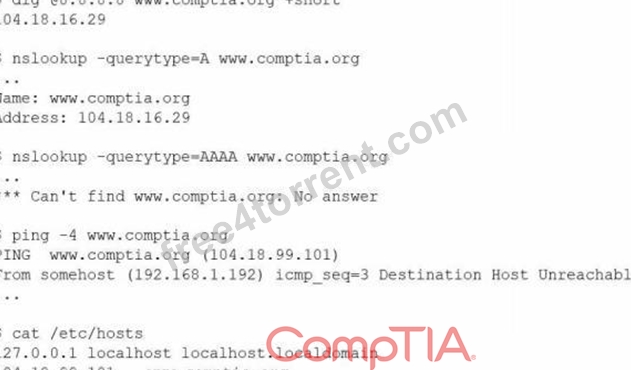
Which of the following is the most likely cause?
- A. The remote website does not support IPv6, and the workstation requires it.
- B. The firewall needs to be modified to allow outbound HTTP and HTTPS.
- C. The static entry needs to be removed from /etc/hosts.
- D. The nameserver in /etc/resolv.conf needs to be updated to 8.8.8.8
Answer: C
Explanation:
When troubleshooting name resolution issues in Linux, /etc/hosts entries take precedence over DNS lookups.
The workstation's /etc/hosts file contains the line:
CopyEdit
104.18.99.101 www.comptia.org
This means any attempt to access www.comptia.org will resolve to 104.18.99.101, regardless of the real DNS response. However, both dig and nslookup show the correct IP as 104.18.16.29. Because the local /etc/hosts entry overrides DNS, and the hardcoded IP is either incorrect or unreachable, all network traffic to www.
comptia.org will fail or not reach the intended destination, resulting in the observed connectivity issue (Destination Host Unreachable).
Other options:
* B. The lack of IPv6 support is irrelevant since the host is using IPv4 and the DNS queries for IPv4 (A record) are successful.
* C. The firewall would block all HTTP/HTTPS connections, but the error shown is a host unreachable, not a port-specific issue.
* D. The nameserver is working; both dig and nslookup queries succeed and return the correct A record.
Reference:
CompTIA Linux+ Study Guide: Exam XK0-006, Sybex, Chapter 8: "Networking Fundamentals", Section:
"Troubleshooting Name Resolution"
CompTIA Linux+ XK0-006 Objectives, Domain 2.0: Networking
NEW QUESTION # 26
A Linux administrator is updating the group membership by executing the following commands: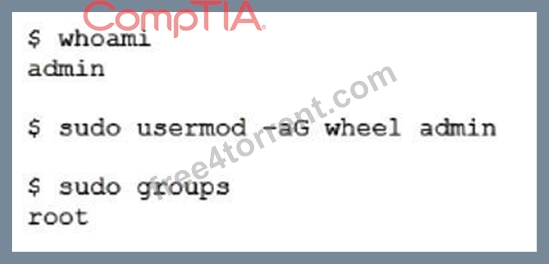
However, the group membership is not changing. Which of the following explains this issue?
- A. Users cannot be added to the wheelgroup with the usermodcommand.
- B. The options wheeland adminare transposed.
- C. The command groupswas run with sudoprivileges.
- D. Executing usermodwith sudois not permitted.
Answer: C
Explanation:
Running groups with sudo shows the groups for the root user, not for the admin user. That's why the output only shows root. Without sudo, groups admin (or re-login) would correctly show the updated group membership, including wheel.
NEW QUESTION # 27
While hardening a system, an administrator runs a port scan with Nmap, which returned the following output: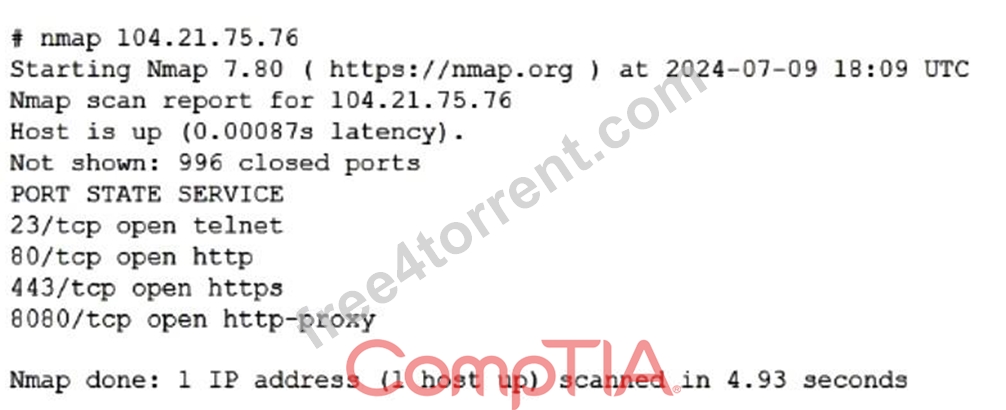
Which of the following is the best way to address this security issue?
- A. Disabling and removing the Telnet service on the server
- B. Closing port 80 on the network switch to block traffic
- C. Changing the systems administrator's password to prevent unauthorized access
- D. Configuring a firewall to block traffic on port 23 on the server
Answer: A
Explanation:
Port 23/tcp indicates Telnet, which is insecure because it transmits data in plaintext. The best hardening approach is to disable and remove the Telnet service entirely, eliminating the vulnerability rather than just blocking it at the firewall. Secure alternatives like SSH should be used instead.
NEW QUESTION # 28
Users are unable to access a server after it is restarted. However, an administrator is able to connect directly to the server through a console in the server room and sees the following: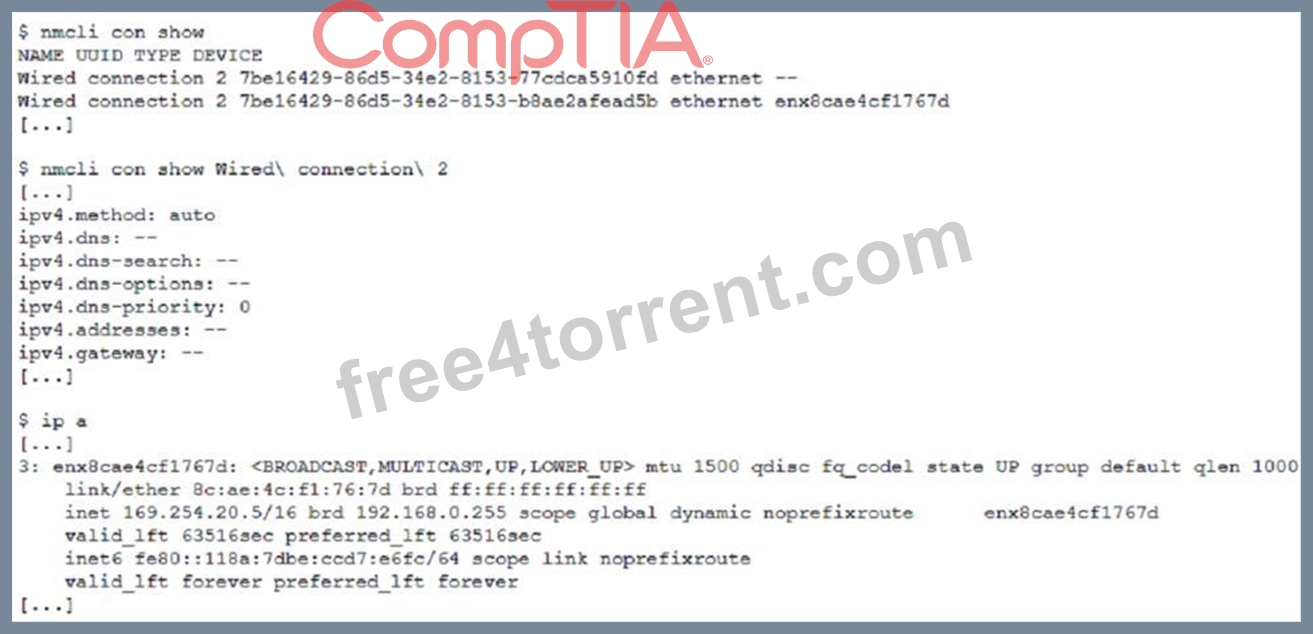
Which of the following is the most likely reason for this connectivity issue?
- A. The server networking cable is plugged into the wrong interface and needs to be moved
- B. The server is not able to obtain an IP address from the DHCP server
- C. The server has no issue with the network and should be restarted to restore functionality
- D. The server's network card has failed and will need to be replaced with a new networking card
Answer: B
Explanation:
The interface has a 169.254.x.x address, which is a link-local address typically assigned when DHCP fails. This indicates the server is not receiving a valid IP address from the DHCP server after the restart.
NEW QUESTION # 29
Which of the following is an example of responsible use of publicly available generative AI by a systems administrator?
- A. Linting of proprietary source code stored in the Git repository
- B. Generating regular expressions based on anonymized data
- C. Fixing typos and styles in medical documentation files
- D. Reviewing the security of server configuration files
Answer: B
Explanation:
Using anonymized data ensures that no sensitive or proprietary information is exposed while still allowing the administrator to benefit from generative AI for tasks such as creating regular expressions.
NEW QUESTION # 30
A systems administrator is experiencing local network connectivity issues. The administrator gathers the following outputs: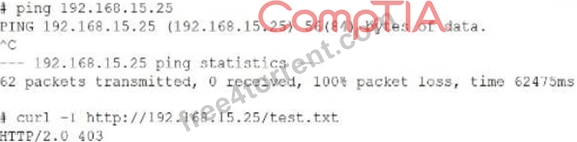
Which of the following conclusions can the systems administrator make?
- A. The web server must be restarted
- B. The remote server is denying TCP traffic on port 8.
- C. The remote server is blocking ICMP requests.
- D. The remote server is configured to only use IPv6.
Answer: C
Explanation:
The ping test shows 100% packet loss, indicating that ICMP echo requests are not being answered, while the HTTP request successfully reaches the server and returns a response. This confirms that the remote server is reachable but is configured to block ICMP requests.
NEW QUESTION # 31
A Linux user runs the following command:
nohup ping comptia.com &
Which of the following commands should the user execute to attach the process to the current terminal?
- A. renice
- B. exec
- C. fg
- D. jobs
Answer: C
Explanation:
The fg command brings a background job to the foreground, attaching it to the current terminal.
Since the ping process was started in the background with &, fg is the correct way to reattach it.
NEW QUESTION # 32
Which of the following is the main reason for setting up password expiry policies?
- A. To avoid using the same passwords repeatedly
- B. To mitigate the use of exposed passwords
- C. To force usage of passwordless authentication
- D. To increase password strength and complexity
Answer: B
Explanation:
Password expiry policies ensure that even if a password has been compromised, its period of validity is limited, reducing the risk of long-term unauthorized access.
NEW QUESTION # 33
Which of the following actions is required to establish passwordless SSH authentication?
- A. Copy the public SSH key to the remote server.
- B. Copy the private SSH key to the remote server.
- C. Copy the public and private keys to the remote server.
- D. Generate public and private keys on the remote server.
Answer: A
Explanation:
Copying the public SSH key to the remote server's authorized_keys file is all that's needed to enable passwordless SSH authentication.
NEW QUESTION # 34
A Linux administrator attempts to log in to a server over SSH as root and receives the following error message: Permission denied, please try again. The administrator is able to log in to the console of the server directly with root and confirms the password is correct. The administrator reviews the configuration of the SSH service and gets the following output: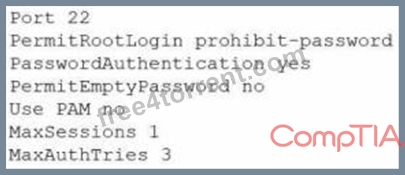
Based on the above output, which of the following will most likely allow the administrator to log in over SSH to the server?
- A. Use a key to log in as root over SSH.
- B. Log out other user sessions because only one is allowed at a time.
- C. Enable PAM and configure the SSH module.
- D. Modify the SSH port to use 2222.
Answer: A
Explanation:
The SSH configuration option PermitRootLogin prohibit-password prevents the root user from logging in with password authentication. This setting means root cannot use a password to log in via SSH; only key- based authentication is permitted for root. The administrator can still log in as root locally, which is not affected by this SSH configuration. To allow SSH access as root, the administrator must use an SSH key instead of a password.
Other options:
* A. MaxSessions controls the number of simultaneous SSH sessions but is not causing the login denial here.
* B. PAM (Pluggable Authentication Modules) is disabled, but enabling it is not required for basic SSH authentication.
* C. Changing the SSH port is unrelated to the authentication method issue.
Reference:
CompTIA Linux+ Study Guide: Exam XK0-006, Sybex, Chapter 11: "Securing Linux", Section: "Securing SSH Access" CompTIA Linux+ XK0-006 Objectives, Domain 3.0: Security
NEW QUESTION # 35
A systems administrator is reconfiguring existing user accounts in a Linux system. Which of the following commands should the administrator use to include "myuser" in the finance group?
- A. groupmod finance myuser
- B. usermod -aG finance myuser
- C. groupadd finance myuser
- D. useradd -g finance myuser
Answer: B
Explanation:
Comprehensive and Detailed Explanation From Exact Extract:
To add an existing user (myuser) to an existing group (finance) without removing them from other groups, the correct command is usermod -aG finance myuser. The -aG option appends the user to the supplementary group (s) specified.
Other options:
* A. groupadd is for creating new groups, not adding users to groups.
* B. groupmod is for modifying group properties, not user membership.
* C. useradd creates new users; not applicable to existing users.
Reference:
CompTIA Linux+ Study Guide: Exam XK0-006, Sybex, Chapter 6: "User and Group Management", Section:
"Modifying Group Membership"
CompTIA Linux+ XK0-006 Objectives, Domain 1.0: System Management
NEW QUESTION # 36
A Linux server is not starting up because files in the /boot/partition are corrupt. After the initial GRUB screen, the following message is displayed:
Probing EDD (edd=off to disable)... ok
uncompression error
--system halted
Which of the following steps should the Linux administrator take to recover the system without destroying the existing installation? (Choose two.)
- A. Start up the system using rescue boot media.
- B. Reinstall the OS.
- C. Increase the amount of swap memory.
- D. Reinstall the kernel packages.
- E. Replace the hard drive.
- F. Start up in single-user mode.
Answer: A,D
Explanation:
Using rescue boot media lets you boot the machine, mount the existing partitions, and access the corrupted /boot files without reinstalling the OS.
Reinstalling the kernel packages restores the missing or corrupt files in /boot (e.g., vmlinuz and initramfs), allowing GRUB to load and uncompress the kernel properly.
NEW QUESTION # 37
A Linux user frequently tests shell scripts located in the /home/user/scripts directory. Which of the following commands allows the user to run the program by invoking only the script name?
- A. export TERM=$TERM=/home/user/scripts
- B. export SHELL=$SHELL=/home/user/scripts
- C. export alias /home/user/scripts='/bin'
- D. export PATH=$PATH:/home/user/scripts
Answer: D
Explanation:
In Linux, the ability to execute a program by typing only its name depends on whether the directory containing the executable is included in the user's PATH environment variable. The PATH variable defines a colon-separated list of directories that the shell searches when a command is entered.
Option C, export PATH=$PATH:/home/user/scripts, correctly appends the /home/user/scripts directory to the existing PATH variable. Once this command is executed, any executable script located in that directory can be run simply by typing its filename, provided the script has execute permissions. This behavior is explicitly covered in the Linux+ V8 objectives related to environment variables and shell configuration.
The other options are incorrect. Option A incorrectly attempts to redefine the SHELL variable and uses invalid syntax. Option B modifies the TERM variable, which controls terminal type and has nothing to do with command execution. Option D attempts to create an alias using invalid syntax and would not affect command lookup behavior.
Linux+ V8 documentation emphasizes modifying the PATH variable as the standard and recommended method for simplifying script execution. This approach is commonly used by developers and administrators who frequently run custom scripts.
Therefore, the correct answer is C.
NEW QUESTION # 38
A systems administrator is preparing a Linux system for application setup. The administrator needs to create an environment variable with a persistent value in one of the user accounts. Which of the following commands should the administrator use for this task?
- A. export "VAR=SomeValue" >> ~/.ssh/profile
- B. export VAR=value
- C. echo "export VAR=value" >> ~/.bashrc
- D. VAR=value
Answer: C
Explanation:
Environment variables are widely used in Linux systems to configure application behavior, and Linux+ V8 emphasizes the distinction between temporary and persistent variables. A variable is persistent only if it is defined in a shell initialization file.
The correct approach is echo "export VAR=value" >> ~/.bashrc. This command appends the variable definition to the user's .bashrc file, ensuring the variable is set automatically every time the user starts a new shell session. This makes the variable persistent for that specific user.
Options B and C only define variables in the current shell session and are lost when the session ends. Option A incorrectly targets the SSH configuration directory and is not appropriate for defining shell environment variables.
Linux+ V8 documentation highlights .bashrc, .bash_profile, and /etc/profile as correct locations for persistent environment variables. Therefore, the correct answer is D.
NEW QUESTION # 39
Following the completion of monthly server patching, a Linux administrator receives reports that a critical application is not functioning. Which of the following commands should help the administrator determine which packages were installed?
- A. dnf info
- B. dnf search
- C. dnf list
- D. dnf history
Answer: D
Explanation:
The dnf history command shows a log of past package operations (install, update, remove), allowing the administrator to review which packages were installed or updated during the patching process.
NEW QUESTION # 40
Which of the following is the first step when starting a new Python project on a Linux system?
- A. export PYTHON_PATH:/path/to/project
- B. python -m venv /path/to/project
- C. python -m pip install -r /path/to/project
- D. python -m source /path/to/project
Answer: B
Explanation:
Creating a virtual environment is the first step because it provides an isolated Python runtime for the project, allowing dependencies to be managed independently without affecting the system- wide Python installation.
NEW QUESTION # 41
Which of the following commands should a Linux administrator use to determine the version of a kernel module?
- A. depmod bluetooth
- B. modinfo bluetooth
- C. modprobe bluetooth
- D. lsmod bluetooth
Answer: B
Explanation:
The modinfo command displays detailed information about a kernel module, including its version, author, description, and parameters.
NEW QUESTION # 42
A Linux administrator needs to create accounts for a list of new users. The user account names have been defined in the user LIST variable by executing the following:
USER_LIST="alice bob charles"
Which of the following commands should the administrator use to successfully create the user accounts?
- A. echo "$USER_LIST" | until username; do useradd -m "$username"; done
- B. echo "$USER LIST" | while username; do useradd -m "$username"; done
- C. for username in $USER_LIST; do useradd -m "$username"; done
- D. select username in "$USER_LIST"; do useradd -m $username"; done
Answer: C
Explanation:
This command iterates over each username stored in the variable and executes the account creation command for each entry, which is the correct and reliable way to create multiple user accounts from a list in a shell script.
NEW QUESTION # 43
In the echo "profile-$num-$name"line of a shell script, the variable $numseems to not be expanding during execution. Which of the following notations ensures the value is expanded?
- A. echo "profile-${num}-$name"
- B. echo "profile-$(num)-$name"
- C. echo 'profile-$num-$name'
- D. echo "profile-'Snum'-$name"
Answer: A
Explanation:
Using ${num} ensures correct variable expansion, especially when variables are adjacent to other characters or hyphens. This prevents ambiguity and guarantees $num is properly expanded within the string.
NEW QUESTION # 44
A systems administrator must provide privileged access to a specific user in a Linux system.
Which of the following commands should the administrator use?
- A. visudo username
- B. usermod -aG sudo username
- C. sed -i 's/username/root/' /etc/passwd
- D. echo username >> /etc/sudoers.d/privileged
Answer: B
Explanation:
Adding the user to the sudo group grants privileged access by allowing the user to execute commands with elevated permissions through sudo, which is the standard and supported method on Linux systems.
NEW QUESTION # 45
Which of the following is a protocol for accessing distributed directory services containing a hierarchy of users, groups, machines, and organizational units?
- A. TLS
- B. LDAP
- C. SMB
- D. KRB-5
Answer: B
Explanation:
Directory services are a key part of enterprise Linux environments and are covered under the Security domain in Linux+ V8. The Lightweight Directory Access Protocol (LDAP) is specifically designed to access and manage distributed directory information.
LDAP directories store structured, hierarchical data such as users, groups, computers, and organizational units. Linux systems commonly use LDAP for centralized authentication, authorization, and identity management. LDAP is also the foundation for services like Active Directory and FreeIPA.
The other options are incorrect. SMB is a file and printer sharing protocol. TLS is an encryption protocol used to secure communications. Kerberos (KRB-5) is an authentication protocol often used alongside LDAP but does not store directory information itself.
Linux+ V8 documentation highlights LDAP as the primary protocol for directory-based identity services.
Therefore, the correct answer is C.
NEW QUESTION # 46
......
CompTIA XK0-006 Exam Practice Test Questions: https://www.free4torrent.com/XK0-006-braindumps-torrent.html
Free XK0-006 Braindumps Download Updated: https://drive.google.com/open?id=1-FJRhNnXPcqF0xI1tEWGJyEVNbQtvnyQ