

[Jun 24, 2025] Health-Cloud-Accredited-Professional Sample with Accurate & Updated Questions
Health-Cloud-Accredited-Professional Exam Info and Free Practice Test | Free4Torrent
Salesforce Health Cloud Accredited Professional exam is a certification program designed for healthcare professionals who want to demonstrate their knowledge and expertise in using Salesforce Health Cloud. Salesforce Health Cloud Accredited Professional certification validates the skills needed to implement, configure, and manage Health Cloud solutions for healthcare organizations. Health-Cloud-Accredited-Professional exam is designed to test professionals on their knowledge and understanding of Health Cloud data models, security and access control, data integration, and data migration.
NEW QUESTION # 19
A clinic is looking to manage its associated physicians within Health Cloud.
Which two objects support Salesforce's recommended approach to model the doctors in the clinic's Health Cloud org?
- A. Person Account
- B. Healthcare Provider
- C. Healthcare Practitioner
- D. Contact
Answer: C,D
Explanation:
The two objects that support Salesforce's recommended approach to model the doctors in the clinic's Health Cloud org are Contact and Healthcare Practitioner. Contact is used to store the personal information of the doctor, such as name, phone, and email. Healthcare Practitioner is used to store the professional information of the doctor, such as specialty, license, and credentials.
NEW QUESTION # 20
When setting up Intelligent Sales, which three types of records should an administrator create for a Field Sales Agent before Visit records can be created? (Choose three.)
- A. Assets
- B. Opportunities
- C. Contacts
- D. Locations
- E. Accounts
Answer: A,C,D
Explanation:
To create Visit records for a Field Sales Agent using Intelligent Sales, the administrator must create Contacts, Locations, and Assets records for the agent. Contacts are the people that the agent visits or interacts with during their sales cycle. Locations are the places where the agent conducts their visits or activities. Assets are the products or devices that the agent sells or services during their visits. Opportunities and Accounts are not required for creating Visit records using Intelligent Sales.
NEW QUESTION # 21
Which underlying object helps with sales compliance with sales agreements?
- A. Orders
- B. Forecasts
- C. Contacts
- D. Opportunities
Answer: A
Explanation:
Reference and details below.
NEW QUESTION # 22
A payer needs to manage requests for concurrent review of prior authorizations within Health Cloud and wants to use out-of-the-box record types and page layouts. However, the payer's Salesforce administrator does not see any preconfigured record types or page layouts for prior authorizations in the payer's Salesforce org.
What should a consultant recommend to the Salesforce administrator to expedite implementation?
- A. Install an AppExchange prior authorization package.
- B. Build custom page layouts and record types to support the requirement.
- C. Install the Health Cloud Claims unmanaged package.
- D. Install the Health Cloud Care Request Extensions package.
Answer: D
Explanation:
The Health Cloud Care Request Extensions package provides out-of-the-box record types and page layouts for prior authorizations, as well as other features for managing care requests1.
NEW QUESTION # 23
Which two interoperability standards are support by salesforce to facilitate the exchange of health data? (Choose two)?
- A. The Direct Standard
- B. FHIR V4( Fast Healthcare interoperability Resources)
- C. EDI ANSI X1- Recall Concept/Remainder 2
- D. HL7 V2- Simple Application3 - Apply to real word/Analyze / Evaluate(Health Level Seven)
- E. DICOM (Digital Imaging and communications In Medicine
Answer: B,D
Explanation:
FHIR V4 and HL7 V2 are two interoperability standards that are supported by Salesforce to facilitate the exchange of health data32. Option A is incorrect, because EDI ANSI X12 is a standard for exchanging business transactions, not health data. Option C is incorrect, because The Direct Standard is a standard for secure email communication, not health data. Option E is incorrect, because DICOM (Digital Imaging and Communications in Medicine) is a standard for storing and transmitting medical images, not health data.
NEW QUESTION # 24
Bloomington Caregivers has created and tested its first care plan template in a sandbox, Which includes problems, goals, and tasks. The company has deployed this template to its final environment using Data Loader.
Which two steps should a consultant recommend, following this deployment, to enable users to successfully leverage this new template?
- A. Activate the new care plan template.
- B. Confirm User access to Care plan objects.
- C. Conduct end-user training O he use of the care plan template.
- D. Activate the problems; goals, and tasks associated with the template.
Answer: A,B
Explanation:
After deploying a care plan template from a sandbox to a final environment using Data Loader, the consultant should recommend the following two steps to enable users to successfully leverage the new template:
Confirm User access to Care plan objects: The consultant should ensure that the users have the appropriate permissions and sharing settings to access the care plan objects, such as Care Plan Template, Care Plan Template Problem, Care Plan Template Goal, and Care Plan Template Task1. The users should also have access to the parent records of the care plan objects, such as Account or Contact2.
Activate the new care plan template: The consultant should activate the new care plan template by changing its status from Draft to Active3. This will make the template available for users to apply to their patients. The consultant does not need to activate the problems, goals, and tasks associated with the template separately, as they are automatically activated when the template is activated3.
Reference:
1: Permissions Required for Care Plans - Salesforce 2: Give Caseworkers Access to Goal Assignments and Benefit Assignments Related to Care Plans - Salesforce 3: Create a Care Plan Template - Salesforce
NEW QUESTION # 25
Which three options explain why the new clinical data model in Health Cloud is labeled as FHIR aligned and not FHIR compliant? (Choose three)
- A. Some entitles have additional non-FHIR attributes to increase the usability of the data within Salesforce.
- B. Not all attributes in a given FHIR resource may be supported.
- C. It does not utilize the latest FHIR R4 standards.
- D. It only aligns with FHIR 0STU2 specs.
- E. The cardinality of a few attributes has been changed (e.g. in picklist scenarios)
Answer: A,B,E
NEW QUESTION # 26
Which two interoperability standards are support by salesforce to facilitate the exchange of health data?
(Choose two)?
- A. DICOM (Digital Imaging and communications In Medicine
- B. FHIR V4( Fast Healthcare interoperability Resources)
- C. EDI ANSI X1- Recall Concept/Remainder 2
- D. The Direct Standard
D HL7 V2- Simple Application3 - Apply to real word/Analyze / Evaluate(Health Level Seven)
Answer: A,B
NEW QUESTION # 27
Bloomington Caregivers has more than 1 million patients and each patient has an average of 10 claims a year, which are maintained in an external claims system. Management would like their agents to view all the claims of patients in Salesforce on demand when they open the patient's record.
What should a consultant recommend as the appropriate integration pattern to achieve this?
- A. Add a nightly job to fetch all the claims from the external system and store them In Salesforce.
- B. Make a callout on demand to the external system and store the claims data against the patient record.
- C. Configure the claims system as an external data source and leverage external objects with the claims data.
- D. Use an Enterprise Service Bus (ESB) to load all the claims data from the external system into Salesforce.
Answer: C
Explanation:
Using External Objects is the most efficient integration pattern for managing large volumes of data, such as claims. In this scenario, the claims data resides in an external system, and fetching 10 million records annually into Salesforce is neither scalable nor cost-effective. External Objects allow Salesforce users to access the data on demand without storing it in Salesforce.
Key Features of External Objects:
Real-Time Access: Fetches claims data directly from the external system when a patient's record is accessed.
Storage Efficiency: Avoids consuming Salesforce storage limits by not importing the data.
Flexible Integration: External data sources such as OData can be configured to integrate with Salesforce.
Why Other Options Are Incorrect:
A . Nightly Job: Importing all claims into Salesforce daily would require excessive storage and processing resources.
B . ESB Load: Loading claims into Salesforce via an ESB introduces similar storage concerns as Option A.
C . Callout on Demand: While possible, storing claims data in Salesforce after a callout defeats the purpose of on-demand integration.
Reference:
External Objects in Salesforce
Integrating External Data with Salesforce Connect
NEW QUESTION # 28
A pharma company wants the ability to:
* Upload a patient's insurance card, including automatic Member Plan record creation
* Run a benefits verification check
* Schedule on behalf of the patient with a provider
Which set of Health Cloud capabilities should enable the company to build this business process?
- A. Intelligent Appointment Management, Benefits Verification, Intelligent Document Automation, eFax Integration
- B. Inte,l'9ent Document Automation, Intelligent Appointment Management, Intelligent Document Reader, Benefits Verification
- C. Virtual Care, Intelligent Appointment Management, Intelligent Document Automation, Intelligent Document Reader
- D. Utilization Management, Care Management, Intelligent Document Automation, Intelligent Appointment Management
Answer: B
Explanation:
The business process requires a combination of capabilities for handling patient insurance cards, benefits verification, and appointment scheduling. The following Health Cloud capabilities are recommended:
Intelligent Document Automation:
Automates the processing of uploaded documents, such as insurance cards.
Intelligent Document Reader:
Reads data from documents and creates corresponding records (e.g., Member Plan records).
Benefits Verification:
Runs real-time verification checks on insurance plans and coverage.
Intelligent Appointment Management:
Facilitates scheduling appointments on behalf of the patient with the provider.
Why Other Options Are Incorrect:
A & B: These options exclude critical elements like Intelligent Document Reader.
D: Utilization Management and Care Management are unrelated to the stated requirements.
Reference:
Intelligent Document Automation Overview
Intelligent Appointment Management Overview
Benefits Verification Overview
NEW QUESTION # 29
Which of the following Salesforce and Health Cloud objects can be used to represent Provider and their relationship in a Provider Management data model? (Choose Three.)
- A. Lead
- B. Healthcare Practitioner Facility
- C. Contact
- D. Healthcare Provider
- E. Case
Answer: B,C,D
Explanation:
Reference and details below.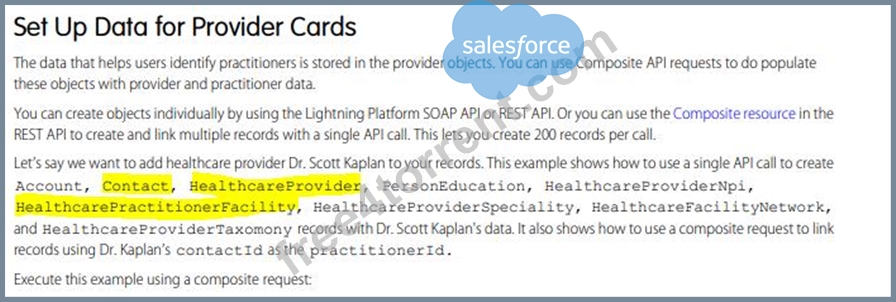
According to the Salesforce documentation3, the following Salesforce and Health Cloud objects can be used to represent providers and their relationships in a provider management data model:
Contact: A contact is a standard object in Salesforce that stores information about an individual person, such as name, phone, email, address, etc. A contact can be used to represent a provider who is a person, such as a physician, nurse, or therapist3.
Healthcare Practitioner Facility: A healthcare practitioner facility is a custom object in Health Cloud that stores information about the relationship between a provider and a facility where they practice, such as hospital, clinic, or pharmacy. A healthcare practitioner facility can be used to track each of the different locations where a provider practices3.
Healthcare Provider: A healthcare provider is a custom object in Health Cloud that stores information about a provider who is an organization or a group of providers, such as hospital system, clinic network, or physician group3.
NEW QUESTION # 30
Which three types of Electronic Health Record data transmitted via HL7 can be stored in Salesforce objects? (Choose Three.
- A. Personal Health Record (PHR)
- B. Admission, Discharge, Transfer Data (ADT)
- C. Continuation of Care document (CCD.
- D. Observation Results (ORU)
- E. Clinical Document Architecture (CDA.
Answer: B,D,E
Explanation:
According to the Salesforce documentation1, the following types of electronic health record data transmitted via HL7 can be stored in Salesforce objects:
Observation Results (ORU): ORU messages contain clinical observations and results, such as lab tests, vital signs, or imaging reports. ORU messages can be stored in the DiagnosticReport object in Health Cloud1.
Admission, Discharge, Transfer Data (ADT): ADT messages contain information about patient admissions, discharges, transfers, or updates, such as demographics, insurance, or diagnosis. ADT messages can be stored in the EhrPatient object in Health Cloud1.
Clinical Document Architecture (CDA): CDA is a standard for exchanging clinical documents, such as discharge summaries, progress notes, or referrals. CDA documents can be stored in the Document object in Health Cloud1.
NEW QUESTION # 31
A customer is looking to implement Discovery Framework to manage their intake and clinical assessments.
Which three capabilities should a consultant configure with Health Cloud out-of-the-box to enhance their assessment functionality?
FHIR Question Bank
- A. Digital Signature Capture
- B. Adding a QR Code
- C. Using Previously Submitted Responses
- D. SMS Assessment Completion
Answer: A,B,C
Explanation:
To enhance their assessment functionality with Discovery Framework, a consultant should configure the following capabilities with Health Cloud out-of-the-box:
Using Previously Submitted Responses: This capability allows users to pre-populate assessment questions with responses from previous assessments, saving time and effort. Users can also edit the responses if needed1.
Digital Signature Capture: This capability allows users to capture electronic signatures from patients or other parties on the assessment form, ensuring consent and compliance. Users can also view and download the signed document as a PDF file2.
Adding a QR Code: This capability allows users to generate a QR code for the assessment form, which can be scanned by patients or other parties to access and complete the assessment on their mobile devices. Users can also track the status of the QR code and send reminders if needed3. FHIR Question Bank or SMS Assessment Completion are not capabilities that are available with Health Cloud out-of-the-box.
NEW QUESTION # 32
Bloomington Caregivers needs to monitor care plan adherence for the patients at various facilities within its network. What is available to extend the reporting capability of Health Cloud?
- A. Reporting unmanaged package
- B. Care Management Extension
- C. Insights for Health Cloud
- D. CRM Analytics for Health Cloud
Answer: D
Explanation:
To extend the reporting capability of Health Cloud, a consultant should recommend CRM Analytics for Health Cloud. This is a feature that provides pre-built dashboards and reports that help users analyze various aspects of health care delivery, such as care plan adherence, patient outcomes, referral management, network performance, and more12. CRM Analytics for Health Cloud also allows users to customize and create their own dashboards and reports based on their specific needs13. Care Management Extension, Insights for Health Cloud, or Reporting unmanaged package are not features that can extend the reporting capability of Health Cloud.
NEW QUESTION # 33
A customer wants to view and navigate to critical insurance, clinical, and primary care physician information on a patient's profile.
Which Health Cloud capability should a consultant implement?
- A. Advanced Patient Card
- B. Enhanced Timeline
- C. Patient Path
- D. Enhanced Highlights Panel
Answer: A
Explanation:
The Advanced Patient Card is a Health Cloud capability that allows users to view and navigate to critical information on a patient's profile, such as insurance, clinical, and primary care physician information1. The Advanced Patient Card is a customizable component that can be added to the Health Cloud console or the Contact Center app2. It can also display data from external sources, such as EHR systems or medical devices3.
Reference:
1: Use the Advanced Patient Card - Salesforce 2: Configure the Person Account Page Layout for Contact Center - Salesforce 3: Display Data from External Sources in the Advanced Patient Card - Salesforce
NEW QUESTION # 34
Which industry data standard should a consultant consider when designing interoperability with electronic health record (EHR) sources with Health Cloud?
- A. Personal Health Record (PHR)
- B. HL7 v1 Messaging
- C. FHIR R4
- D. Clinical Data Acquisition
Answer: C
Explanation:
The FHIR R4 (Fast Healthcare Interoperability Resources) standard is the most suitable industry data standard for designing interoperability with Electronic Health Record (EHR) systems in Salesforce Health Cloud.
Why FHIR R4?
Widespread Adoption:
FHIR R4 is the industry standard for modern EHR systems, supported by regulatory bodies like the ONC (Office of the National Coordinator for Health IT).
Compatibility:
Salesforce Health Cloud's Clinical Data Model and FHIR-compliant APIs are built to align with FHIR R4 standards.
Data Interoperability:
Facilitates seamless exchange of clinical data (e.g., medications, conditions, and encounters) between Health Cloud and EHR systems.
Why Other Options Are Less Relevant:
A . Clinical Data Acquisition: A generic concept rather than a specific standard.
B . Personal Health Record (PHR): Focuses on patient-controlled data, not interoperability.
C . HL7 v1 Messaging: An outdated standard superseded by FHIR for modern systems.
Reference:
Salesforce FHIR Integration Guide
NEW QUESTION # 35
An administrator for Bloomington Caregivers has added an Enhanced Timeline to an existing Patient Lightning page showing patient interactions, including records from a custom object developed to track caregiver preferences. What else should the administrator complete post deployment of the enhanced timeline?
- A. Assign the users permissions to be able to view the Timeline before adding it to the Timeline component.
- B. Add the Timeline component to the Patient Lightning page and activate the Timeline.
- C. Add the Timeline component to the Patient Lightning page and select the Timeline.
- D. Add the custom object to the Timeline after deployment, then add it to the Timeline component.
Answer: D
Explanation:
The administrator needs to add the custom object to the Timeline after deployment, then add it to the Timeline component. This will allow the custom object records to be displayed on the Enhanced Timeline2.
NEW QUESTION # 36
Which statement is true about using PurchaserPlan and MemberPlan together when onboarding new insurance members?
- A. Multiple purchaser plans can be associated to multiple Member Plans.
- B. there is no relationship between MemberPlan and Purchaser Plan.
- C. PurchasePlan is to be used as a template for creating MemberPlan.
- D. Purchaser Plan and Member Plan has a master detail relationship
Answer: C
NEW QUESTION # 37
A Salesforce Admin wants to create task within a Care plan that ..................................
In the Health cloud console can be used to create tasks ...................................
- A. Patient List
- B. Timeline Tab
- C. Care Plan Page
- D. Care Team
- E. Household Tab
Answer: A,C,D
NEW QUESTION # 38
Which two steps can an administrator take to configure the Care Program enrollment flow? (Choose two.)
- A. Customize the provider site flow.
- B. Customize the out of the box enrollment flow template to match requirements.
- C. Use the patient approval flow
- D. Usethe provided enrollment flow out of the box.
- E. Customize the care coordinator flow for patient
Answer: B,C
NEW QUESTION # 39
An administrator at Bloomington Caregivers has received a change request to alter the appearance of the timeline so that it displays vertically instead of horizontally.
Which step should the administrator take when implementing this change request?
- A. Find the Timeline Orientation setting in Custom Metadata, which controls the orientation of all timelines, and change the value to vertical.
- B. Enable Timeline in Salesforce Setup, then set the toggle for vertical orientation to true to set all timeline orientations as vertical.
- C. Find the Timeline View Configuration for each relevant timeline in the Health Cloud - Lightning Admin app and change the orientation to vertical.
- D. Enable Timeline in Salesforce Setup, then configure and activate new timeline and add to the relevant Lightning record.
Answer: C
Explanation:
To modify the timeline orientation in Health Cloud, administrators can adjust the Timeline View Configuration to display the timeline vertically.
Steps:
Access Timeline View Configuration:
Open the Health Cloud - Lightning Admin app in Salesforce.
Locate Timeline View Configuration records.
Edit the Configuration:
Select the relevant configuration for the timeline you wish to update.
Change the orientation setting to Vertical.
Save and activate the updated configuration.
Verify the Changes:
Check the timeline in the respective Lightning record pages to ensure the vertical layout is applied.
Why Other Options Are Incorrect:
A . Enable Timeline in Salesforce Setup: Timelines are already enabled in Health Cloud, and appearance changes are handled at the configuration level.
B . Toggle in Setup: There is no global toggle for orientation in Salesforce Setup.
D . Custom Metadata: Timeline orientation is not controlled by custom metadata; it's managed through view configurations.
Supporting Documentation:
Timeline Configuration Overview (help.salesforce.com)
NEW QUESTION # 40
......
Pass Salesforce Health-Cloud-Accredited-Professional Premium Files Test Engine pdf - Free Dumps Collection: https://www.free4torrent.com/Health-Cloud-Accredited-Professional-braindumps-torrent.html
New 2025 Realistic Health-Cloud-Accredited-Professional Dumps Test Engine Exam Questions in here: https://drive.google.com/open?id=1PHfSomZINfOLr00s8AtUUZk3RIXCSQbx