

Most UptoDate ServiceNow CIS-DF Exam Dumps PDF 2026
100% Free Certified System Administrator CIS-DF Dumps PDF Demo Cert Guide Cover
NEW QUESTION # 36
(Choose 2 options)
A Configuration Management Process Owner is preparing solution options for presentation to technical governance for ingestingcustom CIsinto the CMDB. The solution must align withbest practices, minimizefuture technical debt, and ensureupgrade compliance.
Which solutions accomplish this?
- A. Installing or upgrading theCMDB CI Class Models Storeapplication to find a suitable existing CI class accommodating any new attributes
- B. Extending the existingAssetclass table to custom CI class attributes
- C. Repurposing a base CI class and renaming attributes as required
- D. Extending an existing CI class table to accommodate the custom CI class attributes
Answer: A,D
Explanation:
InServiceNow, ingesting custom CIs must be done with a strong focus onupgrade safety, governance, and long-term maintainability. Data Foundations guidance explicitly discourages repurposing or overloading base classes, as this creates technical debt and upgrade risk.
Option Bis a best practice because theCMDB CI Class Models Storedelivers ServiceNow-supported CI classes that align with platform evolution. Before creating or extending classes, administrators should verify whether a suitable class already exists or has been introduced in newer releases. This avoids duplication and ensures future compatibility.
Option Dis also correct. When no suitable class exists, extending anexisting CI class(under the appropriate parent) to add required attributes preserves inheritance, discovery behavior, reporting, and upgrade compatibility. This approach is preferred over creating entirely new, disconnected schemas.
Option A is incorrect because repurposing base classes and renaming attributes breaks standard semantics, causes confusion, and complicates upgrades. Option C is incorrect because extendingAssettables to represent CIs conflates ITAM and CMDB concerns; assets and CIs serve different purposes and lifecycles.
Therefore, the solutions that minimize technical debt and ensure upgrade compliance areB and D.
NEW QUESTION # 37
The CMDB Administrator has set up two Dynamic Reconciliation Rules within the ServiceNow Production Instance. The 'Server' class has a Dynamic Reconciliation Rule of largest value for the RAM field. The 'Windows Server' class has a Dynamic Reconciliation Rule of most reported for the RAM field.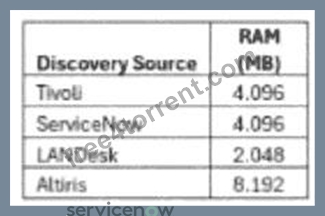
Given the above data inMultisource CMDB, which value is added to the CMDB forRAMfor aServer CI?
- A. 2,048 MB
- B. 8,192 MB
- C. 4,096 MB
Answer: B
Explanation:
This question hinges on understandingclass-specific Dynamic Reconciliation RulesinCMDB 360 / Multisource CMDBwithinServiceNow.
Although two different dynamic rules are configured,the rule applied depends on the CI class being evaluated:
For theServerclass, the configured rule isLargest valuefor the RAM attribute.
For theWindows Serverclass, the ruleMost reportedwould apply-butonly if the CI were evaluated as a Windows Server.
The question explicitly asks for the resulting RAM value for aServer CI, not a Windows Server CI. Therefore, theLargest valuerule governs the outcome.
Looking at the multisource values:
2,048 MB (LANDesk)
4,096 MB (Tivoli)
4,096 MB (ServiceNow)
8,192 MB (Altiris)
Under theLargest valuedynamic reconciliation rule, the IRE selects themaximum numeric value, regardless of how frequently it is reported or which source provided it.
TheMost reportedlogic (which would result in 4,096 MB) doesnot applyhere because that rule is configured for a different class (Windows Server).
This scenario illustrates an important CMDB 360 principle:Dynamic reconciliation is evaluated per class, and child-class rules do not override parent-class rules unless the CI is actually classified under that child class.
NEW QUESTION # 38
A CI should not be updated by Discovery once it reaches "Retired" state. What should control this?
- A. Business Rule
- B. Dictionary attribute
- C. Reconciliation Rule with lifecycle condition
- D. Identification Rule
Answer: C
Explanation:
Reconciliation Rules can prevent updates based on lifecycle state, ensuring retired CIs remain unchanged.
NEW QUESTION # 39
A manufacturing organization has implemented Incident Management in ServiceNow and wants to integrate additional products to enhance its functionality.
Drag each ServiceNow product to the value it brings in supporting Incident Management.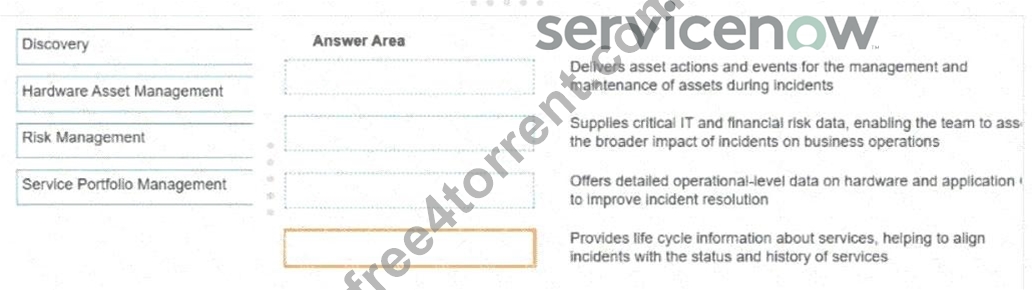
Answer:
Explanation: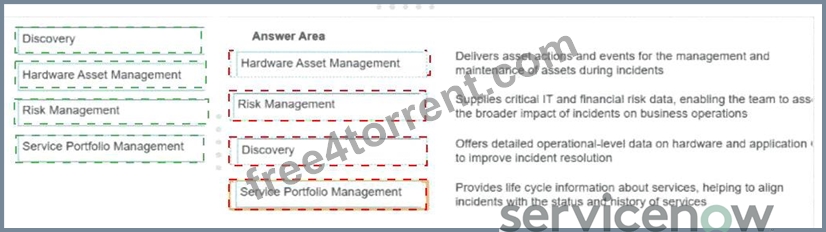
Explanation: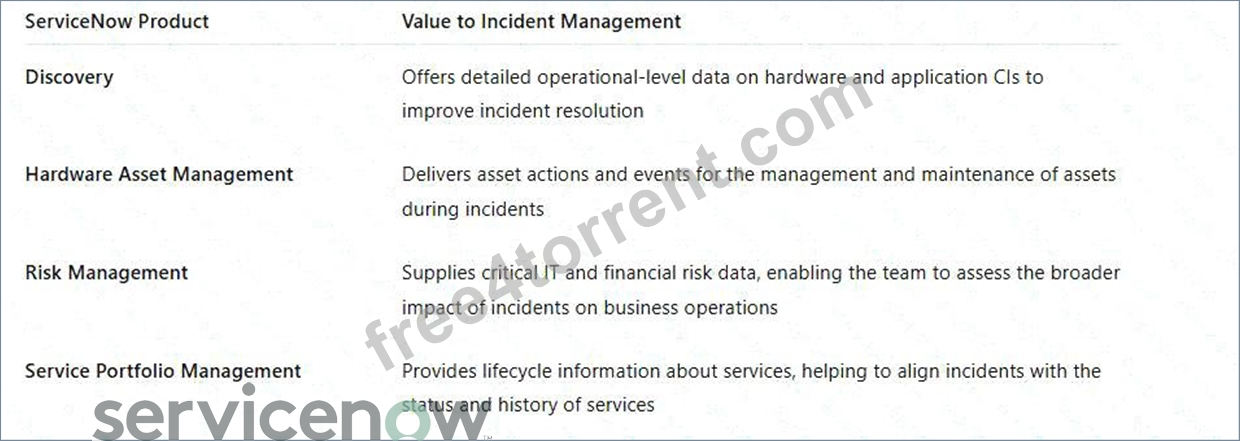
Enhancing Incident Management inServiceNowoften involves integrating complementary products that enrichcontext, prioritization, and decision-making.
Discoverystrengthens incident resolution by automatically populating accurate CI data and relationships, allowing responders to quickly understand affected infrastructure and applications.
Hardware Asset Management (HAM)adds visibility into asset lifecycle, ownership, and maintenance actions, which is especially valuable when incidents involve physical devices or failures.
Risk Management(part of IRM) provides insight intobusiness and financial risk exposure, helping teams prioritize incidents based on potential regulatory, safety, or financial impact.
Service Portfolio Management (SPM)connects incidents to theservice lifecycle, enabling better understanding of whether an incident affects a live, retiring, or planned service-and improving communication with stakeholders.
Together, these integrations transform Incident Management from a reactive process into acontext-rich, business-aligned capability.
NEW QUESTION # 40
(Choose 2 options)
A CMDB Administrator wants to run the"Services Have Owners Identified"Get Well Playbook to remediate issues shown in theCMDB Data Foundations Dashboard.
Whichremediation playswould be used?
- A. Analyze Data
- B. Govern Data
- C. Report Data
- D. Fix Data
Answer: B,D
Explanation:
TheCMDB Data Foundations Dashboardis paired withGet Well Playbooksthat guide administrators through structured remediation. The"Services Have Owners Identified"playbook focuses on closing ownership gaps for services, which is agovernance and data correctionactivity.
Fix Data(Option A) is used tocorrect missing or incorrect values, such as populating owner fields, assigning responsible groups, or updating relationships. In this playbook, Fix Data actions are required to actually remediate the issue by assigning owners to services.
Govern Data(Option D) is also required because ownership is not a one-time correction-it must beenforced and sustained. Govern Data establishes policies, ownership accountability, and controls (such as certifications or attestations) to ensure services continue to have owners over time and do not regress.
Analyze Data(Option B) is used to understand patterns and root causes, but it does not remediate the issue.
Report Data(Option C) provides visibility and communication, not corrective action.
Therefore, the remediation plays that apply to theServices Have Owners Identifiedplaybook areFix DataandGovern Data, makingOptions A and Dcorrect.
NEW QUESTION # 41
A ServiceNow Administrator wants to implement Sen/ice Graph Connectors to provide integrations to many third-party solutions that the company wants integrated into the CMDB Which categories of connectors are available to the Administrator"?
- A. Workflow Automation
- B. Cloud
- C. DevOps
- D. Observability
Answer: B,D
Explanation:
Service Graph Connectors are a key Data Foundations ingestion capability in ServiceNow. They provide out-of-the-box, upgrade-safe integrations that ingest data into the CMDB using the Identification and Reconciliation Engine (IRE), ensuring data quality and source governance.
Two primary categories of Service Graph Connectors are:
Cloud (Option A): These connectors integrate with major cloud providers and platforms (such as AWS, Azure, and GCP) to ingest infrastructure, platform, and service data into the CMDB. They are essential for managing hybrid and multi-cloud environments and maintaining accurate cloud CI relationships.
Observability (Option B): These connectors integrate with monitoring and observability tools (such as APM, infrastructure monitoring, and telemetry platforms). They provide near-real-time operational data that enriches CI records and supports incident correlation, impact analysis, and service health insights.
NEW QUESTION # 42
A new custom class is needed to reflect a new application being managed in the CMDB.
Which roles are minimally needed to add this custom CI class?
- A. itil_admin and personalize_form
- B. sn_cmdb_admin and personalize_dictionary
- C. sn_cmdb_admin and personalize_dictionary
- D. sn_cmdb_admin and personalize_form
Answer: B
Explanation:
Creating a custom CI class in the CMDB is a dictionary-level configuration activity and must be performed with the correct minimum privileges to ensure governance and upgrade safety in ServiceNow.
The sn_cmdb_admin role is required because it grants administrative access to CMDB structures, including CI class hierarchy management. This role ensures that changes align with CMDB governance controls and Data Foundations practices.
The personalize_dictionary role is also required because adding a new CI class involves creating or extending dictionary entries (tables, attributes, inheritance). Without dictionary-level access, a user cannot define new classes or attributes in the CMDB schema.
Option A is incorrect because sn_cmdb_admin alone is insufficient without dictionary privileges. Option B and D focus on form personalization, which affects UI layout only and does not allow creation of new CI classes. Additionally, itil_admin is not the correct role for schema-level CMDB changes.
Therefore, the minimal and correct role combination is sn_cmdb_admin and personalize_dictionary, making Option C the verified answer.
NEW QUESTION # 43
Drag and Drop Question
A CMDB Administrator needs to set up CMDB 360/Multisource CMDB Drag and drop the system property to the functionality Some options may not apply.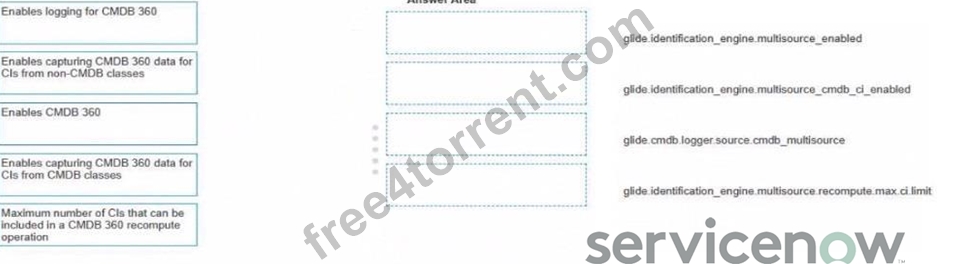
Answer:
Explanation: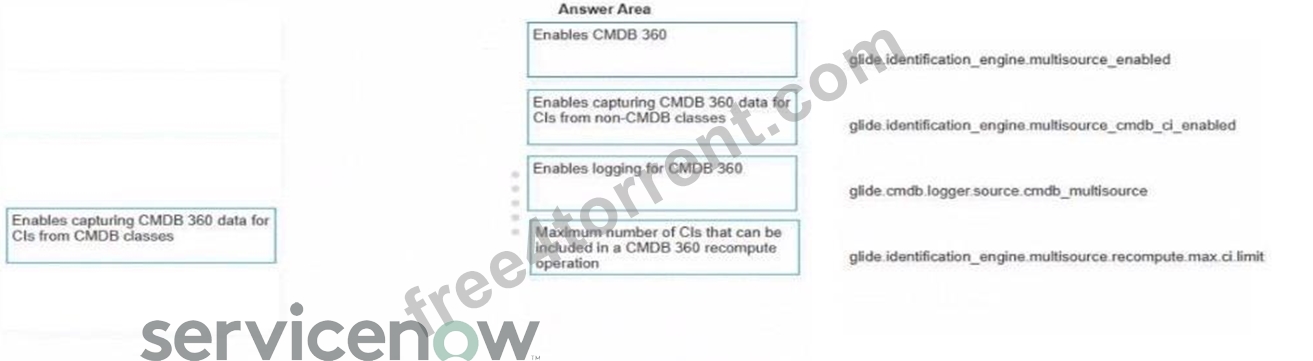
Explanation:
In ServiceNow, CMDB 360 / Multisource CMDB extends the Identification and Reconciliation Engine (IRE) to support multi-source visibility, reconciliation, and confidence scoring.
Configuration is controlled through system properties, each enabling a specific capability.
glide.identification_engine.multisource_enabled is the master switch that activates CMDB 360 functionality.
glide.identification_engine.multisource_cmdb_ci_enabled allows CMDB 360 to collect and evaluate data specifically from CMDB CI classes.
glide.cmdb.logger.source.cmdb_multisource enables detailed logging for troubleshooting multisource ingestion and reconciliation.
glide.identification_engine.multisource_recompute.max_ci_limit protects performance by limiting how many CIs can be processed during a recompute operation.
Capturing CMDB 360 data from non-CMDB classes is not supported, which is why no property applies to that option.
This mapping aligns with Data Foundations and CMDB governance best practices, ensuring CMDB 360 is enabled safely, transparently, and at scale.
NEW QUESTION # 44
Drag and drop the CMDB Health Dashboard metric to the description.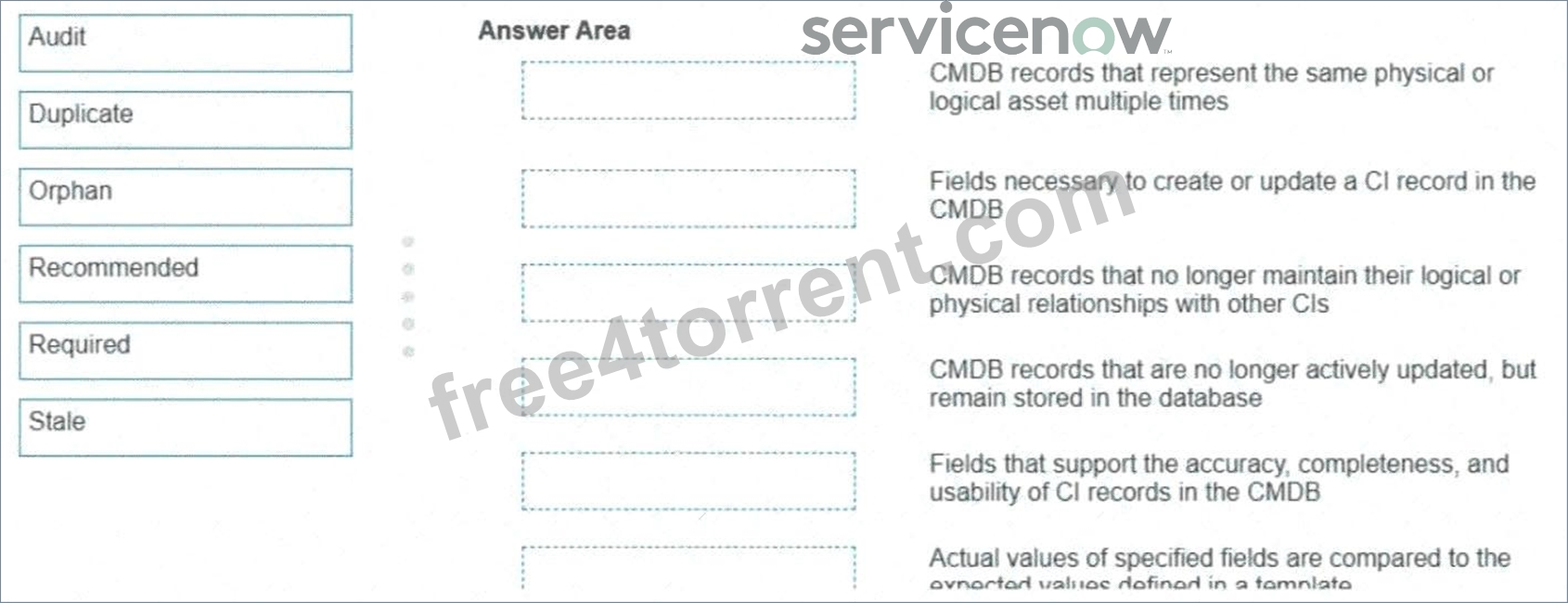
Answer:
Explanation: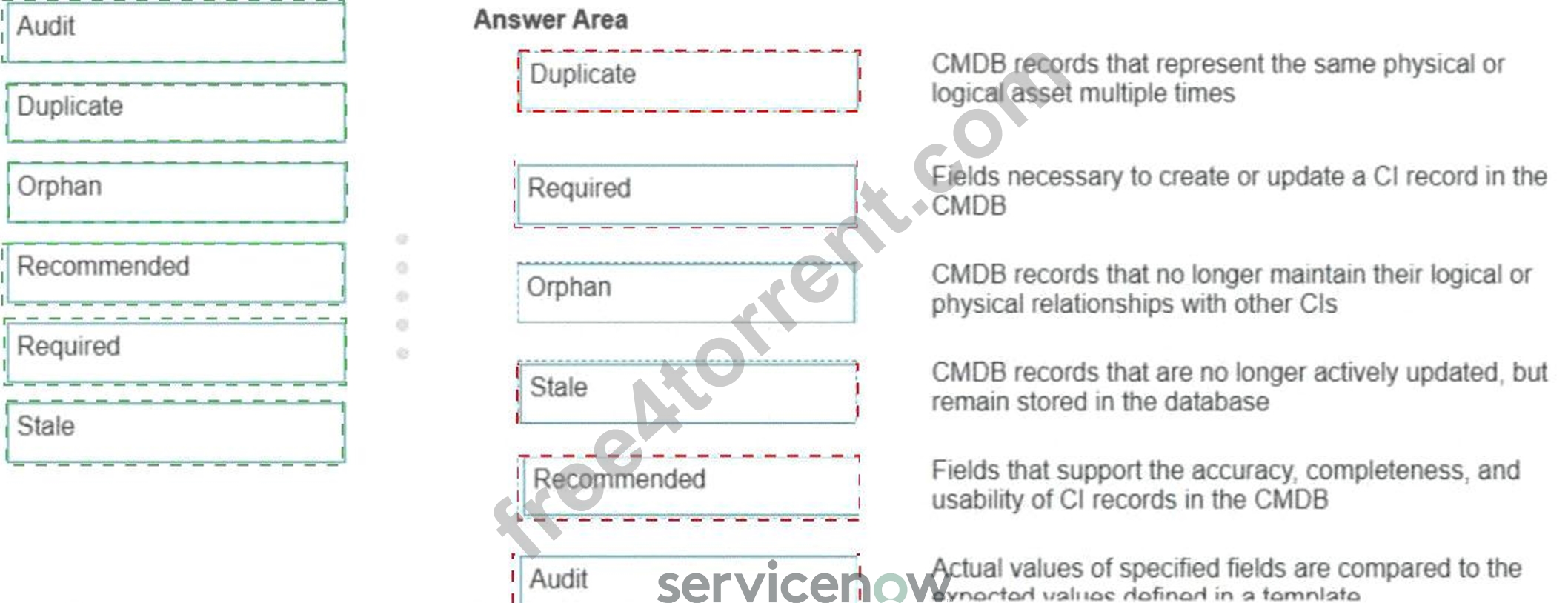
Explanation: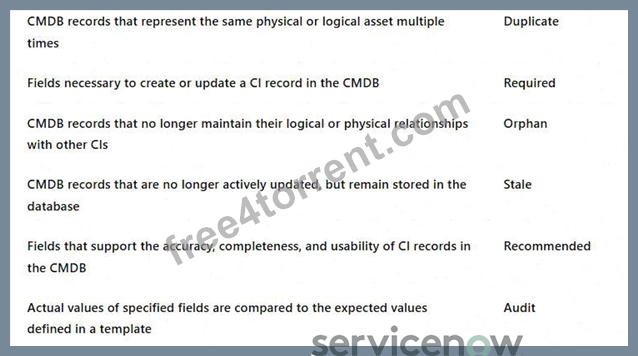
* Duplicate identifies data quality issues where the same asset is modeled more than once, violating CMDB trust principles.
* Required ensures minimum viable CI creation and update-critical for ingestion and lifecycle integrity.
* Orphan highlights broken relationships, which directly impact impact analysis, Service Mapping, and Change Management.
* Stale flags CIs that are no longer being refreshed by Discovery or other sources but still exist in the CMDB.
* Recommended improves completeness and usability, supporting operational and reporting use cases without being mandatory.
* Audit validates data correctness by comparing CI field values against predefined templates or policies.
This exact mapping is what ServiceNow expects in CMDB Health Dashboard-related exam questions and real-world implementations.
NEW QUESTION # 45
A CMDB Administrator wants to remove all Linux Servers in the organization that have not been updated in six months.
Which recommended action should the Administrator take in Data Foundations?
- A. Create an archive policy
- B. Create a business rule
- C. Create a scheduled job
Answer: A
Explanation:
Removing obsolete or inactive CIs from the CMDB must be handled carefully to avoid data loss, audit issues, and unintended operational impact. In ServiceNow, the recommended and governed approach is to use an archive policy.
Archive policies are designed to manage CI lifecycle cleanup based on defined conditions such as class, last updated date, lifecycle status, or operational state. In this scenario, the condition would target Linux Server CIs that have not been updated in six months. Archive policies can either archive or permanently delete records in a controlled, auditable manner, ensuring compliance with data retention and governance standards.
NEW QUESTION # 46
During a Change request, impact analysis does not show downstream affected services. What is the most likely cause?
- A. CMDB Health disabled
- B. Reconciliation conflict
- C. Incorrect CI class
- D. Missing CI relationships
Answer: D
Explanation:
Impact analysis depends on correctly defined CI relationships between upstream and downstream components.
NEW QUESTION # 47
(Choose 2 options)
The followingReconciliation Ruleswere configured forServiceNow, Altiris, and SCCMfor theWindows Server (cmdb_ci_win_server)class: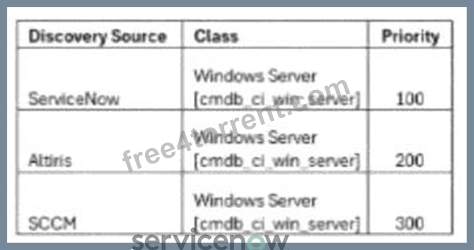
Which statements aretrue?
- A. Data collected with a discovery source ofSCCMcan be inserted as new records in the Windows Server table.
- B. Data collected with a discovery source ofSCCMcan update any record in the Windows Server table because it has the highest priority number.
- C. Data collected with a discovery source ofAltiriscan update records inserted bySCCMinto the Windows Server table.
- D. Data collected with a discovery source ofServiceNowcan insert new records into the Windows Server table, but cannot update records created by Altiris or SCCM.
Answer: A,C
Explanation:
This question tests understanding ofreconciliation source priorityin theIdentification and Reconciliation Engine (IRE)inServiceNow.
In reconciliation rules,lower numeric values represent higher priority. Therefore, the priority order is:
ServiceNow (100)- highest authority
Altiris (200)
SCCM (300)- lowest authority
Why A is correct
BecauseAltiris (200)hashigher priority than SCCM (300), data from Altiriscan update records originally inserted by SCCM. This is exactly how reconciliation precedence works-higher-priority sources can overwrite lower-priority ones.
Why C is correct
SCCM, even though it has thelowest priority, is still anauthorized discovery source. Itcan insert new recordsinto the Windows Server table when no existing CI is identified. Priority only affectsupdates, not the ability to create records.
Why B is incorrect
ServiceNow (priority 100)can update records from Altiris and SCCMbecause it has the highest priority. The statement incorrectly claims it cannot.
Why D is incorrect
SCCM doesnothave the highest authority. Ahigher numeric value means lower priority, so SCCM cannot update records created by higher-priority sources.
NEW QUESTION # 48
A healthcare provider faces a critical incident affecting its patient management system. The provider needs to determine the users impacted to mitigate disruption effectively.
Which CSDM-related data should they leverage?
- A. Incident history of similar CIs
- B. Service Offerings by Department or Location
- C. Application Service environment attribute
- D. Affected CI [task_ci] related list
Answer: B
Explanation:
CSDM is designed to connect technology delivery to business consumption so organizations can answer questions like "who is impacted?" quickly and consistently. In a critical incident, the healthcare provider needs to identify impacted users in business terms--clinicians, admin teams, specific sites, or departments--rather than only listing technical components.
Option D ("Service Offerings by Department or Location") is the most CSDM-aligned data because it reflects who consumes the service and how that consumption is segmented. In CSDM, a Business Service / Service Offering represents what customers consume, and the offering can be associated with organizational constructs such as department, business unit, or location. For healthcare, this is especially valuable because impact is often location-based (hospital site, clinic) and role-based (patient intake, scheduling, ward operations). Using service offerings and their consumer mapping helps quickly identify likely impacted user groups and prioritize communications and workarounds.
NEW QUESTION # 49
A new custom class is needed to reflect a new application being managed in the CMDB.
Which roles are minimally needed to add this custom CI class?
- A. itil_admin and personalize_form
- B. sn_cmdb_admin and personalize_dictionary
- C. sn_cmdb_admin and personalize_dictionary
- D. sn_cmdb_admin and personalize_form
Answer: B
Explanation:
Creating a custom CI class in the CMDB is a dictionary-level configuration activity and must be performed with the correct minimum privileges to ensure governance and upgrade safety in ServiceNow.
The sn_cmdb_admin role is required because it grants administrative access to CMDB structures, including CI class hierarchy management. This role ensures that changes align with CMDB governance controls and Data Foundations practices.
The personalize_dictionary role is also required because adding a new CI class involves creating or extending dictionary entries (tables, attributes, inheritance). Without dictionary-level access, a user cannot define new classes or attributes in the CMDB schema.
NEW QUESTION # 50
Which type ofCMDB Data Manager policycreates tasks that allow the assigned individual toupdate fields on the CI record?
- A. Certification
- B. Attestation
- C. Compliance
- D. Audit
Answer: A
Explanation:
In CMDB governance, differentCMDB Data Manager policy typesserve different validation and enforcement purposes. When the objective is to allow an assigned individual toreview and update specific fields on a CI record, the correct policy type isCertification.
ACertification policycreates actionable tasks that require the assignee tovalidate and, if necessary, correct specific CI attributes, such as lifecycle status, support group, environment, or ownership. During certification, the user can directly update CI fields to bring the record into compliance with defined standards.
Attestation(Option C) only asks the user to confirm that a CIstill existsor is still valid; it does not require or enable attribute-level updates.Audit(Option A) is used for reporting and evidence collection, not remediation.
Compliance(Option D) measures adherence to rules but does not itself generate editable remediation tasks.
Certification is therefore the primary mechanism used whenhuman validation and correctionof CI data is required-making it a cornerstone of CMDB data quality management.
Hence, the correct answer isB - Certification.
NEW QUESTION # 51
A CMDB Administrator is reviewing the CMDB and notices that many Hardware CIs are missing serial numbers. The Administrator is concerned this may cause duplicate CIs and wants to resolve the issue quickly.
What structured guidelines provided by ServiceNow are available to troubleshoot and resolve the issue?
- A. CMDB Health Dashboard Playbooks
- B. CMDB Data Foundations Dashboard Playbooks
- C. CSDM Now Create Playbooks
- D. CSDM Data Foundations Dashboard Playbooks
Answer: B
Explanation:
When data quality issues such as missing serial numbers threaten CMDB integrity and increase the risk of duplicates, ServiceNow provides prescriptive, step-by-step remediation guidance through the CMDB Data Foundations Dashboard Playbooks.
These playbooks are specifically designed to help administrators identify root causes, assess ingestion and governance gaps, and apply corrective actions using structured remediation plays (Analyze Data, Fix Data, Govern Data). For missing serial numbers, the playbooks guide teams to review Discovery patterns, identification rules, reconciliation sources, and governance controls to ensure authoritative data capture and prevention of future issues.
The CMDB Health Dashboard Playbooks focus on health scoring and metrics, not guided remediation. CSDM Data Foundations Dashboard Playbooks is not a distinct product naming; the correct construct is CMDB Data Foundations. Now Create Playbooks provide implementation project guidance, not operational troubleshooting for live data issues.
NEW QUESTION # 52
A CMDB Administrator is using the Duplicate CI Remediator to address a de-duplication task. On the first tab of the wizard, the Main CI is selected.
Which attributes are used to identify the Main CI? (Choose two)
- A. Most Related Items
- B. Least Related Items
- C. Oldest Created
- D. Newest Created
Answer: A,C
Explanation:
In ServiceNow, the Duplicate CI Remediator is a governed tool designed to safely resolve duplicate Configuration Items while preserving the most valuable and authoritative record. The first step in the remediation wizard is identifying the Main CI, which will be retained after remediation.
ServiceNow uses two primary attributes to help determine the best candidate for the Main CI:
The oldest CI is often preferred because it typically has a longer operational history, may be referenced by historical incidents, changes, problems, or audits, and is more likely to be embedded in downstream processes and reports. Retaining the oldest CI helps avoid breaking historical references.
A CI with the most relationships (for example, links to applications, services, incidents, or other CIs) is generally the most valuable from a business and operational context perspective.
Preserving these relationships is critical for impact analysis, Change Management, and CSDM- aligned service modeling.
NEW QUESTION # 53
CMDB class owners are receiving tasks under the"My Work"tab in theCMDB Workspace.
Which CMDB management tool is generating those tasks?
- A. CMDB Data Manager
- B. CMDB Health Dashboard
- C. De-duplication templates
Answer: A
Explanation:
TheCMDB Data Manageris the ServiceNow capability responsible for generatingactionable governance tasksand assigning them to CI class owners and data stewards. These tasks appear directly in the"My Work" tab within the CMDB Workspace, enabling proactive and role-based CMDB governance.
CMDB Data Manager focuses ondata lifecycle management, including archival, retirement, and cleanup of CIs based on defined policies. When lifecycle rules or retention thresholds are met-or when human validation is required-the Data Manager creates tasks to prompt responsible owners to take action. This ensures that CMDB data remainsaccurate, compliant, and leanover time.
TheCMDB Health Dashboard(Option C) provides visibility into health metrics such as completeness, correctness, and compliance, but it doesnot generate tasks. Similarly,De-duplication templates(Option A) support duplicate identification and remediation workflows, but they do not create ongoing governance tasks in the CMDB Workspace.
By surfacing tasks in "My Work," CMDB Data Manager operationalizes governance and embeds accountability into daily workflows, which is a key principle of CMDB Data Foundations.
Therefore, the correct answer isOption B - CMDB Data Manager.
NEW QUESTION # 54
A CMDB Administrator would like to minimize stale CIs in the CMDB.
Which CMDB Health Dashboard scorecard displays this information?
- A. Correctness
- B. Compliance
- C. Completeness
Answer: B
Explanation:
In Data Foundations, "Insight" includes measuring CMDB health in ways that are actionable-so teams can identify where data is degrading and prioritize remediation. Stale CIs (records that are no longer current, not updated, or no longer exist in the environment) are a common source of CMDB risk: they distort reporting, mislead impact analysis, and create noise for operational processes. Reducing staleness supports higher trust in the CMDB and better decision-making.
On the CMDB Health Dashboard, stale CI concerns align most closely with Compliance because staleness is fundamentally about whether CIs continue to meet defined governance expectations over time-such as update frequency, lifecycle status controls, and adherence to rules that indicate whether records are still valid.
Compliance scorecards typically highlight rule-based adherence to standards (for example, policies or health rules indicating that certain CI types must be recently updated or must not exceed staleness thresholds). This makes Compliance the right place to monitor and improve staleness.
By contrast, Completeness focuses on whether required attributes are populated (for example, owner, environment, support group). Correctness focuses on whether values are accurate and relationships make sense. While stale records can indirectly affect correctness, the dashboard tracking of "stale" is primarily treated as a governance adherence issue-whether the CMDB is being maintained according to lifecycle and freshness expectations-therefore it is surfaced through the Compliance scorecard.
NEW QUESTION # 55
......
Updated ServiceNow CIS-DF Dumps – PDF & Online Engine: https://www.free4torrent.com/CIS-DF-braindumps-torrent.html
PDF Exam Material 2026 Realistic CIS-DF Dumps Questions: https://drive.google.com/open?id=1tczrc5E4rzHb1Sxn9as5b7rBBpl2-vJS