

Use Real HCVA0-003 - 100% Cover Real Exam Questions [Jun-2025]
Dumps Brief Outline Of The HCVA0-003 Exam - Free4Torrent
HashiCorp HCVA0-003 Exam Syllabus Topics:
| Topic | Details |
|---|---|
| Topic 1 |
|
| Topic 2 |
|
| Topic 3 |
|
| Topic 4 |
|
NEW QUESTION # 136
Which of the following statements describe the CLI command below?
S vault login -method-1dap username-mitche11h
- A. By default the generated token is valid for 24 hours
- B. You will be prompted to enter the password
- C. Generates a token which is response wrapped
- D. Fails because the password is not provided
Answer: C
Explanation:
The CLI command vault login -method ldap username=mitchellh generates a token that is response wrapped.
This means that the token contains a base64-encoded response wrapper, which is a JSON object that contains information about the token, such as its policies, metadata, and expiration time. The response wrapper is used to verify the authenticity and integrity of the token, and to prevent replay attacks. The response wrapper also allows Vault to automatically renew the token when it expires, or to revoke it if it is compromised. The - method ldap option specifies that the authentication method is LDAP, which requires a username and password to be provided. The username mitchellh is an example of an LDAP user name, and the password will be hidden when entered. References: Vault CLI Reference | Vault | HashiCorp Developer, Vault CLI Reference | Vault | HashiCorp Developer
NEW QUESTION # 137
Which of the following best describes the function of the Vault Secrets Operator in a Kubernetes environment?
- A. It provides an interface to dynamically provision Kubernetes clusters through Vault's infrastructure secrets.
- B. It replaces the Kubernetes secrets API entirely and operates purely as a certificate authority for all workloads.
- C. It is a standalone Vault server that automatically applies security policies and rotates root tokens.
- D. It continuously reconciles and synchronizes secrets from Vault to Kubernetes, ensuring secrets are always updated
Answer: D
Explanation:
Comprehensive and Detailed in Depth Explanation:
The Vault Secrets Operator (VSO) enhances secrets management in Kubernetes. The HashiCorp Vault documentation states: "The Vault Secrets Operator operates by watching for changes to itssupported set of Custom Resource Definitions (CRD). Each CRD provides the specification required to allow the operator to synchronize from one of the supported sources for secrets to a Kubernetes Secret. The operator writes the source secret data directly to the destination Kubernetes Secret, ensuring that any changes made to the source are replicated to the destination over its lifetime." It further explains: "In this way, an application only needs to have access to the destination secret in order to make use of the secret data contained within." This aligns withC: "It continuously reconciles and synchronizes secrets from Vault to Kubernetes, ensuring secrets are always updated." Option A is false-it augments, not replaces, the Kubernetes Secrets API and isn't a CA. Option B is incorrect-it's not a Vault server but an operator. Option D is wrong-it syncs secrets, not provisions clusters. Thus, C is correct.
Reference:
HashiCorp Vault Documentation - Vault Secrets Operator
NEW QUESTION # 138
What does the following policy do?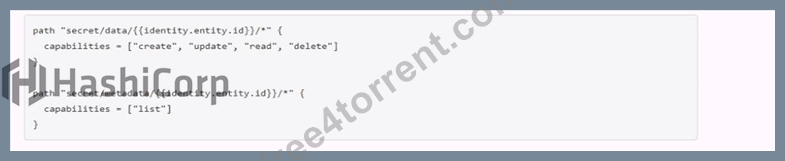
- A. Nothing, this is not a valid policy
- B. Allows a user to read data about the secret endpoint identity
- C. Grants access for each user to a KV folder which shares their id
- D. Grants access to a special system entity folder
Answer: B
Explanation:
This policy allows a user to read data about the secret endpoint identity. The policy grants the user the ability to create, update, read, and delete data in the "secret/data/{identity.entity.id}" path. Additionally, the user is allowed to list data in the "secret/metadata/{identity.entity.id}" path. This policy is useful for users who need to access information about the secret endpoint identity.
The secret endpoint identity is a feature of the Identity Secrets Engine, which allows Vault to generate identity tokens that can be used to access other Vault secrets engines or namespaces. The identity tokens are based on the entity and group information of the user or machine that authenticates with Vault. The entity is a unique identifier for the user or machine, and the group is a collection of entities that share some common attributes.
The identity tokens can carry metadata and policies that are associated with the entity and group.
The "secret/data/{identity.entity.id}" path is where the user can store and retrieve data that is related to the secret endpoint identity. For example, the user can store some configuration or preferences for the secret endpoint identity in this path. The "secret/metadata/{identity.entity.id}" path is where the user can list the metadata of the data stored in the "secret/data/{identity.entity.id}" path. For example, the user can list the version, creation time, deletion time, and destroy time of the data in this path.
:
[Identity - Secrets Engines | Vault | HashiCorp Developer]
[KV - Secrets Engines | Vault | HashiCorp Developer]
NEW QUESTION # 139
True or False? When encrypting data with the Transit secrets engine, Vault always stores the ciphertext in a dedicated KV store along with the associated encryption key.
- A. False
- B. True
Answer: A
Explanation:
Comprehensive and Detailed in Depth Explanation:
* A:Incorrect. Transit doesn't store ciphertext; it returns it to the client.
* B:Correct. The Transit engine performs encryption/decryption without persisting data.
Overall Explanation from Vault Docs:
"The Vault Transit secrets engine does NOT store any data... Ciphertext is returned to the caller." Reference:https://developer.hashicorp.com/vault/docs/secrets/transit
NEW QUESTION # 140
How would you describe the value of using the Vault transit secrets engine?
- A. The transit secrets engine ensures encryption in-transit and at-rest is enforced enterprise wide
- B. Vault has an API that can be programmatically consumed by applications
- C. Encryption for application data is best handled by a storage system or database engine, while storing encryption keys in Vault
- D. The transit secrets engine relieves the burden of proper encryption/decryption from application developers and pushes the burden onto the operators of Vault
Answer: D
Explanation:
The transit secrets engine relieves the burden of proper encryption/decryption from application developers and pushes the burden onto the operators of Vault. The transit secrets engine provides encryption as a service, which means that it performs cryptographic operations on data in-transit without storing any data. This allows developers to delegate the responsibility of managing encryption keys and algorithms to Vault operators, who can define and enforce policies on the transit secrets engine. This way, developers can focus on their application logic and data, while Vault handles the encryption and decryption of data in a secure and scalable manner. References: Transit - Secrets Engines | Vault | HashiCorp Developer, Encryption as a service: transit secrets engine | Vault | HashiCorp Developer
NEW QUESTION # 141
An application is trying to use a dynamic secret in which the lease has expired. What can be done in order for the application to successfully request data from Vault?
- A. Try the expired secret in hopes it hasn't been deleted yet
- B. Request the TTL be extended for the secret lease
- C. Request a new secret and associated lease
- D. Perform a lease renewal
Answer: C
Explanation:
Comprehensive and Detailed in Depth Explanation:
Once a dynamic secret's lease expires, it cannot be renewed or reused; a new secret must be requested. The HashiCorp Vault documentation states: "A lease must be renewed before it has expired. Once it has expired, it is permanently revoked and a new secret must be requested." This means that after expiration, the secret is invalidated, and the application must obtain a new secret with a new lease to regain access.
Trying an expired secret (A) is futile as it's revoked. Performing a lease renewal (B) is impossible post- expiration, as the docs note: "Renewal must occur before the lease expires." Extending the TTL (D) isn't an option for an expired lease. Thus, C is the correct action.
Reference:
HashiCorp Vault Documentation - Leases: Lease Renew and Revoke
NEW QUESTION # 142
Which of the following statements best describes the difference between static and dynamic credentials in a secrets management system?
- A. They are functionally identical-the only difference is what secrets engine creates them.
- B. Static credentials only apply to specific use cases, while dynamic credentials can be used everywhere.
- C. Static credentials often remain persistent for long periods of time, while dynamic are short-lived and auto-rotated.
- D. Static credentials are ephemeral and rotated frequently, while dynamic credentials remain unchanged indefinitely.
Answer: C
Explanation:
Comprehensive and Detailed in Depth Explanation:
The key difference between static and dynamic credentials lies in their lifecycle and management. The HashiCorp Vault documentation explains: "Static credentials are typically assigned and remain valid for long stretches, requiring manual rotation. By contrast, dynamic credentials are issued on-demand, designed to be short-lived, and automatically rotated or revoked when they expire." This reduces exposure risk and simplifies management, making C the correct statement: "Static credentials often remain persistent for long periods of time, while dynamic are short-lived and auto-rotated." Option A is incorrect as static and dynamic credentials differ in function, not just origin. Option B misstates their applicability-static credentials aren't limited to specific use cases, and dynamic credentials have specific purposes. Option D reverses the definitions entirely. Thus, C aligns with Vault's design.
Reference:
HashiCorp Vault Documentation - Static and Dynamic Secrets
NEW QUESTION # 143
Thomas has authenticated to Vault using the API and has received the following response. What data must Thomas parse from the response in order to continue making requests to Vault?
text
CollapseWrapCopy
{
"request_id": "65897160-fd8b-1f87-c24e-fdba14c9728e",
"lease_id": "",
"renewable": false,
"lease_duration": 0,
"data": null,
"wrap_info": null,
"warnings": null,
"auth": {
"client_token": "hvss.lzrmRe5Y3LMcDRmOttEjWoagd92fD29fxakwej_38djs",
"accessor": "EMX0nv4nr0Y1wXoaN7i0WDW1",
"policies": ["bryan", "default"],
"token_policies": ["bryan", "default"],
"metadata": {"username": "bryan"},
"lease_duration": 2764800,
"renewable": true,
"entity_id": "40e203e8-818e-b6ad-4cb3-0befdbf9b598",
"token_type": "service",
"orphan": true
}
}
- A. client_token
- B. request_id
- C. entity_id
- D. accessor
Answer: A
Explanation:
Comprehensive and Detailed In-Depth Explanation:
To continue API requests:
* C. client_token: "When you authenticate to Vault using the API, the response will include the client_token, which is required for subsequent responses." This token, found at .auth.client_token, must be included in the X-Vault-Token header.
* Incorrect Options:
* A. accessor: Used for token management, not requests.
* B. request_id: Tracks the request, not for auth.
* D. entity_id: Identifies the entity, not for requests.
Reference:https://developer.hashicorp.com/vault/api-docs/auth/userpass#login
NEW QUESTION # 144
You are the primary Vault operator. During a routine audit, an auditor requested the ability to display all secrets under a specific path in Vault without seeing the actual stored data. Which policy permits the auditor to display the stored secrets without revealing their contents?
- A. path "kv/apps/production/" { capabilities = ["list"] }
- B. path "kv/+/production" { capabilities = ["list"] }
- C. path "kv/apps/*" { capabilities = ["list", "read"] }
- D. path "kv/apps/+/" { capabilities = ["list"] }
Answer: B
Explanation:
Comprehensive and Detailed In-Depth Explanation:
The list capability allows viewing secret names without data. The Vault documentation states:
"The list capability is required to list keys at a path without necessarily being able to read the data at those paths. The + symbol is a directory replacement and ANY value would be permitted in that path segment."
-Vault Policies: Capabilities
-Vault Policies: Policy Syntax
* C: Correct. Lists all secrets under kv/<anything>/production:
"This policy allows the auditor to list all secrets under the specified path kv/+/production without being able to read the actual stored data."
-Vault Policies: Capabilities
* A,B: Too narrow, missing some secrets.
* D: Includes read, exposing data.
References:
Vault Policies: Capabilities
Vault Policies: Policy Syntax
NEW QUESTION # 145
What command would you use to enable the Kubernetes secrets engine at the path of /k8s-cluster?
- A. vault kv put k8s-cluster type=kubernetes
- B. vault write sys/mounts/k8s-cluster
- C. vault secrets enable kubernetes -path=k8s-cluster
- D. vault secrets enable -path=k8s-cluster kubernetes
Answer: D
Explanation:
Comprehensive and Detailed In-Depth Explanation:
Correct syntax is:
* A. vault secrets enable -path=k8s-cluster kubernetes: "The secrets enable command enables a secrets engine at a given path." The -path flag precedes the engine type.
* Incorrect Options:
* B: kv put is for key-value data, not enabling engines.
* C: Incorrect CLI syntax; API-focused.
* D: Reversed order; path must come first.
Reference:https://developer.hashicorp.com/vault/docs/v1.16.x/commands/secrets/enable
NEW QUESTION # 146
Use this screenshot to answer the question below: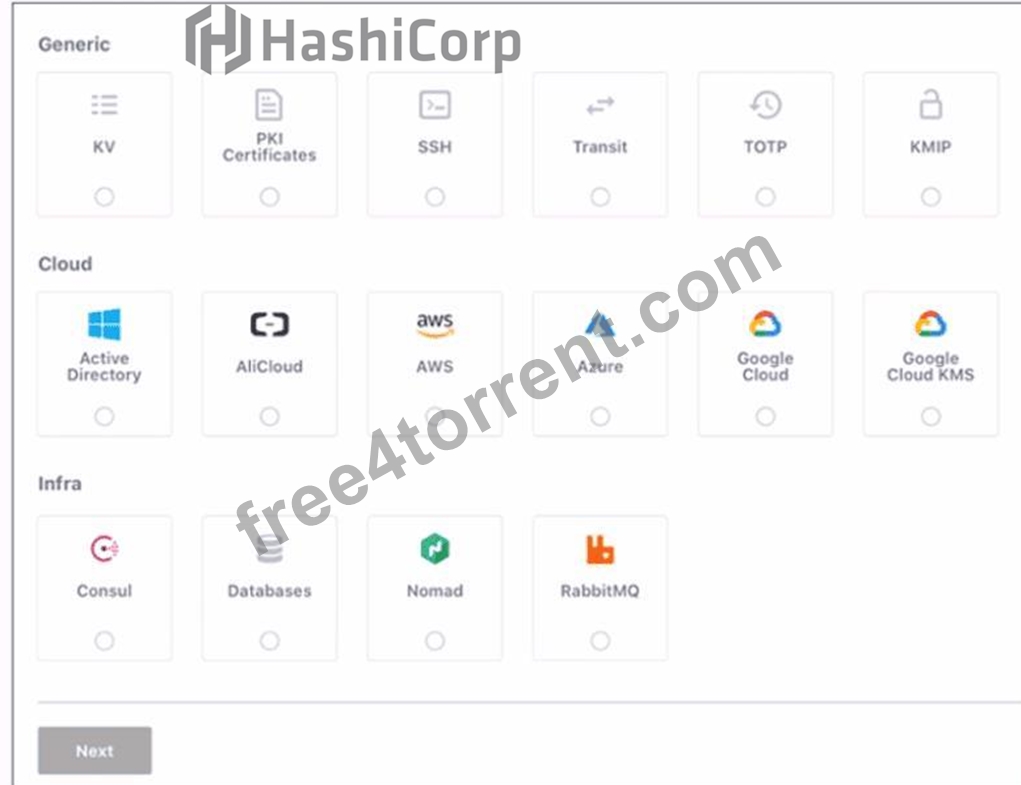
When are you shown these options in the GUI?
- A. Enabling secret engines
- B. Enabling authentication engines
- C. Enabling policies
- D. Enabling authentication methods
Answer: D
Explanation:
This screenshot is shown when you are enabling authentication methods in the GUI. Authentication methods are the ways users and applications authenticate with Vault. Vault supports many different authentication methods, including username and password, GitHub, and more. You can enable one or more authentication methods from the grid of options, which are divided into three categories: Generic, Cloud, and Infra. Each option has a name, a description, and a logo. You can also enable authentication methods using the Vault CLI or API.
Enabling policies, authentication engines, and secret engines are different tasks that are not related to this screenshot. Policies are rules that govern the access to Vault resources, such as secrets, authentication methods, and audit devices. Authentication engines are components of Vault that perform authentication and assign policies to authenticated entities. Secret engines are components of Vault that store, generate, or encrypt data. These tasks have different GUI pages and options than the screenshot.
:
[Authentication | Vault | HashiCorp Developer]
[Policies | Vault | HashiCorp Developer]
[Authentication | Vault | HashiCorp Developer]
[Secrets Engines | Vault | HashiCorp Developer]
NEW QUESTION # 147
True or False? Once the minimum decryption version is set on an encryption key, older versions of the key are removed from Vault and are no longer available for decryption operations.
- A. False
- B. True
Answer: A
Explanation:
Comprehensive and Detailed in Depth Explanation:
The statement isFalse. Setting the minimum decryption version does not remove older key versions. The HashiCorp Vault documentation states: "Key versions that are earlier than a key's specified min_decryption_version get archived, and the rest of the key versions belong to the working set. In an emergency, the min_decryption_version can be moved back to allow for legitimate decryption." Older versions remain available for decryption if needed.
The docs add: "Archiving a key version does not delete it; it simply marks it as outside the active working set, but Vault retains it for potential use." Thus, older versions are not removed, making B correct.
Reference:
HashiCorp Vault Documentation - Transit Secrets Engine: Working Set Management
NEW QUESTION # 148
Your organization has applications in a primary data center and a secondary warm-standby site. You want to configure Vault replication between the primary and secondary clusters. If the primary fails over to the secondary, the applications must interact with Vault without re-authenticating. What type of Vault replication would you use?
- A. Performance Replication
- B. Integrated Storage
- C. Vault Secrets Operator
- D. Disaster Recovery Replication
Answer: D
Explanation:
Comprehensive and Detailed In-Depth Explanation:
Vault Enterprise supports two replication types: Performance Replication and Disaster Recovery (DR) Replication. The key requirement here is that applications must continue interacting with Vault without re- authenticating during a failover from the primary to the secondary cluster. DR Replication is designed for this exact scenario. It replicates all data, including tokens and leases, from the primary cluster to the secondary cluster. When the secondary is promoted to primary during a failover, the existing tokens remain valid, allowing applications to seamlessly continue operations without re-authentication.
Performance Replication, while improving scalability and performance by replicating data across clusters, manages its own tokens and leases on each secondary cluster. Tokens from the primary are not replicated, so a failover would invalidate existing tokens, requiring applications to re-authenticate-failing the requirement.
Integrated Storage is a storage backend, not a replication type, and doesn't address failover behavior. The Vault Secrets Operator is a Kubernetes tool for secret management, unrelated to cluster replication. According to Vault's DR Replication documentation, it ensures continuity of token validity, making it the correct choice.
References:
Disaster Recovery Replication Tutorial
Performance Replication Tutorial
Vault Replication Overview
NEW QUESTION # 149
Which of the following best describes a token accessor?
- A. Describes the value associated with the token's TTL
- B. A token used for clients to access Vault secrets engines
- C. A value that describes which clients have access to the attached token
- D. A value that acts as a reference to a token which can be used to perform limited actions against the token
Answer: D
Explanation:
Comprehensive and Detailed in Depth Explanation:
A token accessor is a unique identifier linked to a token, used for management purposes. The HashiCorp Vault documentation states: "A token accessor is created alongside of each token, and the accessor can be used to perform limited actions against the token, including looking up the token's properties, renewing the token, and even revoking the token." It acts as a reference, not the token itself, enabling specific operations without exposing the token's value.
The docs further clarify: "Token accessors provide a way to interact with a token without needing the token itself, enhancing security by limiting direct exposure." Option A misattributes access control, B ties it to TTL (unrelated), and C confuses it with the token. Thus, D accurately describes its role.
Reference:
HashiCorp Vault Documentation - Tokens: Token Accessors
NEW QUESTION # 150
You can build a high availability Vault cluster with any storage backend.
- A. False
- B. True
Answer: A
Explanation:
Not all storage backends support high availability mode for Vault. Only the storage backends that support locking can enable Vault to run in a multi-server mode where one server is active and the others are standby.
Some examples of storage backends that support high availability mode are Consul, Integrated Storage, and ZooKeeper. Some examples of storage backends that do not support high availability mode are Filesystem, MySQL, and PostgreSQL. References: https://developer.hashicorp.com/vault/docs/concepts/ha1,
https://developer.hashicorp.com/vault/docs/configuration/storage2
NEW QUESTION # 151
Your organization wants to set up human-based authentication for AzureAD. What authentication method should you enable and configure for Vault?
- A. Okta
- B. UserPass
- C. Active Directory
- D. OIDC/JWT
Answer: D
Explanation:
Comprehensive and Detailed in Depth Explanation:
For human-based authentication with Azure Active Directory (AzureAD), theOIDC/JWTauthentication method is the best choice. The HashiCorp Vault documentation explains: "The OIDC/JWT auth method is the best choice here. The organization should configure Vault to send authentication requests to AzureAD, which can then validate credentials on behalf of the user." OIDC (OpenID Connect) leverages AzureAD as an identity provider, allowing users to authenticate via their AzureAD credentials in a secure, human-friendly manner.
Oktais a separate identity provider, not directly tied to AzureAD.Active Directoryauth is deprecated and less suitable for cloud-based AzureAD integration.UserPassuses a local Vault-managed username/password, not external AzureAD authentication. Thus, A (OIDC/JWT) is correct.
Reference:
HashiCorp Vault Documentation - JWT/OIDC Auth Method
NEW QUESTION # 152
You have enabled the Transit secrets engine on your Vault cluster to provide an "encryption as a service" service as your team develops new applications. What is a prime use case for the Transit secrets engine?
- A. Encrypting data before being written to an Amazon S3 bucket
- B. Generating dynamic SSH credentials for access to local systems
- C. Creating X.509 certificates for a new fleet of containers
- D. Storing the encrypted data in Vault for easy retrieval
Answer: A
Explanation:
Comprehensive and Detailed In-Depth Explanation:
The Transit secrets engine provides encryption as a service. The Vault documentation states:
"The Transit secrets engine is used to encrypt data in transit. It does NOT store the data locally. It simply encrypts the data and returns the ciphertext to the requester. A prime use case is encrypting data before being written to an external storage service like Amazon S3."
-Vault Secrets: Transit
* A: Correct. Encrypting data for S3 is a key use case:
"Encrypting data before being written to an Amazon S3 bucket ensures that sensitive data is protected both in transit and at rest."
-Transit Tutorial
* B: Incorrect; Transit doesn't store data long-term.
* C: SSH credentials are handled by the SSH engine.
* D: X.509 certificates are managed by the PKI engine.
References:
Vault Secrets: Transit
Transit Tutorial
NEW QUESTION # 153
Which of the following is NOT a valid way in which a lease can be revoked in Vault?
- A. Using the API to call the /v1/sys/leases endpoint
- B. Automatically when the TTL or Max-TTL expires
- C. Using the user interface (UI)
- D. Via the CLI using the vault token command
Answer: D
Explanation:
Comprehensive and Detailed in Depth Explanation:
Leases manage dynamic secrets' lifecycles. Let's check:
* A:UI allows lease revocation. Valid.
* B:TTL expiration auto-revokes leases. Valid.
* C:API endpoint revokes leases. Valid.
* D:vault token manages tokens, not leases directly. Invalid.
Overall Explanation from Vault Docs:
"Leases can be revoked via API, UI, CLI (vault lease revoke), or TTL expiry... vault token is for tokens." Reference:https://developer.hashicorp.com/vault/docs/concepts/lease
NEW QUESTION # 154
Which statement best explains how Vault handles data encryption?
- A. Vault uses encryption to secure data at rest and in transit, using an encryption key protected by the root key.
- B. Vault encrypts data using a root key stored in plain text on the server's filesystem.
- C. Vault offloads all encryption to third-party services, so no secret data is ever processed by Vault.
- D. Vault stores data in plaintext on disk but encrypts it only when transmitting it over the network.
Answer: A
Explanation:
Comprehensive and Detailed in Depth Explanation:
Vault's encryption mechanism is a core security feature. The HashiCorp Vault documentation states: "When a Vault server is started, it starts in a sealed state. In this state, Vault is configured to know where and how to access the physical storage, but doesn't know how to decrypt any of it. Unsealing is the process of obtaining the plaintext root key necessary to read the decryption key to decrypt the data, allowing access to the Vault." It further explains: "Vault uses encryption to secure data at rest and in transit, using an encryption key protected by the root key." The documentation details: "The data stored by Vault is encrypted using an encryption key in the keyring.
This keyring is itself encrypted by the root key, which is protected by the unseal process (e.g., Shamir's Secret Sharing or auto-unseal). Vault ensures data is encrypted both at rest in the storage backend and in transit over the network using TLS." Option B is false-the root key is never stored in plaintext. Option C is incorrect- data is encrypted at rest, not just in transit. Option D is wrong-Vault performs encryption internally, not via third-party services. Thus, A is correct.
Reference:
HashiCorp Vault Documentation - Seal Concepts
NEW QUESTION # 155
A new application is being provisioned in your environment. The application requires the generation of dynamic credentials against the Oracle database in order to read reporting data. Which is the best auth method to use to permit the application to authenticate to Vault?
- A. OIDC
- B. GitHub
- C. AppRole
- D. Userpass
Answer: C
Explanation:
Comprehensive and Detailed In-Depth Explanation:
AppRole is optimal for machine authentication. The Vault documentation states:
"AppRole is an auth method that is better suited for machine-to-machine authentication. The AppRole auth method allows machines or applications to authenticate with Vault using a role-specific secret ID and role ID."
-Vault Auth: AppRole
* D: Correct. Ideal for dynamic Oracle credentials:
"AppRole is the best auth method to use in this scenario because it allows machines or applications to authenticate with Vault."
-Vault Auth: AppRole
* A,B,C: Human-oriented, not machine-suited.
References:
Vault Auth: AppRole
NEW QUESTION # 156
Your company's security policies require that all encryption keys must be rotated at least once per year. After using the Transit secrets engine for a year, the Vault admin issues the proper command to rotate the key named ecommerce that was used to encrypt your data. What command can be used to easily re-encrypt the original data with the new version of the key?
- A. vault write transit/encrypt/ecommerce v1:v2 <old data>
- B. vault write transit/rewrap/ecommerce ciphertext=<old data>
- C. vault write -f transit/keys/ecommerce/rotate <old data>
- D. vault write -f transit/keys/ecommerce/update <old data>
Answer: B
Explanation:
Comprehensive and Detailed in Depth Explanation:
The Transit secrets engine in Vault manages encryption keys and supports key rotation. After rotating the ecommerce key, existing ciphertext (encrypted with the old key version) must be re-encrypted (rewrapped) with the new key version without exposing plaintext. Let's evaluate:
* A: vault write -f transit/keys/ecommerce/rotate <old data>This command rotates the key, creating a new version, but does not re-encrypt existing data. It's for key management, not data rewrapping.
Incorrect.
* B: vault write -f transit/keys/ecommerce/update <old data>There's no update endpoint in Transit for re-encrypting data. This is invalid and incorrect.
* C: vault write transit/encrypt/ecommerce v1:v2 <old data>The transit/encrypt endpoint encrypts new plaintext, not existing ciphertext. The v1:v2 syntax is invalid. Incorrect.
* D: vault write transit/rewrap/ecommerce ciphertext=<old data>The transit/rewrap endpoint takes existing ciphertext, decrypts it with the old key version, and re-encrypts it with the latest key version (post-rotation). This is the correct command. For example, if <old data> is vault:v1:cZNHVx+..., the output might be vault:v2:kChHZ9w4....
Overall Explanation from Vault Docs:
"Vault's Transit secrets engine supports key rotation... The rewrap endpoint allows ciphertext encrypted with an older key version to be re-encrypted with the latest key version without exposing the plaintext." This operation is secure and efficient, using the keyring internally.
Reference:https://developer.hashicorp.com/vault/tutorials/encryption-as-a-service/eaas-transit-rewrap
NEW QUESTION # 157
You have deployed an application that needs to encrypt data before writing to a database. What secrets engine should you use?
- A. SSH
- B. PKI
- C. Transit
- D. TOTP
Answer: C
Explanation:
Comprehensive and Detailed in Depth Explanation:
For encrypting data before writing it to a database, theTransitsecrets engine is the appropriate choice. The HashiCorp Vault documentation describes it as handling "cryptographic functions on data in-transit" and notes that it "can be viewed as 'cryptography as a service' or 'encryption as a service.'" It is designed to encrypt data without storing it, making it ideal for applications needing to secure data before storage in an external database. The primary use case is "to encrypt data from applications while still storing that encrypted data in some primary data store." TheSSHsecrets engine manages SSH keys and authentication, not data encryption. ThePKIsecrets engine handles certificate management, not general data encryption. TheTOTPsecrets engine generates time-based one-time passwords, unrelated to data encryption. Thus, Transit is the correct choice.
Reference:
HashiCorp Vault Documentation - Transit Secrets Engine
NEW QUESTION # 158
You have multiple Kubernetes pods that need frequent access to Vault to retrieve credentials for establishing connectivity to a backend database. You enable the Kubernetes auth method in Vault. What resource do you need to create within Kubernetes to complete this configuration?
- A. Username and password for kubectl
- B. k8s service account token
- C. A Vault token for authentication
- D. An AppRole role_id and secret_id
Answer: B
Explanation:
Comprehensive and Detailed In-Depth Explanation:
Kubernetes auth requires:
* B. k8s service account token: "The kubernetes auth method can be used to authenticate with Vault using a Kubernetes Service Account Token."
* Incorrect Options:
* A, C, D: Not specific to Kubernetes auth.
Reference:https://developer.hashicorp.com/vault/docs/auth/kubernetes
NEW QUESTION # 159
Which of the following are supported auth methods for Vault? (Select six)
- A. Userpass
- B. AWS
- C. Cubbyhole
- D. AppRole
- E. Token
- F. Kubernetes
- G. OIDC/JWT
Answer: A,B,D,E,F,G
Explanation:
Comprehensive and Detailed In-Depth Explanation:
Supported auth methods:
* A, B, C, D, E, G: "All of the options are valid auth methods except for Cubbyhole." Detailed in Vault docs.
* Incorrect Option:
* F: "Cubbyhole is a secrets engine."
Reference:https://developer.hashicorp.com/vault/docs/auth
NEW QUESTION # 160
What of the following features are true about batch tokens in Vault? (Select two)
- A. Batch tokens can be renewed
- B. Batch tokens can create child tokens
- C. Batch tokens are valid across all clusters when using Vault Enterprise replication
- D. Batch tokens are not persisted (written) to storage
Answer: C,D
Explanation:
Comprehensive and Detailed In-Depth Explanation:
Batch tokens are lightweight tokens in Vault, designed for high-performance use cases.
* A: They are not persisted to storage, reducing backend load, as confirmed by the batch token tutorial.
* C: In Vault Enterprise with DR Replication, batch tokens are replicated and remain valid across clusters when the secondary is promoted, per replication docs.
* B: Batch tokens cannot be renewed; they have a fixed TTL, per the service vs. batch token comparison.
* D: They cannot create child tokens, lacking features of service tokens.
References:
Batch Tokens Tutorial
Tokens Docs
NEW QUESTION # 161
......
Certification Training for HCVA0-003 Exam Dumps Test Engine: https://www.free4torrent.com/HCVA0-003-braindumps-torrent.html
HCVA0-003 Training & Certification Get Latest HashiCorp Security Automation : https://drive.google.com/open?id=1czcQxlulJgesJ2QgjybO65s939EKq5Cq