

Share Latest Mar-2026 NCP-US-6.10 DUMP with 108 Questions and Answers
PDF Dumps 2026 Exam Questions with Practice Test
NEW QUESTION # 44
An administrator is managing two Nutanix clusters that are both hosting Nutanix Files instances. One cluster is running out of space, compression is already enabled, and data can't be deleted. Which feature could help the administrator to reduce the space constraints on the affected cluster?
- A. Smart DR
- B. Smart Sync
- C. Smart Tiering
- D. Object Replication
Answer: C
Explanation:
To address space constraints on a Nutanix Files instance in a cluster where compression is already enabled and data cannot be deleted, the administrator should useSmart Tiering. Smart Tiering, enabled through Nutanix Data Lens, allows the administrator to tier infrequently accessed (cold) data from the Nutanix Files instance to a secondary storage tier, such as a cloud-based object store (e.g., AWS S3), thereby freeing up space on the primary cluster without deleting data.
TheNutanix Unified Storage Administration (NUSA)course explains that "Smart Tiering, managed via Nutanix Data Lens, enables Nutanix Files to offload cold data to a secondary storage tier, such as cloud storage, to alleviate space constraints while maintaining data accessibility." This feature uses lifecycle policies to identify data that has not been accessed for a specified period and moves it to a cost-effective tier, reducing the storage footprint on the primary cluster.
TheNutanix Certified Professional - Unified Storage (NCP-US)study guide further states that "Smart Tiering is an effective solution for managing space constraints in Nutanix Files by tiering cold data to external storage, such as AWS S3, while keeping the data accessible to users through a unified namespace." This approach is ideal for the scenario, as it addresses the space issue without requiring data deletion, and it works even when compression is already enabled.
The other options are incorrect:
* Smart DR: Smart DR is a disaster recovery feature for Nutanix Files that replicates data between sites for failover and recovery. It does not reduce space usage on the primary cluster, as it creates a copy of the data on the secondary site.
* Object Replication: Object Replication is a feature of Nutanix Objects, not Nutanix Files, and it focuses on replicating object store buckets, not file shares, to another site.
* Smart Sync: Smart Sync is not a Nutanix feature; it may refer to third-party tools or unrelated functionalities and is not applicable here.
The NUSA course documentation emphasizes that "Smart Tiering with Nutanix Data Lens provides a seamless way to manage space constraints in Nutanix Files by offloading cold data to secondary storage, ensuring efficient use of primary cluster resources." References:
Nutanix Unified Storage Administration (NUSA) Course, Section on Nutanix Data Lens: "Smart Tiering for Nutanix Files space management." Nutanix Certified Professional - Unified Storage (NCP-US) Study Guide, Topic 2: Configure and Utilize Nutanix Unified Storage, Subtopic: "Smart Tiering with Nutanix Data Lens for Nutanix Files." Nutanix Documentation (https://www.nutanix.com), Nutanix Data Lens Guide: "Configuring Smart Tiering for Nutanix Files."
NEW QUESTION # 45
What should the administrator do to satisfy the configuration requirements?
- A. Configure Lifecycle rules with enabled replication for AWS S3 and Objects instance.
- B. Configure Lifecycle rule with enabled replication for AWS S3 and tiering for Objects instance.
- C. Configure Lifecycle rule with enabled tiering for AWS S3 and replication for Objects instance.
- D. Configure Lifecycle rules with enabled tiering for AWS S3 and Objects instance.
Answer: D
Explanation:
To satisfy the configuration requirements for managing data lifecycle in Nutanix Unified Storage, the administrator shouldconfigure Lifecycle rules with enabled tiering for AWS S3 and Objects instance.
Nutanix Data Lens, which integrates with Nutanix Objects and supports tiering to cloud storage like AWS S3, allows administrators to define lifecycle rules to automatically tier data to cost-effective storage based on access patterns or age.
TheNutanix Unified Storage Administration (NUSA)course explains that "Nutanix Data Lens enables lifecycle management through tiering policies that move data from Nutanix Objects to cloud storage, such as AWS S3, to optimize storage costs." Lifecycle rules in Data Lens can be configured to tier infrequently accessed data to AWS S3, which supports tiering to storage classes like S3 Standard-Infrequent Access or S3 Glacier.
TheNutanix Certified Professional - Unified Storage (NCP-US)study guide states that "lifecycle rules in Nutanix Data Lens are used to configure tiering for Nutanix Objects, allowing data to be moved to AWS S3 for long-term storage or archival." This applies to both Nutanix Objects and AWS S3, as Data Lens supports tiering policies for both environments to ensure efficient data placement.
The other options are incorrect:
* Configure Lifecycle rule with enabled tiering for AWS S3 and replication for Objects instance:
Replication is not a primary function of lifecycle rules in Nutanix Data Lens for Nutanix Objects.
Replication is typically handled by other mechanisms, such as Smart DR or bucket replication, not lifecycle rules.
* Configure Lifecycle rule with enabled replication for AWS S3 and tiering for Objects instance:
Lifecycle rules in Data Lens focus on tiering, not replication, for Nutanix Objects. AWS S3 replication is a separate feature that is not managed through Data Lens.
* Configure Lifecycle rules with enabled replication for AWS S3 and Objects instance: Lifecycle rules in Data Lens do not support replication for either AWS S3 or Nutanix Objects; they are designed for tiering.
The NUSA course documentation notes that "Nutanix Data Lens lifecycle rules enable tiering to AWS S3 and other cloud storage, ensuring data is stored cost-effectively while remaining accessible, making tiering the primary mechanism for lifecycle management." References:
Nutanix Unified Storage Administration (NUSA) Course, Section on Nutanix Data Lens: "Configuring lifecycle rules for data tiering." Nutanix Certified Professional - Unified Storage (NCP-US) Study Guide, Topic 2: Configure and Utilize Nutanix Unified Storage, Subtopic: "Data lifecycle management and tiering with Nutanix Data Lens." Nutanix Documentation (https://www.nutanix.com), Nutanix Data Lens Guide: "Lifecycle rules for tiering to AWS S3."
NEW QUESTION # 46
An administrator has been asked to classify data in Data Lens to help with monitoring data usage.
Data Lens uses the file category configuration to do what?
- A. Classify Owner
- B. Classify File Extensions
- C. Classify File Size
- D. Classify Access Time
Answer: B
Explanation:
Data Lens classifies files primarily by file extensions (e.g., .pdf, .xlsx) to:
* Group files into categories (Documents, Media, Code, etc.).
* Track storage usage/access patterns by type.
Other options are invalid:
* A/B/D: File size, access time, and ownership are attributes but not classification criteria. Data Lens uses extensions as the default classifier.
Reference:Nutanix Data Lens Administration Guide:
"File categories are auto-defined by file extensions. Custom rules can map extensions to categories like
'Financial Documents' or 'Videos'."(Chapter: "Data Classification Policies") Nutanix Unified Storage (NCP-US) Study Guide:
"Extension-based classification enables granular monitoring (e.g., identifying PST file sprawl). Ownership
/size are filters, not classifiers."(Section: "Data Lens Analytics")
NEW QUESTION # 47
Question:
A user with Edit Buckets permission has been tasked with deleting old Nutanix Objects buckets created by a former employee.
Why is this user unable to execute the task?
- A. User is only able to delete buckets assigned to them.
- B. The buckets don't have a Lifecycle Policy associated.
- C. The buckets don't have Object Versioning enabled.
- D. User does not have the Delete Buckets permission.
Answer: D
Explanation:
In Nutanix Objects,bucket management permissionsare granularly controlled. TheEdit Bucketspermission allows a user tomodify bucket configurations(such as policy changes, tagging, and settings), but it doesnot grant the ability todeletethe bucket.
From the NUSA training:
"The Delete Buckets permission is separate from Edit Buckets. Users with Edit Buckets can change configurations but cannot remove the bucket itself." Thus, the user's inability to delete buckets stems fromlacking the explicit Delete Buckets permission.
NEW QUESTION # 48
An administrator is required to provide a summary of metrics to the Security team.
The entity information being asked for by the Security team is as follows:
* Total folders where permissions are tracked
* Size of those folders
* Total unique users
* Total unique groups
In which product and dashboard would the administrator find all the requested data?
- A. Data Lens - Recommendations
- B. Data Lens Footprint Widget
- C. File Analytics - Top Users
- D. File Analytics File Operations
Answer: B
Explanation:
As per the official Nutanix Unified Storage Administration (NUSA) course documentation, the Data Lens Footprint Widget provides comprehensive insights regarding folder-level data usage, permissions tracking, and user/group access details. Specifically, it offers metrics such as:
* Total number of folders being tracked, including security and access control data
* Size of the folders monitored
* Total unique users and groups with access to the folders
This aligns with the requirements listed by the Security team in the question, namely:
* Total folders where permissions are tracked
* Size of those folders
* Total unique users
* Total unique groups
The Data Lens Footprint Widget was specifically highlighted in the NUSA course module"Monitoring and Analyzing Data with Data Lens", under the section"Using Data Lens for Security and Compliance", which explicitly states:
"The Footprint Widget offers a consolidated view of folder usage, access control metadata, and group/user- level data. This includes unique user and group counts, as well as overall folder count and size, making it ideal for security teams needing access-level information and usage metrics." Therefore, based on this authoritative reference, the correct product and dashboard that would provide all the requested data to the Security team is theData Lens Footprint Widget.
Reference:
Nutanix Unified Storage Administration (NUSA) course - Module: Monitoring and Analyzing Data with Data Lens - Section: Using Data Lens for Security and Compliance.
Nutanix Unified Storage (NCP-US) Study Guide - Topic: Data Lens Dashboards and Metrics.
NEW QUESTION # 49
At what level of granularity can Smart DR replicate?
- A. Volume
- B. Bucket
- C. File
- D. Share
Answer: D
Explanation:
Smart DR (Disaster Recovery) is a feature within Nutanix Unified Storage (NUS), specifically designed to facilitate data replication and disaster recovery for Nutanix Files, which is the file storage service component of NUS. Nutanix Unified Storage integrates file, object, and block storage services, but Smart DR is primarily associated with the file storage functionality provided by Nutanix Files. To determine the level of granularity at which Smart DR operates, we need to examine how it handles replication within this context.
Understanding the Options
* Volume: In Nutanix terminology, a volume typically refers to a logical storage unit used in block storage services (e.g., Nutanix Volumes). It can contain multiple files or datasets and is managed at a higher abstraction level.
* Bucket: A bucket is a container used in object storage (e.g., Nutanix Objects) to store objects, akin to a directory but specific to object-based storage systems.
* Share: In Nutanix Files, a share refers to a file share (accessible via SMB or NFS protocols), which contains files and directories that are made available over a network for user access.
* File: This represents an individual file, the smallest unit of data within a storage system.
Smart DR's purpose is to ensure data availability and consistency for disaster recovery scenarios, which implies that the replication granularity should support recovering cohesive sets of data rather than fragmented pieces that could lead to inconsistencies.
Smart DR and Nutanix Files
According to the Nutanix Unified Storage documentation, Smart DR is specifically tailored for Nutanix Files to enable replication of file shares for disaster recovery. The key evidence comes from the NCP-US and NUSA course materials, which state:
"NUS also offers Smart DR to facilitateshare-level data replicationand file server-level disaster recovery." (Reference: Nutanix Unified Storage Administration (NUSA) Study Guide, Section on Disaster Recovery Features for Nutanix Files) This excerpt explicitly indicates that Smart DR performs replication at theshare level. In Nutanix Files, a share is a logical entity that groups files and directories together, accessible via protocols like SMB (Server Message Block) for Windows environments or NFS (Network File System) for UNIX/Linux environments.
When configuring Smart DR, administrators select specific shares to replicate to a remote site, ensuring that the entire share-including all its files and directory structures-is replicated as a single unit. This approach maintains data consistency and simplifies recovery by allowing the entire share to be restored in a disaster scenario.
Why Not the Other Options?
* Volume: While Nutanix Volumes (block storage) supports replication through features like Protection Domains or asynchronous replication, Smart DR is not documented as a feature for block storage replication. Protection Domains, for instance, operate at the VM or volume group level, not under the Smart DR umbrella. Thus, "Volume" is not the correct granularity for Smart DR.
* Bucket: In Nutanix Objects (object storage), replication can occur at the bucket level, but this is managed through different mechanisms, such as object replication policies, not Smart DR. The documentation does not associate Smart DR with bucket-level replication, making "Bucket" incorrect.
* File: Replicating individual files would be highly granular and impractical for disaster recovery, as it risks inconsistencies (e.g., missing related files or directory structures). While Nutanix Files supports file-level operations, Smart DR does not allow administrators to configure replication for individual files within a share. The replication unit is the share itself, ruling out "File." Configuration in Practice In the Nutanix Prism interface, when setting up Smart DR for Nutanix Files, administrators define replication policies by selecting specific file shares. The process involves:
* Identifying the source file server and the shares to replicate.
* Configuring a remote target (e.g., another Nutanix Files instance).
* Scheduling replication to ensure data is copied to the DR site.
This is consistent with the NUSA course, which emphasizes that:
"Smart DR enables administrators to configure replication at the share level, ensuring that all data within the share is protected and recoverable." (Reference: Nutanix Unified Storage (NCP-US) Study Guide, Module on Configuring Disaster Recovery) Clarifying Scope While Nutanix Unified Storage encompasses file, object, and block services, Smart DR is distinctly a feature of Nutanix Files. For object storage (Nutanix Objects), replication is handled at the bucket level via separate features, and for block storage (Nutanix Volumes), replication uses mechanisms like synchronous or asynchronous replication at the volume group level. However, the question specifically pertains to Smart DR, and the documentation consistently ties this feature to share-level replication.
Conclusion
The level of granularity for Smart DR replication is theshare, as it replicates entire file shares within Nutanix Files to ensure data consistency and effective disaster recovery. Among the provided options-Volume, Bucket, Share, and File-the correct answer is "Share," corresponding to option C.
References:
Nutanix Unified Storage (NCP-US) Study Guide, Module on Disaster Recovery and Replication.
Nutanix Unified Storage Administration (NUSA) Course, Section on Nutanix Files and Smart DR Configuration.
NEW QUESTION # 50
An administrator needs to reduce the amount of storage used by Nutanix Files on the cluster. The administrator is looking to enable Tiering capabilities to send data to an on-premise S3 compatible bucket.
The administrator needs to keep the control on-premise and no cloud services should be used.
Which Smart Tiering function should the administrator use?
- A. Standard
- B. Data Lens
- C. Files Analytics
- D. Advanced
Answer: D
Explanation:
Nutanix Files Smart Tiering offers two modes:
* Standard Tiering: Tiers data to internal Nutanix Objects (on the same cluster).
* Advanced Tiering: Tiers data to external S3-compatible storage (on-premises or public cloud).
The requirement specifies an *on-premise S3 bucket* with no cloud services, making Advanced Tiering the solution.
* Option A (Standard): Requires internal Nutanix Objects, not external S3.
* Option C (Files Analytics): Provides usage insights but doesn't tier data.
* Option D (Data Lens): A cloud-based governance tool (requires cloud connectivity).
Reference:Nutanix Unified Storage Administration (NUSA) Course Study Guide:
"Advanced Smart Tiering integrates with external S3-compatible object stores for cost-effective tiering. Use it for on-premises object storage to maintain data locality."(Section: "Smart Tiering for Storage Optimization") (Module: "Nutanix Files Advanced Features") Nutanix Objects Administration Guide:
"Advanced Tiering supports on-premises S3 targets like Nutanix Objects or third-party solutions, ensuring full control over tiered data."(Chapter: "Configuring Advanced Smart Tiering")
NEW QUESTION # 51 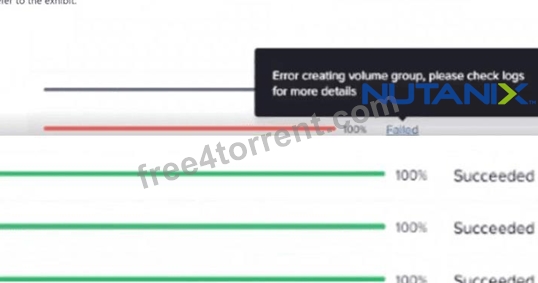
Question:
An administrator is deployingFile Analytics. The following subnets are available:
* CVM subnet: 10.1.1.0/24
* AHV subnet: 10.1.2.0/24
* Nutanix Files client network: 10.1.3.0/24
* Nutanix Files storage network: 10.1.4.0/24
The administrator has reserved10.1.4.100as the File Analytics IP. However, the deploymentfailswith the error shown:
"Error creating volume group, please check logs for more details."
What action must the administrator take to successfully deploy File Analytics?
- A. Allow port 445 in the firewall.
- B. Re-deploy File Analytics on the Files storage network.
- C. Re-deploy File Analytics on the Files client network.
- D. Allow port 139 in the firewall.
Answer: C
Explanation:
According to the NUSA course materials,File Analyticsis designed to be deployed on thesame networkas the Nutanix Filesclient networkbecause:
File Analyticsaccesses file share metadata and analytics datathrough the same SMB/NFS protocolsused by clients accessing the shares.
Using theclient networkensures that File Analytics canconnect to the SMB/NFS endpoints, collect activity logs, and provide visibility without traversing storage-only traffic.
Using thestorage network(as was done with IP 10.1.4.100 in this case) leads to deployment errors because:
"The storage network in Nutanix Files is used exclusively for data replication and cluster-level operations- not for client or analytics traffic. Using this network for File Analytics deployment causes communication failures." Thus, the administrator mustredeploy File Analytics on the Files client network (10.1.3.0/24), ensuring proper access and connectivity.
The firewall port configuration (ports 445/139) is relevant for SMB traffic butnotthe root cause of the deployment error in this case.
NEW QUESTION # 52
Which workload type describes I/O sizes for read and write operations that are less than or equal to 16 KB while file sizes are equal to 10 MB or more?
- A. Sequential
- B. Random
- C. Default
- D. Asynchronous
Answer: B
Explanation:
The workload type that describes I/O sizes for read and write operations that areless than or equal to 16 KB while file sizes are10 MB or moreisRandom. In Nutanix Files, workload types are used to optimize share performance based on I/O patterns. Small I/O sizes (#16 KB) indicate a random access pattern, as opposed to sequential, even if the files themselves are large (#10 MB). This is common in workloads like databases or virtual desktops, where small, non-contiguous I/O operations are performed on larger files.
TheNutanix Unified Storage Administration (NUSA)course states, "A Random workload type in Nutanix Files is characterized by small I/O sizes, typically 16 KB or less, regardless of file size, as it reflects random access patterns rather than sequential ones." The Random workload type optimizes the share for such patterns by adjusting caching, prefetching, and data placement to handle frequent small I/O operations efficiently, even when the files are large.
TheNutanix Certified Professional - Unified Storage (NCP-US)study guide further elaborates that
"workloads with I/O sizes of 16 KB or less, even on large files (e.g., 10 MB or more), are classified as Random, as the small I/O size indicates non-sequential access patterns." Large file sizes do not necessarily imply sequential I/O; the I/O size itself determines the workload type, and 16 KB or less is typical of random access.
The other options are incorrect:
* Sequential: Sequential workloads involve larger I/O sizes (typically >64 KB) and contiguous access patterns, such as those seen in media streaming or backups, not small I/O sizes like 16 KB or less.
* Asynchronous: Asynchronous is not a workload type in Nutanix Files; it may refer to replication or I/O handling methods but is not relevant here.
* Default: The Default workload type applies a balanced configuration but does not specifically optimize for small I/O sizes like the Random type does.
The NUSA course documentation emphasizes that "I/O sizes of 16 KB or less, even with large file sizes, indicate a Random workload type in Nutanix Files, ensuring optimal performance for random access patterns." References:
Nutanix Unified Storage Administration (NUSA) Course, Section on Nutanix Files: "Understanding workload types based on I/O patterns." Nutanix Certified Professional - Unified Storage (NCP-US) Study Guide, Topic 2: Configure and Utilize Nutanix Unified Storage, Subtopic: "Defining workload types for Nutanix Files shares." Nutanix Documentation (https://www.nutanix.com), Nutanix Files Administration Guide: "Workload type definitions for share optimization."
NEW QUESTION # 53
An administrator has configured a volume-group with four vDisks and needs them to be load-balanced across multiple CVMs. The volume-group will be directly connected to the VM. Which task must the administrator perform to meet this requirement?
- A. Select multiple iSCSI adapters within the VM
- B. Enable load-balancing for the volume-group using ncli
- C. Select multiple initiator IQNs when creating the volume-group
- D. Enable load-balancing for the volume-group using acli
Answer: D
Explanation:
To load-balance a volume-group with four vDisks across multiple Controller Virtual Machines (CVMs) for a VM using Nutanix Volumes, the administrator mustenable load-balancing for the volume-group using acli.
Nutanix Volumes supports iSCSI-based block storage, and load-balancing ensures that I/O traffic from the VM is distributed across multiple CVMs, improving performance and scalability. The acli (AHV Command- Line Interface) is the tool used to configure this setting for volume-groups.
TheNutanix Unified Storage Administration (NUSA)course states, "Nutanix Volumes supports load- balancing of iSCSI traffic across CVMs, which can be enabled for a volume-group using the acli command to ensure optimal performance for VMs." The specific command in acli allows the administrator to enable load- balancing, distributing the iSCSI sessions for the volume-group's vDisks across the available CVMs in the cluster. This ensures that the VM's I/O requests are handled by multiple CVMs, preventing any single CVM from becoming a bottleneck.
TheNutanix Certified Professional - Unified Storage (NCP-US)study guide further elaborates that "to enable load-balancing for a volume-group, the administrator can use the acli vg.update command with the enable_load_balancing=true option, ensuring that iSCSI traffic is distributed across CVMs for better performance." This is particularly important for volume-groups with multiple vDisks, as in this case with four vDisks, to optimize I/O distribution.
The other options are incorrect:
* Enable load-balancing for the volume-group using ncli: The ncli (Nutanix Command-Line Interface) is used for cluster-wide configurations, but load-balancing for volume-groups is specifically managed via acli, which is tailored for AHV and volume-group operations.
* Select multiple initiator IQNs when creating the volume-group: Initiator IQNs (iSCSI Qualified Names) are used to authenticate and connect initiators to the volume-group, but selecting multiple IQNs does not enable load-balancing across CVMs.
* Select multiple iSCSI adapters within the VM: Configuring multiple iSCSI adapters in the VM is a client-side configuration that can help with multipathing, but it does not control load-balancing across CVMs, which is a cluster-side setting.
The NUSA course documentation highlights that "enabling load-balancing via acli for a volume-group ensures that iSCSI traffic is distributed across multiple CVMs, optimizing performance for VMs with direct- attached volumes." References:
Nutanix Unified Storage Administration (NUSA) Course, Section on Nutanix Volumes: "Configuring load- balancing for volume-groups." Nutanix Certified Professional - Unified Storage (NCP-US) Study Guide, Topic 2: Configure and Utilize Nutanix Unified Storage, Subtopic: "Nutanix Volumes load-balancing with acli." Nutanix Documentation (https://www.nutanix.com), Nutanix Volumes Administration Guide: "Enabling load- balancing for volume-groups using acli."
NEW QUESTION # 54
A company is managing two Nutanix clusters between two different availability zones: one on-prem and one running in the public cloud (NC2). The company is evaluating Nutanix Files and is looking for a solution that supports: 15-minute RPO or less, guided DR process, and minimal operations at failover time. Which data protection strategy should be considered?
- A. Protection Domain
- B. Smart Sync
- C. Cloud Connect
- D. Smart DR
Answer: D
Explanation:
To meet the requirements of a15-minute RPO (Recovery Point Objective) or less, aguided DR (Disaster Recovery) process, andminimal operations at failover timefor Nutanix Files across two Nutanix clusters (on-prem and in the public cloud via NC2), the company should considerSmart DR. Smart DR is a disaster recovery feature specifically designed for Nutanix Files, enabling replication of file shares between primary and recovery sites with low RPOs, guided failover processes, and automated recovery workflows.
TheNutanix Unified Storage Administration (NUSA)course states, "Smart DR for Nutanix Files supports replication with an RPO as low as 15 minutes, provides a guided disaster recovery process through Prism Central, and minimizes operations at failover by automating client redirection and share activation." Smart DR uses asynchronous replication to copy file share data to the recovery site, allowing for a 15-minute RPO by scheduling replication at 15-minute intervals. The guided DR process is facilitated through Prism Central's UI, which provides step-by-step workflows for failover and failback. Additionally, Smart DR automates client redirection by leveraging AD and DNS updates, minimizing manual operations during failover.
TheNutanix Certified Professional - Unified Storage (NCP-US)study guide further elaborates that "Smart DR is ideal for Nutanix Files deployments across availability zones, such as on-prem and NC2, supporting RPOs as low as 15 minutes, guided recovery workflows, and automated failover with minimal operational overhead." This makes Smart DR the best match for the company's requirements, as it addresses all three criteria effectively.
The other options are incorrect:
* Protection Domain: Protection Domains are used for VM-level replication and disaster recovery in Nutanix, not for Nutanix Files. They also typically have higher RPOs (e.g., 1 hour) and are not designed for file share recovery.
* Smart Sync: Smart Sync is not a Nutanix feature; it may refer to third-party tools or unrelated functionalities and is not applicable here.
* Cloud Connect: Cloud Connect is a feature for backing up or replicating data to public cloud providers, but it is not specific to Nutanix Files and does not support a 15-minute RPO or guided DR processes for file shares.
The NUSA course documentation highlights that "Smart DR is the recommended data protection strategy for Nutanix Files in multi-site environments, offering low RPOs, guided DR workflows, and automated failover to minimize downtime and operational complexity." References:
Nutanix Unified Storage Administration (NUSA) Course, Section on Nutanix Files: "Smart DR for disaster recovery across availability zones." Nutanix Certified Professional - Unified Storage (NCP-US) Study Guide, Topic 2: Configure and Utilize Nutanix Unified Storage, Subtopic: "Smart DR capabilities for Nutanix Files." Nutanix Documentation (https://www.nutanix.com), Nutanix Files Administration Guide: "Smart DR setup for multi-site file share protection."
NEW QUESTION # 55
Question: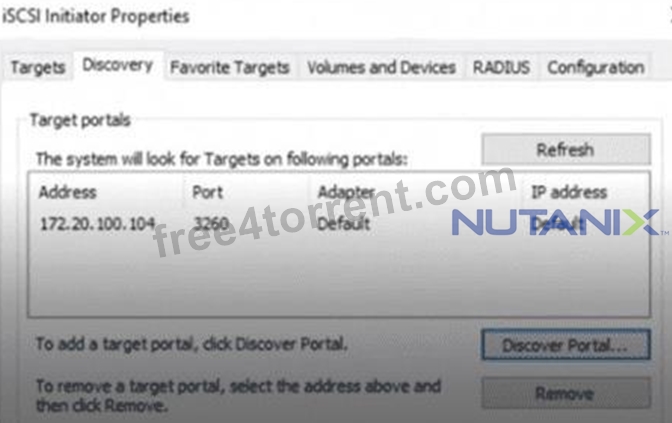
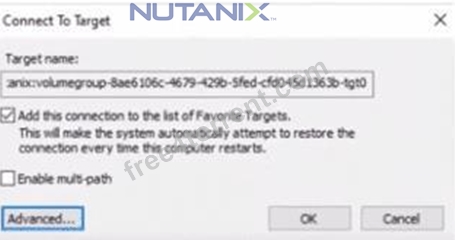
An administrator has received a complaint from a user that a Windows VM lost access to an iSCSI Volume Group (VG) during a maintenance window of an ESXi-based Nutanix cluster. The VM's iSCSI configuration shows it is connecting to a specific IP (172.20.100.104).
What recommended change should the administrator make to resolve this disruption?
- A. Change the Discovery IP to match the configured VIP.
- B. Select the Enable multi-path checkbox.
- C. Remove Discovery IP and configure with DSIP.
- D. Add all missing CVM IPs in Discovery tab.
Answer: C
Explanation:
When configuring iSCSI connections to Nutanix Volume Groups (VGs), Nutanix recommends using theData Services IP (DSIP)as the discovery IP in the iSCSI Initiator configuration. Here's why:
TheDSIP (172.20.100.50)in this environment is designed to be highly available andfloats across CVMs within the Nutanix cluster.
The DSIP automatically handles failover between CVMs during maintenance, software upgrades, or node failures.
Configuring the iSCSI initiator withindividual CVM IPs (like 172.20.100.104)is not recommended because:
* If the CVM goes down (maintenance, upgrade, etc.), the initiator willlose connectionto the volume group, causing the exact issue seen here.
The NUSA and NCP-US course materials specifically emphasize:
"The Data Services IP should be used as the discovery target for iSCSI Volume Groups to ensure automatic failover and eliminate connection disruptions during maintenance windows." VIPis used formanagement traffic(Prism Central/Prism Element) and is not used for iSCSI.
Enable multi-pathis important for performance but does not resolve this misconfigured discovery IP issue.
Adding all CVMsindividually also doesn't provide automated failover and isn't a best practice.
Thus, the fix is toremove the CVM IP (172.20.100.104) and configure the Windows iSCSI initiator with the DSIP (172.20.100.50)as the discovery target.
NEW QUESTION # 56
An administrator wants to utilize File Analytics to send anomaly alerts and data to email recipients. Which statement describes when File Analytics will send the emails?
- A. When a minimum of anomalies are detected.
- B. As defined in the Anomaly Rules.
- C. Every 15 minutes.
- D. Whenever an anomaly is detected.
Answer: B
Explanation:
Nutanix File Analytics sends anomaly alerts and data to email recipientsas defined in the Anomaly Rules.
File Analytics uses anomaly detection to identify unusual activities on the file server, such as permission changes, excessive file access, or potential ransomware behavior. Administrators can configure anomaly rules to specify which activities to monitor and how to handle notifications, including sending emails to designated recipients based on the defined rules.
TheNutanix Unified Storage Administration (NUSA)course explains that "File Analytics allows administrators to define anomaly rules to detect suspicious activities, with email notifications configured as part of the rule settings to alert recipients when specific conditions are met." This ensures that emails are sent only when the criteria in the anomaly rules are triggered, allowing for targeted and timely alerts.
TheNutanix Certified Professional - Unified Storage (NCP-US)study guide further states that "anomaly rules in File Analytics are customizable, enabling administrators to set thresholds, conditions, and notification preferences, including email alerts, to ensure timely responses to detected anomalies." The timing and frequency of email notifications depend on the configuration of the anomaly rules, not a fixed schedule or automatic detection.
The other options are incorrect:
* Whenever an anomaly is detected: While anomalies trigger alerts, emails are sent only if the anomaly rules are configured to do so. Not every detected anomaly automatically results in an email unless specified in the rules.
* Every 15 minutes: File Analytics does not send emails on a fixed 15-minute schedule; notifications are event-driven based on anomaly rule triggers.
* When a minimum of anomalies are detected: There is no concept of a "minimum number of anomalies" in File Analytics; alerts are sent based on the specific conditions defined in the anomaly rules.
The NUSA course documentation emphasizes that "File Analytics anomaly rules provide granular control over alert notifications, with email alerts sent to recipients as specified in the rule configuration, ensuring timely communication of critical events." References:
Nutanix Unified Storage Administration (NUSA) Course, Section on File Analytics: "Configuring anomaly rules and email notifications." Nutanix Certified Professional - Unified Storage (NCP-US) Study Guide, Topic 3: Analyze and Monitor Nutanix Unified Storage, Subtopic: "Anomaly detection and notification settings in File Analytics." Nutanix Documentation (https://www.nutanix.com), Nutanix File Analytics Guide: "Setting up anomaly rules for email alerts."
NEW QUESTION # 57
An administrator is tasked with upgrading Objects Manager to the latest release that came out earlier in the week. The administrator has navigated to the LCM page in Prism Central and does not see the latest version of Objects Manager as an available upgrade. What is the likely reason the administrator does not see the current release of Objects Manager as an available upgrade?
- A. An LCM inventory has not been performed
- B. The administrator needs to perform the upgrade through Prism Element
- C. The administrator is logged in as local admin rather than a domain admin
- D. Prism Central needs to be scaled out
Answer: A
Explanation:
The administrator is attempting to upgrade Objects Manager (a component of Nutanix Objects) using Prism Central's Lifecycle Manager (LCM) but does not see the latest version, which was released earlier in the week (prior to June 05, 2025). The most likely reason is thatan LCM inventory has not been performed. LCM requires an inventory operation to check for available updates by querying Nutanix's external repositories or a dark site server (if configured), and without this step, the latest version of Objects Manager will not appear in the LCM page.
TheNutanix Unified Storage Administration (NUSA)course states, "Before upgrading components like Objects Manager via LCM, an inventory must be performed in Prism Central to retrieve the latest available versions from Nutanix repositories." The inventory process updates the LCM catalog with the latest software versions, including Objects Manager, ensuring that the administrator can see and select the new release for upgrade. If the inventory has not been run recently, LCM will only show versions that were available during the last inventory, which may not include the latest release from earlier in the week.
TheNutanix Certified Professional - Unified Storage (NCP-US)study guide further elaborates that "a common reason for missing the latest component versions in LCM is the failure to perform an inventory; administrators must run an LCM inventory to ensure the latest versions, such as new releases of Objects Manager, are available for upgrade." Since the latest version was released recently, an inventory is necessary to refresh the LCM catalog.
The other options are incorrect:
* The administrator is logged in as local admin rather than a domain admin: The issue is not related to the type of admin account (local vs. domain). Both local and domain admins can perform LCM inventories and upgrades if they have the necessary permissions, and there is no indication of a permission error.
* The administrator needs to perform the upgrade through Prism Element: LCM upgrades for Nutanix Objects components, including Objects Manager, are performed through Prism Central, not Prism Element, as Prism Central provides centralized management for such operations.
* Prism Central needs to be scaled out: Scaling out Prism Central (e.g., adding more VMs) is not required to see available upgrades in LCM. The issue is related to the inventory process, not Prism Central's scale.
The NUSA course documentation emphasizes that "running an LCM inventory is a critical step to ensure the latest versions of components like Objects Manager are visible in Prism Central for upgrades, especially for recent releases." References:
Nutanix Unified Storage Administration (NUSA) Course, Section on Lifecycle Management: "Performing LCM inventory for component upgrades." Nutanix Certified Professional - Unified Storage (NCP-US) Study Guide, Topic 1: Deploy and Upgrade Nutanix Unified Storage, Subtopic: "LCM inventory process for Nutanix Objects upgrades." Nutanix Documentation (https://www.nutanix.com), LCM Administration Guide: "Running inventory to check for available upgrades."
NEW QUESTION # 58
Which share workload type should be configured to support workloads with small I/O?
- A. Sequential
- B. Random
- C. Default
- D. Compression
Answer: B
Explanation:
To support workloads with small I/O operations in Nutanix Files, the share should be configured with the Randomworkload type. Small I/O operations, typically less than 64 KB, are characteristic of random I/O patterns, which are common in workloads like databases, virtual desktops, or applications with frequent small read/write operations. Nutanix Files allows administrators to optimize share performance by selecting a workload type that aligns with the I/O pattern.
TheNutanix Unified Storage Administration (NUSA)course states, "Nutanix Files supports configuring shares with a Random workload type to optimize performance for small I/O operations, which are typical of random access patterns." The Random workload type adjusts internal optimizations, such as caching and data placement, to better handle the characteristics of small, non-sequential I/O operations, improving performance for such workloads.
TheNutanix Certified Professional - Unified Storage (NCP-US)study guide further elaborates that "the Random workload type in Nutanix Files is designed for shares hosting applications with small I/O sizes, ensuring efficient handling of random read and write operations." This contrasts with sequential workloads, which involve larger, contiguous I/O operations, such as those seen in media streaming or backups.
The other options are incorrect:
* Sequential: The Sequential workload type is optimized for large, contiguous I/O operations, not small I
/O, making it unsuitable for this scenario.
* Compression: Compression is a data reduction feature, not a workload type, and does not directly address I/O performance optimization.
* Default: The Default workload type applies a balanced configuration but does not specifically optimize for small I/O operations like the Random type does.
The NUSA course documentation emphasizes that "configuring a share with the Random workload type ensures optimal performance for workloads with small I/O, aligning with the random access patterns of such applications." References:
Nutanix Unified Storage Administration (NUSA) Course, Section on Nutanix Files: "Configuring workload types for share optimization." Nutanix Certified Professional - Unified Storage (NCP-US) Study Guide, Topic 2: Configure and Utilize Nutanix Unified Storage, Subtopic: "Workload type configuration for Nutanix Files shares." Nutanix Documentation (https://www.nutanix.com), Nutanix Files Administration Guide: "Setting workload types for share performance."
NEW QUESTION # 59
Question:
When naming an Object Store instance, which two naming rules must be followed? (Choose two.)
- A. Must begin with a number and end with a letter or number.
- B. Must begin with a letter, and end with a letter or number.
- C. Must be unique across all existing object store names in Objects.
- D. Must be a minimum of three and a maximum of 32 characters long.
Answer: B,D
Explanation:
During Nutanix Objects deployment,Object Store instance namingis governed by specific conventions to ensure system consistency and compatibility with DNS and object storage standards.
The NUSA course describes thesestrict naming rules:
Length Rule:
"Object store names must be between 3 and 32 characters in length. This ensures that the names are concise yet descriptive enough for operational clarity." Start/End Rule:
"Object store names must begin with a letter and end with a letter or a number. Names cannot start with a number or symbol to maintain naming consistency across DNS and storage services." Uniqueness Across All Clusters:
"While object store names must be unique within the same Nutanix cluster, global uniqueness across multiple clusters is not enforced or required." Starting with a number:
"Names starting with numbers are not supported, as per best practices to align with DNS naming standards." Thus, the enforced rules:
#Minimum 3, maximum 32 characters
#Begin with a letter and end with a letter/number
NEW QUESTION # 60
Which two protocols can be enabled during a Nutanix Files installation? (Choose two.)
- A. iSCSI
- B. NFS
- C. SMB
- D. S3
Answer: B,C
Explanation:
During a Nutanix Files installation, the two protocols that can be enabled areNFS (Network File System)and SMB (Server Message Block). Nutanix Files is a scale-out file storage solution designed to provide file- sharing services, supporting both NFS for Linux/Unix environments and SMB for Windows environments.
TheNutanix Unified Storage Administration (NUSA)course states, "Nutanix Files supports NFS and SMB protocols, which can be enabled during the installation and configuration of a file server to provide file- sharing services for diverse workloads." NFS is typically used for Unix/Linux clients, while SMB is used for Windows clients, allowing Nutanix Files to serve a wide range of applications and users.
TheNutanix Certified Professional - Unified Storage (NCP-US)study guide further clarifies that "during Nutanix Files deployment, administrators can enable NFS and SMB protocols based on the needs of the environment, ensuring compatibility with both Linux and Windows clients." These protocols are configured at the file server level, and shares can be created with either or both protocols enabled.
The other options are incorrect:
* S3: The S3 protocol is specific to Nutanix Objects, an object storage solution, and is not supported by Nutanix Files, which focuses on file-level storage.
* iSCSI: The iSCSI protocol is used for block storage and is supported by Nutanix Volumes, not Nutanix Files, which is designed for file-sharing protocols like NFS and SMB.
The NUSA course documentation emphasizes that "Nutanix Files installation allows the administrator to select NFS and SMB protocols to meet the file-sharing requirements of the organization, ensuring broad compatibility across client environments." References:
Nutanix Unified Storage Administration (NUSA) Course, Section on Nutanix Files: "Protocol configuration during Nutanix Files installation." Nutanix Certified Professional - Unified Storage (NCP-US) Study Guide, Topic 1: Deploy and Upgrade Nutanix Unified Storage, Subtopic: "Nutanix Files deployment and protocol support." Nutanix Documentation (https://www.nutanix.com), Nutanix Files Administration Guide: "Enabling NFS and SMB protocols for Nutanix Files."
NEW QUESTION # 61
What prerequisite must be met before a Nutanix Files SMB share can be used?
- A. Register the cluster with Prism Central.
- B. Configure directory services.
- C. Enable a strong password policy.
- D. Run afs infra.start
Answer: B
Explanation:
Directory services integration (e.g., Active Directory) is mandatory for SMB shares to:
* Authenticate users.
* Apply access controls (ACLs).
* Enable Kerberos-based security.Without this, SMB shares cannot be accessed by domain-joined clients.
* Option B: Prism Central registration enables central management but isn't a share prerequisite.
* Option C: afs infra.start is an invalid command.
* Option D: Password policies are enforced via directory services but not a standalone prerequisite.
Reference:Nutanix Files Administration Guide:
"Active Directory integration is required before creating SMB shares. File Server VMs must be domain- joined for user authentication."(Chapter: "Configuring SMB Shares") Nutanix Unified Storage Administration (NUSA) Course:
"Directory services configuration is the foundational step for SMB share deployment."(Module: "Nutanix Files SMB Implementation")
NEW QUESTION # 62
Question:
An administrator needs to stop an FSVM.
What should the administrator check before stopping a specific FSVM?
- A. Is VDI Sync configured.
- B. High Availability (HA) state.
- C. Data Protection status.
- D. Is SSR configured in the cluster.
Answer: B
Explanation:
FSVMs (File Server VMs)are essential for delivering file services (SMB/NFS) in Nutanix Files. Each FSVM is responsible for handling client connections and file access requests.Stopping an FSVMcan temporarily disrupt file share access if not properly coordinated.
TheHigh Availability (HA) stateis thecritical factorto check before stopping an FSVM because:
TheNUSA and NCP-US coursesemphasize:
"In a Nutanix Files deployment, High Availability (HA) for FSVMs ensures that client connections are redistributed to other FSVMs in the cluster when an FSVM is stopped or fails. Before stopping an FSVM, administrators must confirm that HA is enabled to avoid data access disruption." If HA is disabled or misconfigured:
* Stopping an FSVM could lead toclient disconnectionsand potential data access issues.
* Thefiles servicemay temporarily becomeunavailablefor the workloads handled by that FSVM.
The other options are not directly related tostopping FSVMs:
Data Protection status- more relevant to snapshots and replication, not FSVM runtime status.
VDI Sync- relates to desktop sync, not FSVM management.
SSR (Self-Service Restore)- depends on file share snapshots, not FSVM status.
Thus, the best practice is tocheck HA stateto ensure a seamless failover and minimal service impact before stopping the FSVM.
NEW QUESTION # 63
......
Dumps for Free NCP-US-6.10 Practice Exam Questions: https://www.free4torrent.com/NCP-US-6.10-braindumps-torrent.html
NCP-US-6.10 Dumps PDF And Certification Training: https://drive.google.com/open?id=1rU83sjloFg6_Sc5bN3fbwUGlkG_r2_Dx