

Current PMI-RMP Exam Dumps [2024] Complete PMI Exam Smoothly
PMI-RMP Premium PDF & Test Engine Files with 133 Questions & Answers
NEW QUESTION # 58
You work as a project manager for BlueWell Inc. You are preparing to plan risk responses for your project with your team. How many risk response types are available for a negative risk event in the project?
- A. Three
- B. Seven
- C. One
- D. Four
Answer: D
NEW QUESTION # 59
Stakeholder deliverable reviews will start soon and additional work is expected to resolve any issues or required adjustments. Budget overruns during execution have put serious constraints on the remainder of the project's budget.
What should the project manager do next?
- A. Request a budget relief using the management reserve.
- B. Review the consequences of potential changes.
- C. Conduct a risk reassessment and reserve analysis.
- D. Coach stakeholders on risk identification practices.
Answer: C
Explanation:
Explanation
The project manager should reassess the risks and analyze the reserve to determine if any adjustments can be made to accommodate the expected additional work. This will help in identifying potential budget-saving measures and making informed decisions on how toproceed.
NEW QUESTION # 60
John works as a project manager for BlueWell Inc. He is determining which risks can affect the project. Which of the following inputs of the identify risks process is useful in identifying risks associated to the time allowances for the activities or projects as a whole, with a width of the range indicating the degrees of risk?
- A. Activity duration estimates
- B. Risk management plan
- C. Activity cost estimates
- D. Schedule management plan
Answer: A
Explanation:
Explanation
NEW QUESTION # 61
Kelly is the project manager of the BHH project for her organization. She is completing the risk identification process for this portion of her project. Which one of the following is the only thing that the risk identification process will create for Kelly?
- A. Change requests
- B. Project document updates
- C. Risk register updates
- D. Risk register
Answer: D
NEW QUESTION # 62
A project manager is working on a construction project. Based on past experience, the project manager identifies a risk that a supplier of a critical material may not deliver on time. The project manager has already accounted for this risk in the risk management plan. If this risk materializes, the project manager plans to procure the material from a different supplier. A potential risk in this plan is that there may be differences in the material provided by the first and second supplier.
What type of risk is this?
- A. Residual risk
- B. Primary risk
- C. Normal risk
- D. Secondary risk
Answer: D
Explanation:
Explanation
This is a secondary risk because it is a risk that arises as a direct result of implementing a risk response (in this case, procuring material from a different supplier).
A secondary risk is a risk that arises as a direct result of implementing a risk response to a specific risk. In this case, the risk response is to procure the material from a different supplier if the first supplier fails to deliver on time. The secondary risk is that there may be differences in the material provided by the first and second supplier, which could affect the quality, cost, or schedule of the project. A secondary risk is different from a residual risk, which is a risk that remains after a risk response has been implemented. A primary risk is the original risk that triggers a risk response. A normal risk is not a standard term in risk management, but it could refer to a risk that is expected or inherent in a project. References: PMI Risk Management Professional (PMI-RMP) Examination Content Outline and Specifications1, page 9; A Guide to the Project Management Body of Knowledge (PMBOK Guide) - Sixth Edition, page 397; Secondary vs Residual Risk | Types of Risks on the PMP Exam.
NEW QUESTION # 63
Linda is the project manager of the NAB Project. One of the risks her project team has identified is too dangerous for the project team to manage internally so she has hired a vendor to complete this portion of the project and to manage the identified risk. What risk response has Linda used in this instance?
- A. Mitigation
- B. Transference
- C. Avoidance
- D. Contractual
Answer: B
NEW QUESTION # 64
A risk manager works with the project team, senior management team, subject matter experts and other stakeholders to identify the project risks. Which of the following tools/methods from the risk management plan can be used to identify a risk, which is based on project objectives by category?
- A. Work breakdown structure
- B. Affinity diagram
- C. Risk breakdown structure
- D. Decision tree method
Answer: D
NEW QUESTION # 65
You are the project manager of the BlueStar project in your company. Your company is structured as a functional organization and you report to the functional manager that you are ready to move onto the qualitative risk analysis process. What will you need as inputs for the qualitative risk analysis of the project in this scenario?
- A. Qualitative risk analysis does not happen through the project manager in a functional structure.
- B. You will need the risk register, risk management plan, permission from the functional manager, and any relevant organizational process assets.
- C. You will need the risk register, risk management plan, outputs of qualitative risk analysis, and any relevant organizational process assets.
- D. You will need the risk register, risk management plan, project scope statement, and any relevant organizational process assets.
Answer: D
NEW QUESTION # 66
Jeff, a key stakeholder in your project, wants to know how the risk exposure for the risk events is calculated during quantitative risk analysis. He is worried about the risk exposure which is too low for the events surrounding his project requirements. How is the risk exposure calculated?
- A. The probability of a risk event plus the impact of a risk event determines the true risk exposure.
- B. The probability and impact of a risk event are gauged based on research and in-depth analysis.
- C. The risk exposure of a risk event is determined by historical information.
- D. The probability of a risk event times the impact of a risk event determines the true risk exposure.
Answer: D
NEW QUESTION # 67
A project manager is working on a high priority and high profile project. The project team had identified three opportunities, and after analysis, risk responses were recorded. Although risk responses were adequate for the identified opportunities, two of those opportunities were not acted upon. During the risk audit, the project manager found out that several of the planned risk responses were not implemented.
What should the project manager have done to avoid this?
- A. Determined risk triggers and thresholds in the risk response plan
- B. Updated the project schedule, adding risk owner implementation tasks.
- C. Provided regular training to the risk owners for plan implementation
- D. Increased communications to influence stakeholder risk responses
Answer: B
Explanation:
Explanation
The project manager should have updated the project schedule by adding risk owner implementation tasks.
This would have ensured that the planned risk responses were implemented in a timely manner and tracked as part of the project schedule. This would also have allowed the project manager to monitor the progress of risk response implementation and take corrective action if necessary.
NEW QUESTION # 68
Holly is the project manager of the GHH Project. During risk identification and the subsequent risk analysis process she has identified a risk with a high probability and high impact for her project. She and the stakeholder agree that the project management plan should be changed to eliminate the risk threat entirely. What risk response has Holly used in this instance?
- A. This is the avoidance risk response.
- B. This is the transference risk response.
- C. This is a scope change and not a risk response.
- D. This is the risk mitigation response.
Answer: A
NEW QUESTION # 69
You are working as a project manager in your organization. You are nearing the final stages of project execution and looking towards the final risk monitoring and controlling activities. For your project archives, which one of the following is an output of risk monitoring and control?
- A. Qualitative risk analysis
- B. Risk audits
- C. Requested changes
- D. Quantitative risk analysis
Answer: C
NEW QUESTION # 70
The project manager and the risk manager of a new project to develop an application to support autonomous driving are meeting with the sponsor and key stakeholders to discuss the project. During the meeting, it is identified that the transport authority is discussing new traffic regulations for the industry that could be in place before the project ends.
How should the project manager and the risk manager handle this situation?
- A. Perform inquiries on the website of the traffic authority weekly.
- B. Ensure the project complies with the current traffic regulations and laws.
- C. Send a letter to the traffic authority with the general project information.
- D. Meet with the traffic authority staff in charge of the new regulation.
Answer: D
Explanation:
Explanation
Meeting with the traffic authority staff responsible for the new regulation allows the project manager and risk manager to understand the potential changes and their impact on the project. This will help them proactively address any potential issues and ensure the project complies with the new regulations.
NEW QUESTION # 71
Your project team has identified a project risk that must be responded to. The risk has been recorded in the risk register and the project team has been discussing potential risk responses for the risk event. The event is not likely to happen for several months but the probability of the event is high. Which one of the following is a valid response to the identified risk event?
- A. Risk audit
- B. Technical performance measurement
- C. Earned value management
- D. Corrective action
Answer: D
NEW QUESTION # 72
After starting a new pipeline project, a risk manager schedules an initial meeting with the project sponsor. For the meeting, the project sponsor requests a presentation of the risks that have the most impact on achieving the project objectives.
What should the risk manager do to facilitate the sponsor's ask?
- A. Qualitative risk analysis
- B. Monte Carlo analysis
- C. Sensitivity analysis
- D. Quantitative risk analysis
Answer: C
Explanation:
Explanation
Quantitative risk analysis helps to numerically analyze the probability and impact of risks on project objectives. By performing quantitative risk analysis, the risk manager can present the risks with the most impact on achieving the project objectives to the project sponsor. (Reference: PMBOK Guide, 6th Edition, p.
423)
According to the PMI Risk Management Professional (PMI-RMP) Reference Materials, sensitivity analysis is a type of probabilistic analysis that determines how sensitive the results of the analysis are to uncertainties in input variables. Sensitivity analysis determines which uncertainty has the greatest potential for an impact on the project objectives, such as cost, schedule, scope, or quality1. In this case, the risk manager should use sensitivity analysis to facilitate the sponsor's ask, as it will help to identify and present the risks that have the most impact on achieving the project objectives. Sensitivity analysis can also show how the project objectives will vary with the changes in the input variables, such as the probability and impact of risks2. Sensitivity analysis can be performed using various tools and techniques, such as tornado diagrams, spider charts, or influence diagrams3.
References: 1: PMI, A Guide to the Project Management Body of Knowledge (PMBOK Guide), Sixth Edition, 2017, p. 403 2: PMI, Practice Standard for Project Risk Management, 2009, p. 95 3: Quantitative Risk Analysis in Project Management - PM-Training
NEW QUESTION # 73
A company in the mining industry accommodates a lot of innovation and changing work conditions. Because of this, the company experiences difficulty in predicting long term business plans.
How should a professional risk manager manage the risks in such situations?
- A. Utilize proper documentation to help manage the risks.
- B. Adopt a predictive approach to manage the risks.
- C. Conduct weekly risk management meetings with all stakeholders.
- D. Adopt agile approaches to manage the risks.
Answer: D
Explanation:
Explanation
In a company with rapidly changing work conditions and difficulty in predicting long-term business plans, a professional risk manager should adopt agile approaches to manage the risks (B). Agile approaches allow for flexibility, adaptability, and quick response to changes, making them suitable for managing risks in such situations. This is supported by the PMI's PMBOK Guide, Sixth Edition, and the Agile Practice Guide.
A professional risk manager should adopt agile approaches to manage the risks in situations where the company accommodates a lot of innovation and changing work conditions, and experiences difficulty in predicting long term business plans. Agile approaches are adaptive, iterative, and collaborative methods that focus on delivering value and reducing uncertainty in a dynamic and complex environment. Agile approaches can help the risk manager to identify, analyze, respond, and monitor risks in a flexible and timely manner, by using tools and techniques such as risk-adjusted backlog, risk burndown charts, risk-based spike, and risk-based testing. Agile approaches can also help the risk manager to engage the stakeholders and the project team in risk management activities, by using practices such as daily stand-up meetings, sprint planning, sprint review, and sprint retrospective. Agile approaches can enable the risk manager to manage the risks effectively and efficiently, by aligning the risk management strategy with the project goals and the customer needs.
Adopting a predictive approach to manage the risks is not the best option, as it may not be suitable or feasible for situations where the project scope, schedule, and budget are uncertain or variable. A predictive approach is a plan-driven and sequential method that relies on upfront planning and detailed documentation to manage the risks. A predictive approach may not be able to cope with the frequent changes and emerging risks that may occur in an innovative and dynamic environment. Utilizing proper documentation to help manage the risks is not the best option, as it may not be sufficient or effective for situations where the project requirements and deliverables are evolving or changing. Proper documentation is a useful and necessary component of risk management, but it is not a substitute for agile risk management practices. Proper documentation may not be able to capture and communicate the current and relevant information about the risks and their impacts in a timely and accurate manner. Conducting weekly risk management meetings with all stakeholders is not the best option, as it may not be optimal or efficient for situations where the project risks and opportunities are changing rapidly or frequently. Weekly risk management meetings are a common and beneficial practice for risk management, but they may not be enough or appropriate for agile risk management. Weekly risk management meetings may not be able to address the risks and their responses as soon as they arise or occur, and they may not be able to involve all the relevant and available stakeholders and project team members. References: 3, 4, 5
NEW QUESTION # 74
You are working with the project stakeholders to analyze and prioritize their requirements for the project.
One of the project requirements is to achieve a high-level of customer satisfaction for the project deliverable. What is the danger in this project requirement?
- A. Achieving customer satisfaction is an assumption and should be documented in the project scope.
- B. Achieving customer satisfaction is a subjective requirement and entails a high level of risk of being successfully accomplished.
- C. Achieving customer satisfaction should always map to the quality requirements for the project.
- D. Achieving customer satisfaction is a risk as the project manager cannot control how satisfied the customer will be with the project deliverables.
Answer: B
NEW QUESTION # 75 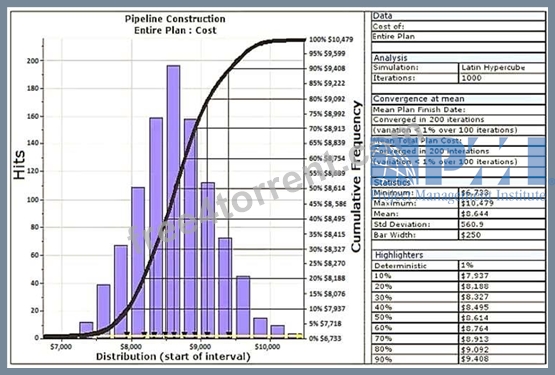
The project values are in thousands. What is the average cost of the project?
- A. US$8,619,000
- B. US$8,495,000
- C. US$8,764,000
- D. US$8,614,000
Answer: D
NEW QUESTION # 76
......
PMI-RMP Premium Files Practice Valid Exam Dumps Question: https://www.free4torrent.com/PMI-RMP-braindumps-torrent.html
Get 100% Real PMI-RMP Accurate & Verified Answers As Seen in the Real Exam!: https://drive.google.com/open?id=1CwdzJq_ZCHb9GDVrcIej15DXN7NCaTGK