

[Nov-2023] Pass TDA-C01 Exam in First Attempt Updated TDA-C01 Exam Questions
Tableau Certified Dumps TDA-C01 Exam for Full Questions - Exam Study Guide
NEW QUESTION # 32
You have the following dataset in Microsoft Excel.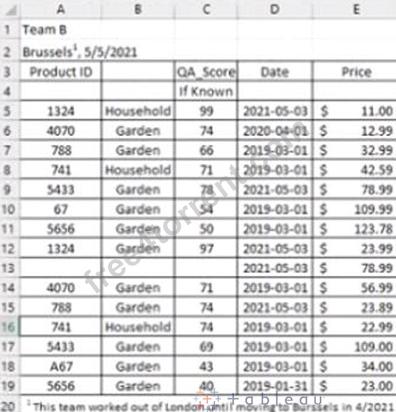
You are using interpreter to cleans the dataset. Data interpreter provides the following results.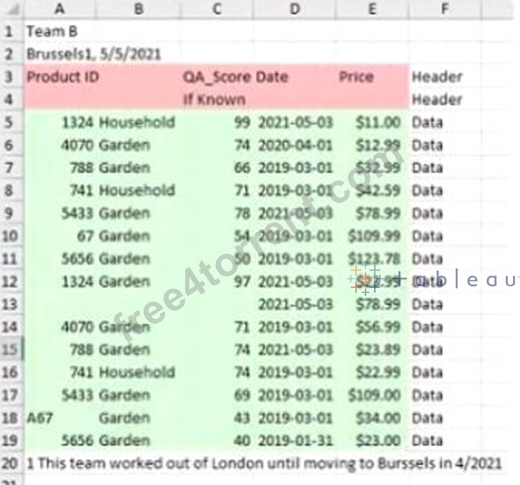
How many rows of data will be ingested into Tableau as values?
- A. 0
- B. 1
- C. 2
- D. 3
Answer: C
NEW QUESTION # 33
Open the link to Book1 found on the desktop. Open Disciplines worksheet.
Filter the table to show the members of the Top10 set and the members of the Bottom10 set. There should be a total of 20 rows.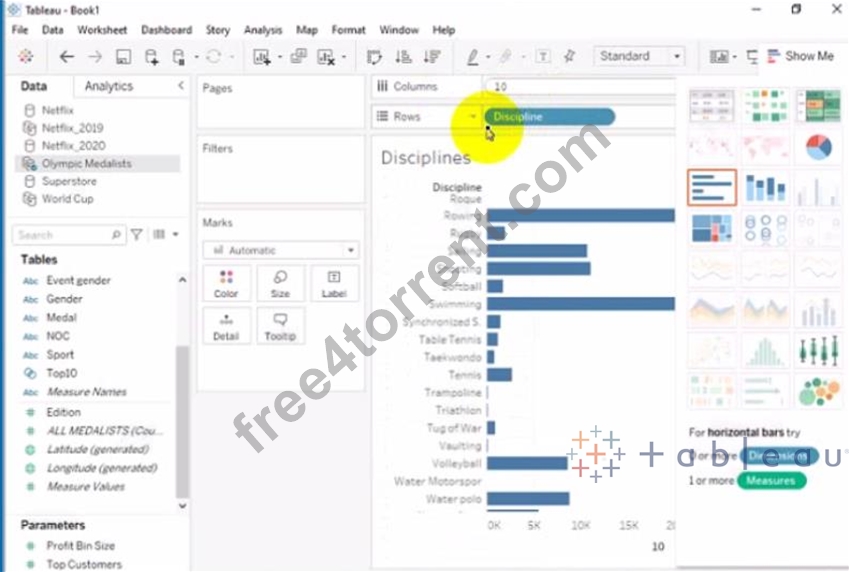
Answer:
Explanation:
check the steps below in explanation
Explanation:
To filter the table to show the members of the Top10 set and the Bottom10 set, you need to do the following steps:
Open the link to Book1 found on the desktop. This will open the Tableau workbook that contains the Disciplines worksheet.
Click on the Disciplines tab at the bottom of the workbook to open the worksheet. You will see a table that shows the disciplines, sales, and profit for each salesperson.
Click on the drop-down arrow next to Salesperson on the Filters shelf. This will open a menu that allows you to filter by different criteria.
Select Set from the menu. This will show you the sets that are available for the Salesperson field. You will see Top10 and Bottom10 as two sets that have been created based on the sales ranking.
Check the boxes next to Top10 and Bottom10. This will filter the table to show only the members of these two sets. You can also click on All to deselect all other values.
Click OK to apply the filter. You will see that the table now shows 20 rows, 10 for each set.
NEW QUESTION # 34
You have the following dataset.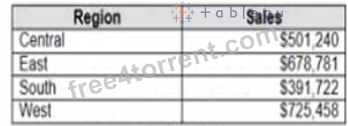
Which Level of Detail (LOD) expression should you use to calculate tie grand total of all the regions?
- A. {FIXED: TOTAL (Sales)}
- B. {Fixed: [Region]: TOTAL Sales}
- C. {FIXED: SUM Sales}
- D. {FIXED: [Region] SUM Sales}
Answer: A
Explanation:
To calculate the grand total of all the regions, you need to use a Level of Detail (LOD) expression that ignores any dimensions in the view and returns the total sum of sales. The FIXED keyword allows you to specify the level of detail for the calculation, and the TOTAL function returns the sum of all values in the expression. Therefore, the correct LOD expression is {FIXED: TOTAL (Sales)}. Reference: https://help.tableau.com/current/pro/desktop/en-us/calculations_calculatedfields_lod.htm https://help.tableau.com/current/pro/desktop/en-us/functions_functions_tablecalculation.htm#TOTAL
NEW QUESTION # 35
Open the link to Book1 found on the desktop. Open Disciplines worksheet.
Filter the table to show the Top 10 NOC based on the number of medals won.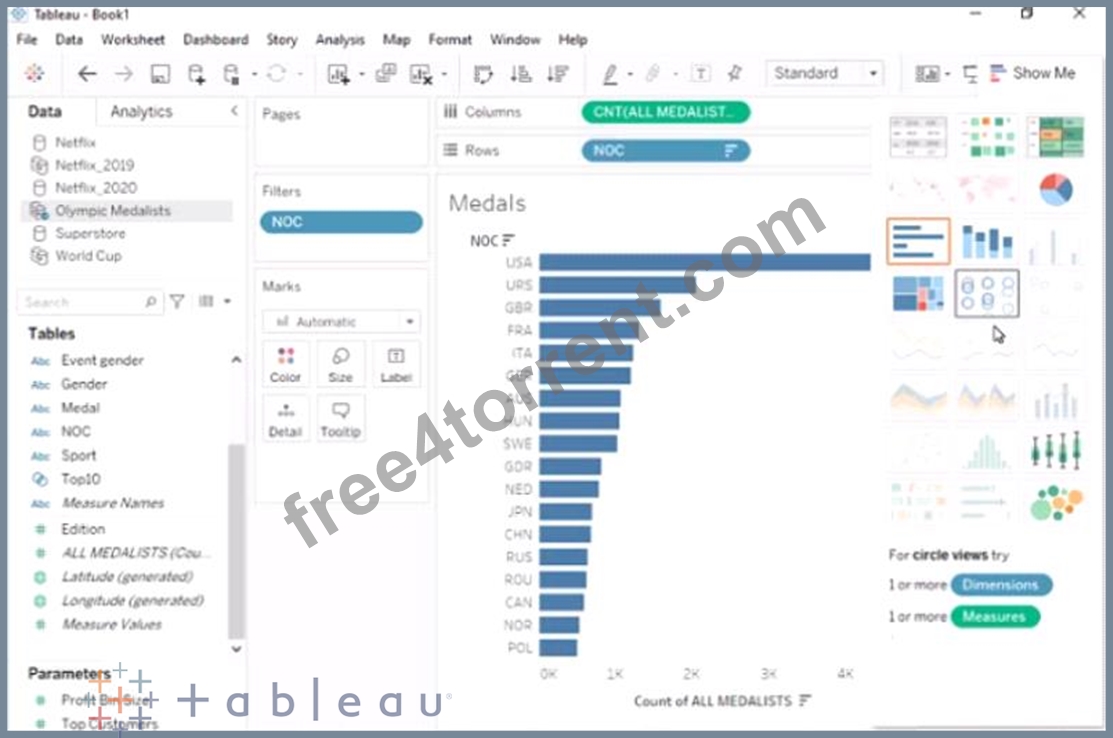
- A. Send us your feedback on it.
- B. Send us your
Answer: A
NEW QUESTION # 36
You want to add a draft watermark to a dashboard as shown in the following exhibit.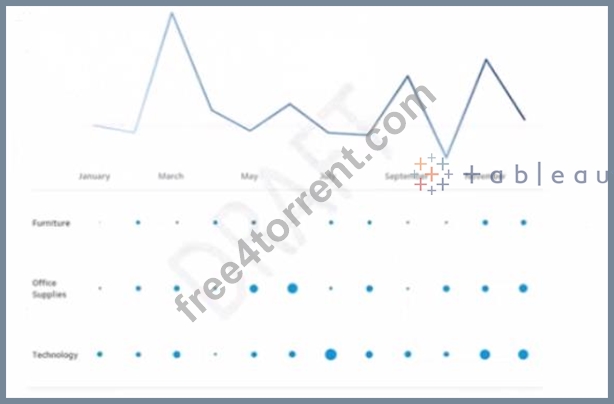
Which type of object should you use?
- A. Sheet
- B. Horizontal
- C. Image
- D. Web page
Answer: A
Explanation:
To add a draft watermark to a dashboard, you should use a sheet as a type of object. A sheet is a worksheet that contains a chart or a table that you can add to your dashboard. You can create a sheet that shows the word "Draft" as a text mark and format it with transparency, size, and color. Then you can drag the sheet to your dashboard and position it behind your other sheets as a floating element. You can also adjust the opacity and layering of the sheet to make it look like a watermark. Reference: https://help.tableau.com/current/pro/desktop/en-us/dashboards.htm https://help.tableau.com/current/pro/desktop/en-us/dashboards_create_layouts.htm https://help.tableau.com/current/pro/desktop/en-us/dashboards_create_watermarks.htm
NEW QUESTION # 37
You have the following data source in tableau Server.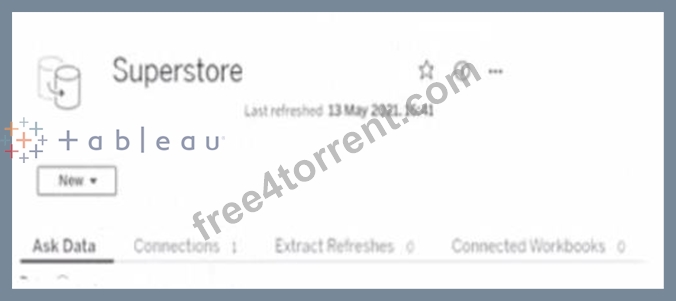
You need to ensure that the data is updated every hour.
What should you select?
- A. Connected Workbooks
- B. Connections
- C. New
- D. Extract Refreshes
Answer: D
Explanation:
To ensure that the data is updated every hour, you need to select Extract Refreshes from the data source menu on Tableau Server. This will allow you to add a new extract refresh schedule or edit an existing one. You can specify the frequency and time of the refresh, as well as any custom options or credentials. New will create a new data source, Connected Workbooks will show you which workbooks use this data source, and Connections will show you which tables or files are connected to this data source. Reference: https://help.tableau.com/current/server/en-us/refresh_extracts.htm https://help.tableau.com/current/server/en-us/refresh_extracts_add.htm
NEW QUESTION # 38
A colleague provides you with access to a folder that contains the following files:
* Sates.csv
* Bookl.twb
* Sates.hyper
* Export.mdb
Which He contains an extract?
- A. Sales.csv
- B. Export mdb
- C. Book1.twb
- D. Sales.hyper
Answer: B
NEW QUESTION # 39
Open the link to Book1 found on the desktop. Open the Histogram worksheet and use the Superstone data source.
Create a histogram on the Quantity field by using bin size of 3.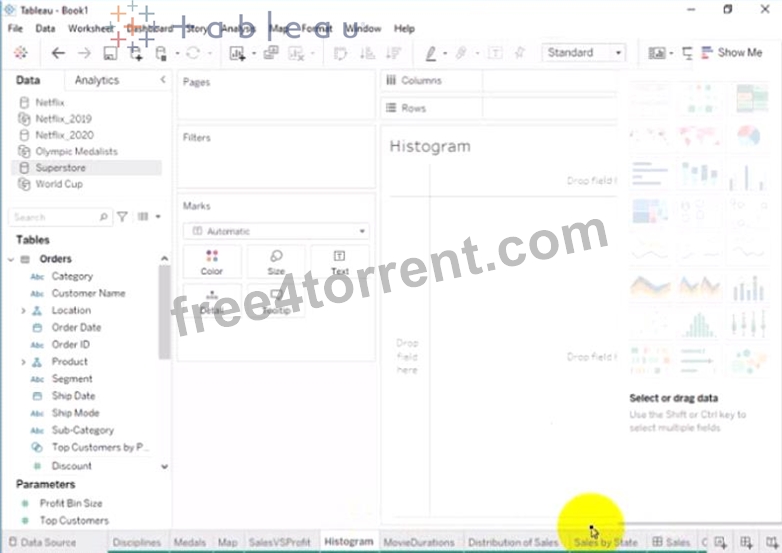
- A. Send us your feedback on it.
- B. Send us your
Answer: A
NEW QUESTION # 40
Open the link to Book1 found on the desktop. Open the Line worksheet.
Modify the chart to show only main and max values of both measures in each region.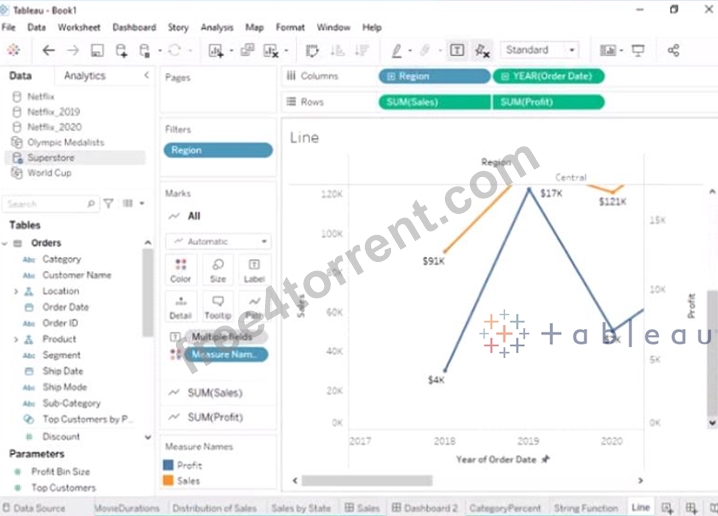
- A. Send us your feedback on it.
- B. Send us your
Answer: A
NEW QUESTION # 41
A colleague provides you with access to a folder that contains the following files:
* Sates.csv
* Bookl.twb
* Sates.hyper
* Export.mdb
Which He contains an extract?
- A. Sales.csv
- B. Export mdb
- C. Book1.twb
- D. Sales.hyper
Answer: D
Explanation:
A .hyper file is an extract file that contains a snapshot of data from a data source. It is a compressed and optimized file format that can be used to improve the performance and portability of dashboards and workbooks. A .twb file is a workbook file that contains the visualization and connection information, but not the data itself. A .csv file is a comma-separated values file that contains plain text data. A .mdb file is a Microsoft Access database file that contains tables, queries, forms, and other objects. Reference: https://help.tableau.com/current/pro/desktop/en-us/save_savework_packagedworkbooks.htm https://help.tableau.com/current/pro/desktop/en-us/extracting_data.htm https://help.tableau.com/current/pro/desktop/en-us/examples_csv.htm https://support.microsoft.com/en-us/office/introduction-to-access-database-files-9f9a0f8c-9a3c-4a0b-8e6c-6d1f1f7c2b7e
NEW QUESTION # 42
You have a line chart on a worksheet.
You want to add a comment to March 2020 as shown in the following visualization.
What should you do?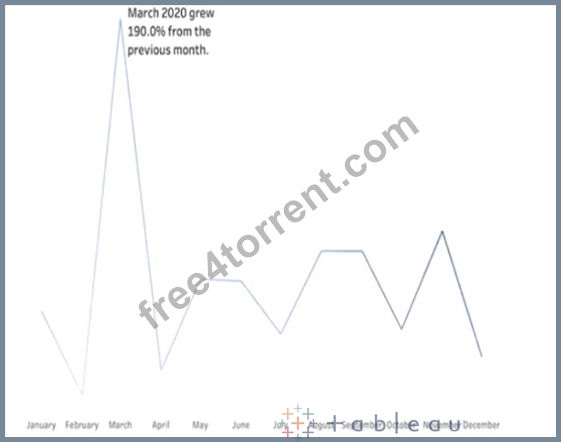
- A. Annotate March 2020
- B. Enable captions
- C. Drag the growth rate to Text on the Marks card
- D. Add a tooltip
Answer: D
NEW QUESTION # 43
You have the following line chart that shows the average sales by month.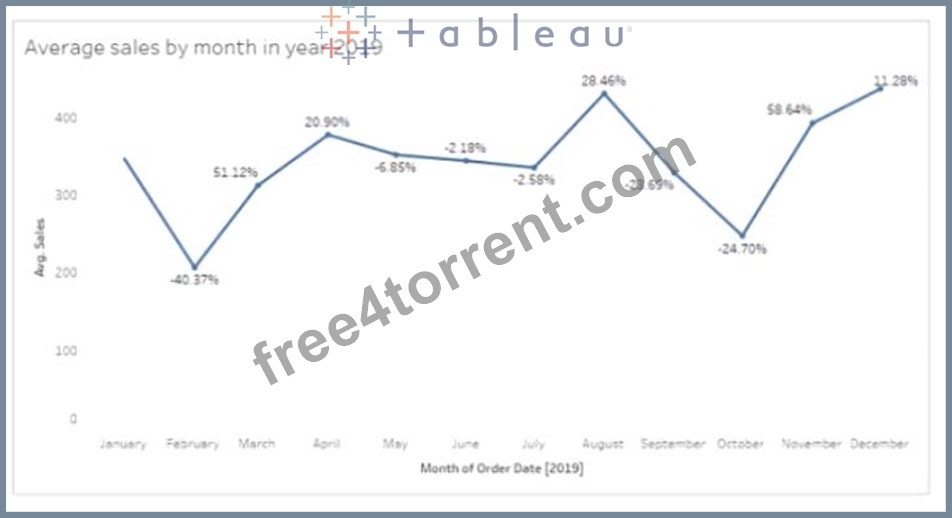
Which month had the biggest increase in swage sales compared to me previous month in 2019?
- A. December
- B. November
- C. October
- D. August
Answer: B
NEW QUESTION # 44
You have the following chart that shows profits and discounts over time.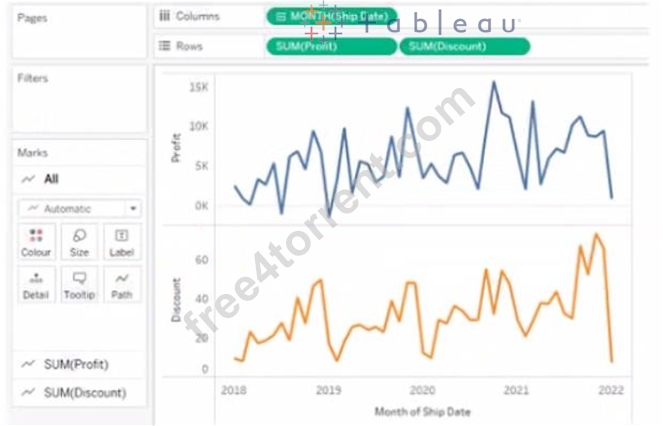
You need to combine the lines to appear as shown in the following chart.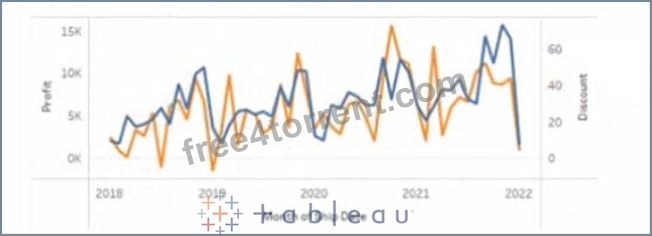
What should you do?
- A. Convert Discount to Discrete
- B. Drag Discount to Color on the Marks card
- C. Drag Discount to the Columns shelf
- D. Set Discount to Dual Axis
Answer: D
Explanation:
To combine the lines to appear as shown in the second chart, you should set Discount to Dual Axis. Dual Axis is a feature that allows you to show two measures on two separate axes on one chart. You can create a dual axis by right-clicking on a measure on any shelf and selecting Dual Axis from the menu. This will create two axes on one chart and synchronize their scales.
In this case, you want to show Profit and Discount on two separate axes on one chart. You can right-click on Discount on any shelf and select Dual Axis from the menu. This will create a dual axis chart that shows Profit and Discount as two lines with different colors.
The other options are not correct for this scenario. Dragging Discount to Color on the Marks card will change the color of Profit based on Discount, but it will not show two lines. Converting Discount to Discrete will change Discount from a green pill to a blue pill, but it will not affect how it appears on the chart. Dragging Discount to Columns shelf will create two separate charts for Profit and Discount, but it will not combine them. Reference: https://help.tableau.com/current/pro/desktop/en-us/multiplemeasures.htm https://help.tableau.com/current/pro/desktop/en-us/multiplemeasures_dualaxes.htm
NEW QUESTION # 45
You create a parameter named Choose Region fiat contains values from a field named Region.
You want users to be able to use the Choose Region parameter to interact with a chart by logging between different regions What should you do next?
- A. Set the Choose Region parameter to Single Value (list)
- B. Add the [Region] = [choose Region) formula to the Filters card
- C. Add the Choose Region parameter to the Pages card
- D. Add Region to me Fitters card
Answer: D
NEW QUESTION # 46
You have the following two datasets:
* A Microsoft Excel worksheet that has two columns named Employee Name and Department
* A Microsoft SQL Server table that has three columns named Employee Name. Pay Grade and Team Size.
You want to use Tableau Prep to join the two datasets.
Which three actions should you perform in order? (Place the three correct options in order.)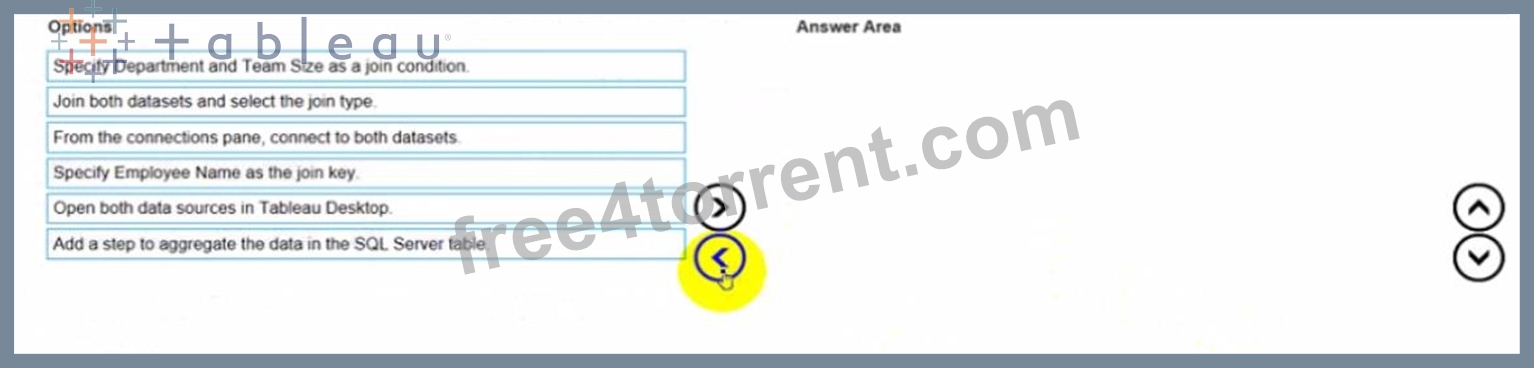
Answer:
Explanation: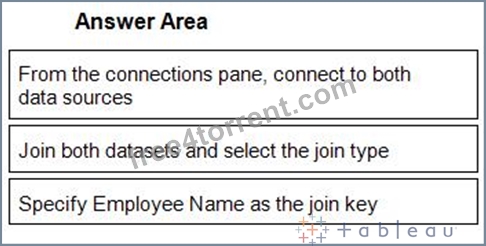
1 - From the connections pane, connect to both data sources
2 - Join both datasets and select the join type
3 - Specify Employee Name as the join key
Reference:
https://help.tableau.com/current/prep/en-us/prep_connect.htm https://help.tableau.com/current/prep/en-us/prep_join.htm https://help.tableau.com/current/prep/en-us/prep_join_types.htm
NEW QUESTION # 47
You create a parameter named Choose Region fiat contains values from a field named Region.
You want users to be able to use the Choose Region parameter to interact with a chart by logging between different regions What should you do next?
- A. Add the [Region] = [choose Region) formula to the Filters card
- B. Set the Choose Region parameter to Single Value (list)
- C. Add Region to me Fitters card
- D. Add the Choose Region parameter to the Pages card
Answer: A
Explanation:
To use the Choose Region parameter to interact with a chart by toggling between different regions, you should add the [Region] = [Choose Region] formula to the Filters card. This formula will create a boolean filter that returns TRUE if the value in the Region field matches the value in the Choose Region parameter, and FALSE otherwise. You can add this formula to the Filters card by right-clicking on it and selecting Add Filter from the menu. Then you can select Condition from the dialog box and enter the formula in the text box. This will filter the chart to show only the data for the selected region.
The other options are not correct for this scenario. Adding Region to the Filters card will create a categorical filter that shows a list of values from the Region field, but it will not use the Choose Region parameter. Adding the Choose Region parameter to the Pages card will create a page control that allows you to cycle through different values of the parameter, but it will not filter the chart. Setting the Choose Region parameter to Single Value (list) will change how the parameter control appears on the worksheet, but it will not affect how it interacts with the chart. Reference: https://help.tableau.com/current/pro/desktop/en-us/parameters.htm https://help.tableau.com/current/pro/desktop/en-us/filtering.htm https://help.tableau.com/current/pro/desktop/en-us/filtering_condition.htm
NEW QUESTION # 48
You have the following dashboard.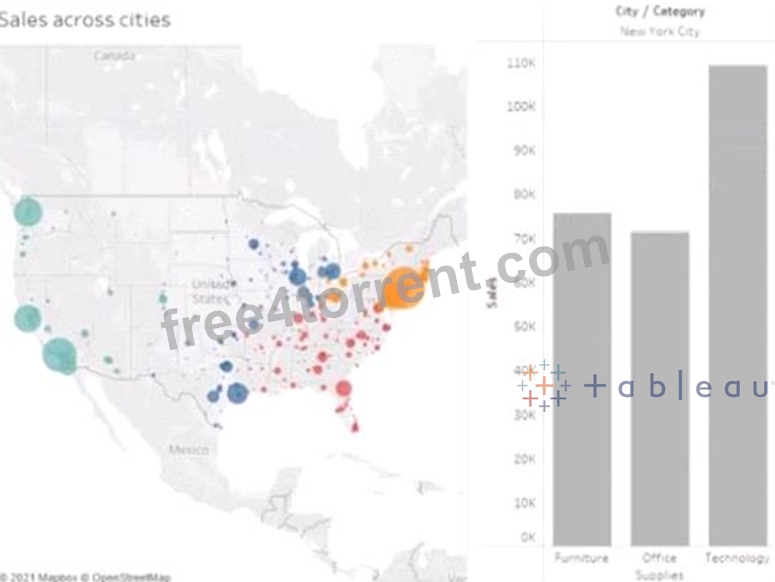
When a user selects a only on the map the data on the bar chart must show only the data for the selected city. The data in the bar chart must change only when the user selects a different city How should you configure the dashboard action? (Use the dropdowns in the Answers Area to select the correct options.)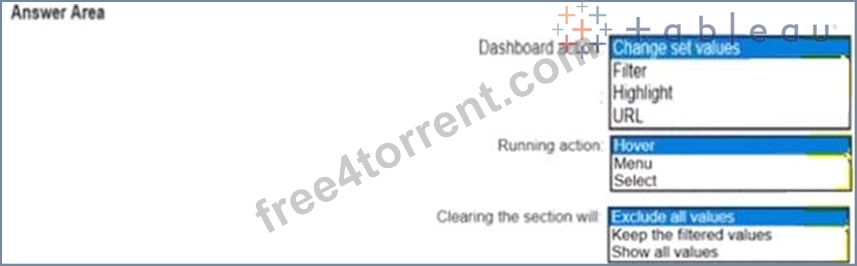
Answer:
Explanation: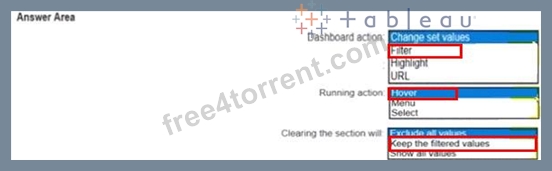
NEW QUESTION # 49
You plan to create a visualization that has a dual axis chart. The dual axis chart will contain a shape chart and a line chart will use the same measure named Population on the axis.
You need to configure be shapes to be much larger than the line.
What should you do?
- A. For the second axis select Shape on the Marks card From Select Shape Palette select Custom and then select Reset
- B. Duplicate Population Drag the duplicate to the second Marks card and configure the see of the marks independently
- C. Change Population to a discrete dimension
- D. Create a custom shape that is larger than the default shape and add the shape to the Shapes folder in My Repository
Answer: B
Explanation:
To configure the shapes to be much larger than the line, you need to duplicate Population and drag it to the second Marks card. This will create a dual axis chart with two measures on one axis. You can then select Shape on one Marks card and Line on another Marks card, and adjust the size of each mark independently using the Size slider or menu. Reference: https://help.tableau.com/current/pro/desktop/en-us/multiplemeasures_dualaxes.htm https://help.tableau.com/current/pro/desktop/en-us/marks_markproperties_size.htm
NEW QUESTION # 50
You conned to a Microsoft SQL Server database
You need to create a custom SQL query that retrieves rows from a table named Students Only students m the city of Berlin must be returned How should you complete the query? (Drag the appropriate Options to the Answer Area and drop into the correct locations.)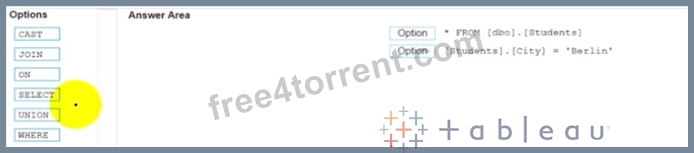
Answer:
Explanation: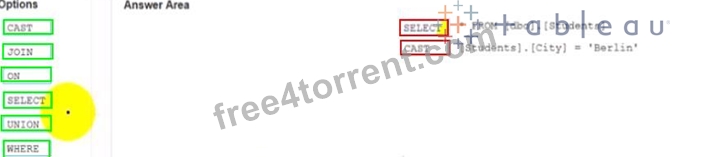
NEW QUESTION # 51
You have the following dataset that contain null values in the Profits field.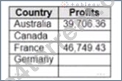
You want the data to appear as shown in the following table.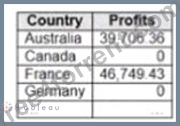
Which two formulas achieve the goal? Choose two.
- A. 2N ([Profits])
- B. ISNULL ([Profits])
- C. IF [Profits] != null then [Profits] END
- D. IFNULL [(profits] ,0)
Answer: A,D
NEW QUESTION # 52
You have a data source that contains data tor every city in the Unites States. The following is a sample of the data.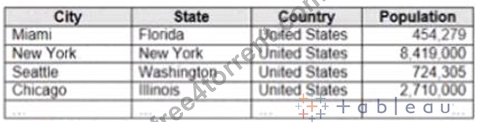
You need to use the City dimension to create a dynamic filter that snows the cities that have a population greater than one million Which type of filter should you use?
- A. Wildcard filter
- B. Condition filter
- C. General filter
- D. Top filter
Answer: D
NEW QUESTION # 53
You have a database that includes field named sales, City and Region.
You have the following chart that shows the number of sales made in different cities.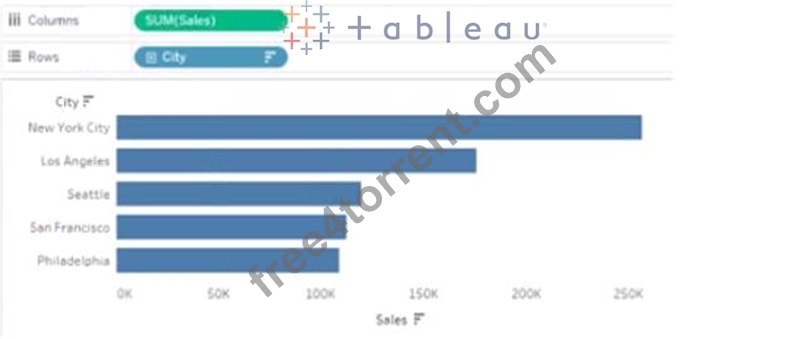
You want to dynamically show the corresponding region when users hover their mouse over any of the bars.
What should you do?
- A. Drag Region to Tooltip on the Marks card
- B. Edit the aliases for City.
- C. Right-click a in the chat, select Annotate and then select Mark.
- D. Right-click a bar in the chart select Mark Label and then select Always show.
Answer: C
NEW QUESTION # 54
in which three formats can you export a worksheet from the Worksheet menu? Choose three
- A. .txt
- B. .html
- C. .csv
- D. .png
- E. .xlsx
- F. .pptx
Answer: B,C,D
NEW QUESTION # 55
You have the following visualization.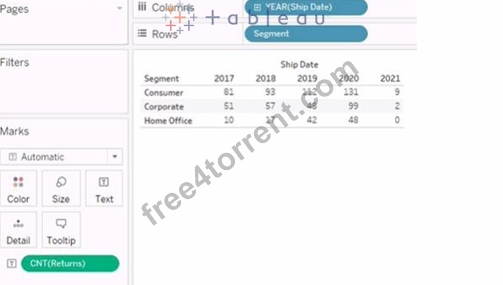
You want the count of Returns displayed only for the first year in the table.
How should you complete the formula in the calculated field? (Use the dropdowns in the Answer Area to select the correct options to complete the formula.)
Answer:
Explanation:
NEW QUESTION # 56
You have a dataset that contains daily sales by business segment from 2017 to the present You want to use monthly historical trends to predict sales by segment in the future Which three actions should you perform m order?
(Place the three correct options in order Use the arrows to move Options lo Answer Area I In Answer Area arrows to re order the options.)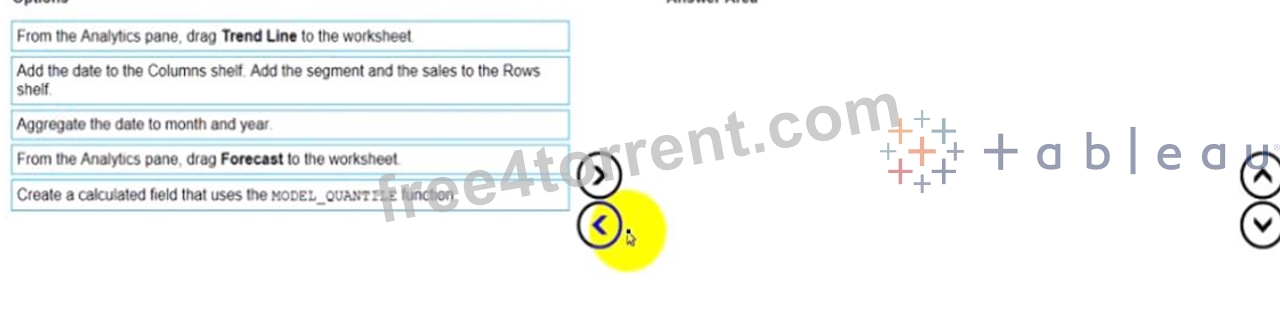
Answer:
Explanation: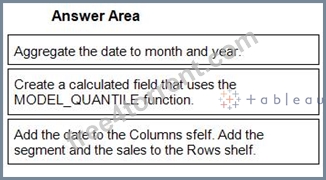
1 - Aggregate the date to month and year.
2 - Create a calculated field that uses the MODEL_QUANTILE function.
3 - Add the date to the Columns sfelf. Add the segment and the sales to the Rows shelf.
NEW QUESTION # 57
......
The TDA-C01 Certification Exam is a valuable certification for professionals who work with Tableau. It is a great way to showcase one's proficiency in Tableau and advance one's career in the field of data analytics. Candidates who pass the exam are awarded the Tableau Certified Data Analyst certification, which is valid for two years and can be renewed by passing a recertification exam.
Tableau TDA-C01 certification exam is a vendor-neutral certification that is recognized globally. It is designed to help data analysts and business intelligence professionals demonstrate their proficiency in the use of Tableau Desktop. TDA-C01 exam covers a range of topics, including data preparation, data analysis, visualization, and dashboard development. Tableau Certified Data Analyst certification also includes a practical component that requires candidates to demonstrate their ability to create interactive dashboards and data models using Tableau.
Authentic Best resources for TDA-C01 Online Practice Exam: https://www.free4torrent.com/TDA-C01-braindumps-torrent.html
Get the superior quality TDA-C01 Dumps with explanations waiting just for you, get it now: https://drive.google.com/open?id=1jztfN2WunzwWxnu1asAauX036wYF0IaB