
Cisco Understanding Cisco Cybersecurity Operations Fundamentals (200-201日本語版) : 200-201日本語

- Exam Code: 200-201日本語
- Exam Name: Understanding Cisco Cybersecurity Operations Fundamentals (200-201日本語版)
- Updated: Nov 25, 2026
- Q & A: 564 Questions and Answers
About Cisco Understanding Cisco Cybersecurity Operations Fundamentals (200-201日本語版) : 200-201日本語 Exam
As we all know, we should equipped ourselves with strong technological skills, thus we can have a possibility to get a higher level of position. Nowadays, 200-201日本語 - Understanding Cisco Cybersecurity Operations Fundamentals (200-201日本語版) certification has become the essential skills in job seeking. Gaining the Understanding Cisco Cybersecurity Operations Fundamentals (200-201日本語版) test certification is the goals all the candidates covet. Here, Understanding Cisco Cybersecurity Operations Fundamentals (200-201日本語版) latest dump torrent will give you a chance to be a certified professional by getting the Understanding Cisco Cybersecurity Operations Fundamentals (200-201日本語版) : 200-201日本語 certification. We provide you the optimum way to learn, providing you an insightful understanding of the IT technology about Understanding Cisco Cybersecurity Operations Fundamentals (200-201日本語版) exam test. With the study of Understanding Cisco Cybersecurity Operations Fundamentals (200-201日本語版) study guide torrent, you will feel more complacent and get high scores in your upcoming exams.

Instant Download: Upon successful payment, Our systems will automatically send the 200-201日本語 dumps you have purchased to your mailbox by email. (If not received within 12 hours, please contact us. Note: don't forget to check your spam.)
Understanding functional and technical aspects of Cisco Cybersecurity Operations Fundamentals v1.0 (200-201 CBROPS) Network Intrusion Analysis
The following will be discussed in CISCO 200-201 exam dumps pdf:
- Destination port
- Ethernet frame
- Extract files from a TCP stream when given a PCAP file and Wireshark
- Proxy logs
- Firewall
- Destination address
- Client and server port identity
- Process (file or registry)
- Protocols
- Payloads
- True negative
- Interpret common artifact elements from an event to identify an alert
- ARP
- True positive
- Network application control
- Compare deep packet inspection with packet filtering and stateful firewall operation
- Transaction data (NetFlow)
- SMTP/POP3/IMAP
- DNS
- IPv6
- IP address (source / destination)
- Source port
- HTTP/HTTPS/HTTP2
- Interpret basic regular expressions
- System (API calls)
- ICMP
- False positive
- IPv4
- URI / URL
- Compare the characteristics of data obtained from taps or traffic monitoring and transactional data (NetFlow) in the analysis of network traffic
- Hashes
- False negative
- Map the provided events to source technologies
- Benign
- Identify key elements in an intrusion from a given PCAP file
- UDP
- Interpret the fields in protocol headers as related to intrusion analysis
- Source address
- IDS/IPS
- Antivirus
- Compare impact and no impact for these items
- Compare inline traffic interrogation and taps or traffic monitoring
- TCP
Exam Topics
The Cisco 200-201 exam will validate your skills and knowledge of security monitoring, security concepts, security policies & procedures, host-based analysis, and network intrusion analysis. All in all, its content comes with 5 topics that are listed as follows:
Security Concepts
This domain makes up 20% of the exam content and measures the applicants’ abilities to perform the following tasks:
- Analyze security deployments – It includes the agent-based and agentless protections as well as network, endpoint, and application security systems. You should also know about log management, SOAR & SIEM, and Legacy antivirus & antimalware;
- Understand CVSS – You need to have knowledge of the attack vector, privileges required, scope, and user interaction;
- Differentiate access control models – In this subsection, you are required to learn about discretionary, nondiscretionary, and mandatory access control, as well as authentication, accounting, and authorization;
- Determine the possible data loss from the available traffic profiles;
- Describe the 5-tuple method to separate a compromised host in a grouped set of logs.
- Define the CIA triad;
- Compare various security concepts – As for this one, it covers the details of risk scoring, assessment, and reduction as well as vulnerability, exploit, and threat;
- Compare rule-based detection vs. behavioral and statistical detection;
- Explain the policies of the defense-in-depth approach;
- Define security terms – The potential candidates have to know about hunting, actor & threat intelligence, and TI platform, malware analysis, run book cybernation, as well as sliding window exception detection;
- Classify the difficulties of data visibility in detention;
200-201 Details
The test has a duration of 120 minutes during which the candidates will have to answer 95 to 105 questions. Applicants can enroll in their exams by using the Pearson VUE platform after having created an account there and selected the “proctored exam” section. Thereafter, you should search the code 200-201 and follow the instructions to fully register. The fee for this test is $300 and it's available in the English language only.
Less time investment & high efficiency
To everybody, time is previous and time is money. We are busy with lots of things every day. The work time may account for the most proportion of the daytime. After work you may spend time with your family, such as, play football with your little son or accompany your wife to enjoy an excellent movie. When it comes to Understanding Cisco Cybersecurity Operations Fundamentals (200-201日本語版) exam test, you feel tired and spare no time for the preparation. But now, your worry and confusion will be vanished soon. Our Understanding Cisco Cybersecurity Operations Fundamentals (200-201日本語版) free valid material & latest dump torrent will help you get out of the predicament. You just need to speed 20-30h with our Understanding Cisco Cybersecurity Operations Fundamentals (200-201日本語版) practice torrent on your study for the preparation, then you can face the actual exam with confident and ease. The 100% pass is our guarantee for you. In addition, we have On-line test and soft-ware test engine which can allow you to have the simulation test. Our Cisco 200-201日本語 Understanding Cisco Cybersecurity Operations Fundamentals (200-201日本語版) test engine is suitable for any electronic device. You can download and store on your phone or pad and take full use of the fragmentary time for study, such as take the subway and wait for a coffee. Thus time is saved easily and your reviewing for the test is also done at the same time. The high-accurate Understanding Cisco Cybersecurity Operations Fundamentals (200-201日本語版) valid practice torrent will improve your reviewing efficiency and help you get success at the actual test.
Cisco 200-201 Exam Topics:
| Section | Weight | Objectives |
|---|---|---|
| Security Monitoring | 25% | 1.Compare attack surface and vulnerability 2.Identify the types of data provided by these technologies
3.Describe the impact of these technologies on data visibility
4.Describe the uses of these data types in security monitoring
5.Describe network attacks, such as protocol-based, denial of service, distributed denial of service, and man-in-the-middle
|
| Host-Based Analysis | 20% | 1.Describe the functionality of these endpoint technologies in regard to security monitoring
2.Identify components of an operating system (such as Windows and Linux) in a given scenario
4.Identify type of evidence used based on provided logs
5.Compare tampered and untampered disk image
|
| Security Concepts | 20% | 1. Describe the CIA triad 2. Compare security deployments
3. Describe security terms
4. Compare security concepts
5.Describe the principles of the defense-in-depth strategy
7.Describe terms as defined in CVSS
8.Identify the challenges of data visibility (network, host, and cloud) in detection |
| Network Intrusion Analysis | 20% | 1.Map the provided events to source technologies
2.Compare impact and no impact for these items
3.Compare deep packet inspection with packet filtering and stateful firewall operation
8.Interpret the fields in protocol headers as related to intrusion analysis
9.Interpret common artifact elements from an event to identify an alert
10.Interpret basic regular expressions |
| Security Policies and Procedures | 15% | 1.Describe management concepts
2.Describe the elements in an incident response plan as stated in NIST.SP800-61
5.Map the organization stakeholders against the NIST IR categories (CMMC, NIST.SP800-61)
6.Describe concepts as documented in NIST.SP800-86
7.Identify these elements used for network profiling
8.Identify these elements used for server profiling
9.Identify protected data in a network
10.Classify intrusion events into categories as defined by security models, such as Cyber Kill Chain Model and Diamond Model of Intrusion |
Free demo is available for everyone
When you visit our site, you will find there are Understanding Cisco Cybersecurity Operations Fundamentals (200-201日本語版) exam free demo for you to download. To many people, the free demo holds significant contribution towards the evaluation for the Understanding Cisco Cybersecurity Operations Fundamentals (200-201日本語版) training torrent. Actually, when you decide to spend your money on the exam dumps, you should assess whether it is worth or not firstly. You think your investment on the products are worth and may do some help to your Understanding Cisco Cybersecurity Operations Fundamentals (200-201日本語版) exam test. Here, Cisco Understanding Cisco Cybersecurity Operations Fundamentals (200-201日本語版) free demo is accessible and available for all of you. You can download the free demo and have a try. We have three version free demos which are in accord with the complete dumps below. From the demo, you can know about the format of each version and decide which format is suitable for you. If possible, you can choose all of them. The questions & answers are part of the complete Understanding Cisco Cybersecurity Operations Fundamentals (200-201日本語版) study guide torrent, from which you may find the similar questions you ever meet in the actual test. While, if you don't intend to buy our complete 200-201日本語 Understanding Cisco Cybersecurity Operations Fundamentals (200-201日本語版) latest dump torrent, what you get from our free demo will also do some help. Your knowledge is broadened and your ability is enhanced, what an excellent thing. So try our Cisco Understanding Cisco Cybersecurity Operations Fundamentals (200-201日本語版) free demo first, no matter you are going to buy or not.
Cisco Understanding Cisco Cybersecurity Operations Fundamentals (200-201日本語版) Sample Questions:
ユーザーは「Hr405-report2609-empl094.exe」という名前の電子メールの添付ファイルを受け取りましたが、実行しませんでした。このタイプのイベントには、サイバーキルチェーンのどのカテゴリを割り当てる必要がありますか?
- A. 偵察
- B. 配達
- C. 兵器化
- D. インストール
Correct Answer: B 🗳️
図を参照してください。エンジニアが、予想よりも大きいDNS応答パケットを分析しています。エンジニアが詳しく調べたところ、適切なDNSクエリが不足していることに気づきました。何が起こっているのでしょうか?
- A. DNSキャッシュポイズニング
- B. DNS増幅攻撃
- C. DNSハイジャック攻撃
- D. DNSトンネリング
Correct Answer: B 🗳️
Explanation: Only visible for Free4Torrent members. You can sign-up / login (it's free).
レイヤーによって隔てられた 2 つのデバイスからのログ メッセージを比較する場合に発生する問題はどれですか。
ネットワークアドレス変換を実行するデバイスは3つありますか?
- A. ログメッセージ内のIPアドレスが一致しません。
- B. ログメッセージ内のIPアドレスが一致します。
- C. ログメッセージに誤った情報が含まれています。
- D. ログメッセージのタイムスタンプが異なります。
Correct Answer: A 🗳️
Explanation: Only visible for Free4Torrent members. You can sign-up / login (it's free).
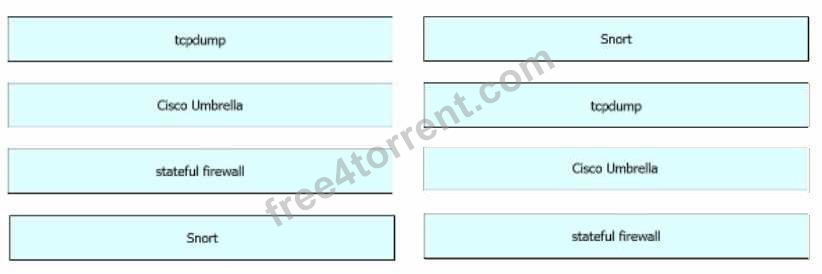
ドラッグアンドドロップ問題
左側のテクノロジーを、右側のテクノロジーが提供するデータタイプにドラッグアンドドロップしてください。
Correct Answer:
侵入テスト担当者は、潜在的な脆弱性を発見し、それを悪用するために、会社のサーバーに対してNmapスキャンを実行します。侵入テスト担当者は、スキャン結果からどの2つの要素を特定できますか?(2つ選択してください。)
- A. サーバーが同時に処理できる接続数
- B. UIDとグループ識別子
- C. サーバーの目的と機能
- D. サーバーの稼働時間と内部時計
- E. サービスとアプリケーションの実行
Correct Answer: C,E 🗳️
Explanation: Only visible for Free4Torrent members. You can sign-up / login (it's free).
Viewing page 1 out of 113 pages.
Viewing questions 1-5 out of 564 questions.
Related Exam
Related Certifications
Over 79687+ Satisfied Customers
What Clients Say About Us
Quality and Value
Free4Torrent Practice Exams are written to the highest standards of technical accuracy, using only certified subject matter experts and published authors for development - no all study materials.
Tested and Approved
We are committed to the process of vendor and third party approvals. We believe professionals and executives alike deserve the confidence of quality coverage these authorizations provide.
Easy to Pass
If you prepare for the exams using our Free4Torrent testing engine, It is easy to succeed for all certifications in the first attempt. You don't have to deal with all dumps or any free torrent / rapidshare all stuff.
Try Before Buy
Free4Torrent offers free demo of each product. You can check out the interface, question quality and usability of our practice exams before you decide to buy.












Here you can get the most valid and free IT exam torrent for your upcoming exam test. Our promise is to help you pass the exam successfully, get a higher salary and build a better life.